
Here and Now
Janine Geske on Wisconsin's Commutation Advisory Board
Clip: Season 2500 Episode 2509 | 6m 14sVideo has Closed Captions
Janine Geske on restorative justice and the state's process to commute criminal sentences.
Former Wisconsin Supreme Court Justice Janine Geske discusses the goals of restorative justice as Gov. Tony Evers restarts the state's process to commute criminal sentences of approved applicants.
Problems playing video? | Closed Captioning Feedback
Problems playing video? | Closed Captioning Feedback
Here and Now is a local public television program presented by PBS Wisconsin
Here and Now
Janine Geske on Wisconsin's Commutation Advisory Board
Clip: Season 2500 Episode 2509 | 6m 14sVideo has Closed Captions
Former Wisconsin Supreme Court Justice Janine Geske discusses the goals of restorative justice as Gov. Tony Evers restarts the state's process to commute criminal sentences of approved applicants.
Problems playing video? | Closed Captioning Feedback
Where to Watch Here and Now
Here and Now is available to stream on pbs.org and the PBS app.
Providing Support for PBS.org
Learn Moreabout PBS online sponsorship>> Another controversy in Wisconsin involves criminal justice and Governor Tony Evers new commutation board.
While many applaud the governor bringing back commutations after 25 years, others assail it for early release of violent criminals.
The board is now reviewing those currently imprisoned looking to shorten their prison sentences.
12 people came before the board earlier this month, and more will appear in September.
There are 800 applicants so far.
The rules include no commutation for crimes against children, but by design, people serving long sentences are eligible for commutation, including for first degree intentional homicide.
They must have served at least 20 years of a life sentence.
Also by design, a focus on juveniles tried as adults and sentenced to life or more than 39 years.
Our next guest is former Wisconsin Supreme Court Justice and Marquette Law School professor, where she was director of its Restorative Justice Center.
Janine Gajewski joins us now.
And thanks very much for being here.
>> Oh you're welcome.
>> What do you think about commutations being reinstated in Wisconsin after 25 years?
>> I think it's a very important move, particularly on some of these cases that, you know, people have been incarcerated for a long periods of time.
And I can tell you, as a former sentencing judge, you know, you wanted them to be reevaluated as they go through the years.
And, you know, I have I have inner worked in the community in Milwaukee with a number of formerly incarcerated first degree murderers who are doing incredible work and were released either on parole or for other reasons.
I think it's good to look at them and make the decision based on all the factors they have to consider as to whether they can shorten their sentence, but they can also make them parole more quickly.
They can they can adjust.
They can put supervision longer so that the the governor ultimately has a lot of discretion on how he handles each case.
>> Does reducing the sentence, though, of a person convicted of first degree intentional homicide, for example, make Wisconsin soft on crime?
>> No.
How's that for a quick answer?
You know, I'll give you an example of of a defendant that I worked with.
There was a woman who had been active in the community, had done all sorts of good work, no prior record.
She had a very challenging domestic situation, and she wound up murdering her husband.
You know, the likelihood that this woman was ever going to commit another homicide or violent act was really small, and yet she served.
She stayed in prison until the day she died.
And, I mean, that's just an example.
There's certainly other, you know, a lot of these defendants that they're looking at are people who committed these crimes when they're 14, 15, 16 years old.
And you look at them 20 years later and they're different people.
And the one thing I like to emphasize with people is these the people that are incarcerated are supervised 24 hours a day.
So for 20 years, 24 hours a day, they've been observed and there's a good there's a good track record of how they're doing and whether or not they continue to pose a risk to the community.
restorative justice in a big way.
What is that?
>> Well, it is it's a harm victim focused process.
In particular, relevant to this issue is that victims and survivors who are interested in having a face to face meeting with the perpetrator of their crime.
And we did a lot of homicides.
We we work with them for about a year and a half, both sides.
And then we let them have a conversation.
It's an incredibly healing process for those survivors who are interested in it.
And it's really an amazing, amazing process.
And those questions that victims have finally can get answered.
>> But does commuting a sentence undermine justice for victims of crime?
>> No.
And this process allows the voice of the victim there.
So the victims are notified.
Now, a lot of survivors, 20 years later, are either no longer in contact with corrections or have moved on.
But there are survivors of surviving family members who are interested, and they have a voice, and that's supposed to be consideration.
In addition, I see that on the commission itself, there are there are victim advocates, people who are expert in trauma and expert in victims issues.
There's a former police officer, a former prosecutor.
So I, I have no doubt that that will be a factor in looking at whether or not to have someone released, but it doesn't mean that the victim will have the sole say over the individual.
>> So the governor's executive order on commutation prioritizes youth offenders sentenced to life in prison.
Why are juveniles carved out in this way?
>> Because because we have learned through the years, and I've learned since I was on the bench, the whole development of the juvenile brain and how that changes.
And I guess I should have known that I was a school teacher.
But but when you know how kids think and approach things, it's very different.
And if you wait 20 years and take a look at them, they are usually different people.
One of the individuals that I have encountered in the community was someone I sentenced for first degree murder at age 14.
It was it was an awful murder.
And I remember sitting as a judge thinking, how long do I set the parole eligibility date on this kid?
Because he's, you know, is he salvageable?
You know, is he always going to be violent?
And I gave him a pretty significant full eligibility date.
Well, he's out in the community now.
He actually contacted me.
He served decades and he is doing such incredible work with the Medical College of Wisconsin on violence, interruption in the community.
And is, you know, it was just the most wonderful day for me to meet him and see how different he is than the young kid that sat in front of me who killed another kid.
>> Janine Geske, thanks very much.
Thanks for your thoughts.
>> You're welcome.
>> For more on this and other issues facing
 New
NewCharles Franklin on Polling Voters About Crowley and Tiffany
Video has Closed Captions
Clip: S2500 Ep2509 | 5m 2s | Charles Franklin on what voters say about 2026 governor candidates and the Legislature. (5m 2s)
 New
NewHere & Now opening for August 28, 2026
Video has Closed Captions
Clip: S2500 Ep2509 | 1m 17s | The introduction to the August 28, 2026 episode of Here & Now. (1m 17s)
 New
NewJohn Miller on How the US-Canada Trade War Affects Wisconsin
Video has Closed Captions
Clip: S2500 Ep2509 | 6m 29s | John Miller on How the US-Canada Trade War Affects Wisconsin (6m 29s)
 New
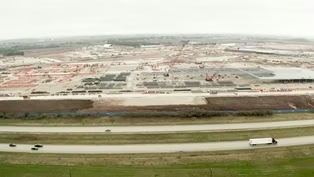
NewWisconsin's Economy, Environment and Fight over Data Centers
Video has Closed Captions
Clip: S2500 Ep2509 | 7m 9s | Development of data centers has become a major community issue across Wisconsin. (7m 9s)
Providing Support for PBS.org
Learn Moreabout PBS online sponsorship New Episode
- News and Public Affairs

Top journalists deliver compelling original analysis of the hour's headlines.
 New Episode
- News and Public Affairs

Today's top journalists discuss Washington's current political events and public affairs.
 New Episode

 New Episode
 New Episode
 New Episode

 New Episode
 New Episode
 New Episode
Support for PBS provided by:
Here and Now is a local public television program presented by PBS Wisconsin