Virginia Home Grown
How to Sharpen Garden Tools
Clip: Season 26 Episode 1 | 6m 4sVideo has Closed Captions
Learn tips to keep your garden tools sharp and clean
At the Virginia Home Grown studio Peggy Singlemann demonstrates proper tool sharpening techniques with Serome Hamlin while discussing the benefits of using properly maintained garden tools. Featured on VHG episode 2601, March 2026.
Problems playing video? | Closed Captioning Feedback
Problems playing video? | Closed Captioning Feedback
Virginia Home Grown is a local public television program presented by VPM
Virginia Home Grown
How to Sharpen Garden Tools
Clip: Season 26 Episode 1 | 6m 4sVideo has Closed Captions
At the Virginia Home Grown studio Peggy Singlemann demonstrates proper tool sharpening techniques with Serome Hamlin while discussing the benefits of using properly maintained garden tools. Featured on VHG episode 2601, March 2026.
Problems playing video? | Closed Captioning Feedback
How to Watch Virginia Home Grown
Virginia Home Grown is available to stream on pbs.org and the free PBS App, available on iPhone, Apple TV, Android TV, Android smartphones, Amazon Fire TV, Amazon Fire Tablet, Roku, Samsung Smart TV, and Vizio.
Providing Support for PBS.org
Learn Moreabout PBS online sponsorshipSpeaking of fresh flowers, people have to understand that there's certain steps we can follow to keep our fresh flowers longer in our vases.
And it all starts with, you know, conditioning the flowers, which we'll get into.
But the most important step is sharp tools.
>>Having the tools for the job.
>>Exactly.
And so many of us pick up our tools that have been in that shed all winter long.
>>Guilty.
>>Yeah, brush them off and expect them to work like a charm.
(chuckles) And unfortunately they don't.
>>No, but you're gonna give us a tip on what we can do to improve our chances of making nice fresh cuts.
>>Yes, because fresh cuts are gonna keep those flowers longer in that vase and in our houses to enjoy.
First thing is, is choosing the right tool, and it's a secateur or a scissor-type clipper and making sure that it has a little nub on it, which is the sharpening guide because that sharpening guide enables us to get the right angle.
Plus another one is if you need an ergonomic pair, if your hand cramps up quickly or can't fit this large, I'll say grasp.
You can get a pair that's smaller and also that will be a little more gentle to your hand.
>>Yes.
>>But it all needs to be sharpened.
>>So many tools out there that works with individuals.
>>Absolutely.
And the other thing is, is to get a good sharpener, one that can fit in your hand.
I've got some smaller little stones, but I've moved to this one.
I like this a lot and I got it at my local garden center.
And on this side I have a rough edge, and this one is smooth just like an emery board.
So what we wanna do is to understand that we've only got one cutting edge on these clippers.
>>Yeah.
>>And the other edge is not.
So we only need to sharpen one edge.
And on that edge we only need to sharpen one side.
>>This is a bi fold kind of motion instead of an anvil.
>>Yes.
>>So it makes it a lot easier for cutting things like fresh flowers 'cause you're not crushing the stems.
>>Truly.
Those anvil style clippers do crush.
They don't cut no matter how sharp they are, yes.
So what I'm gonna do is start first with my rough side, and I'm going to use my sharpening guide here to angle my blade or my sharpening tool so I get the right angle every time because sharpening is all about angles, and I make continuous long strokes on that blade.
And after a few I test it and I go, "Oh, it needs to be fine tuned."
So I move to the less rough size, follow the same thing just to fine tune it again, okay?
And then I'll flip it over, and I'll just take that little bur off.
Are you familiar with that little burr?
>>Take that little rough edge off.
One thing that we always forget is the other side gotta get that just cleaned off.
>>Exactly.
And one big swipe does it as well.
>>Because you're not sharpening the other side.
>>No.
>>You're just cleaning it.
>>You're just cleaning it.
And the other thing is, is to make sure that your clippers are in the hand where the sharpened side is in your dominant, is able to be moved with your fingers, not on the thumb side, so that you're actually working the clippers with the stronger part of your hand, your grip.
And that will work the clippers and not you as much.
>>Yes.
Let the tool do the work and you can go through your season because it's gonna be a long season ahead, and you're going to be doing a lot of cutting.
>>Yes.
And speaking of, I don't wait till the end of the season to sharpen my clippers.
(laughs) The other day I was pruning, and I sharpened them probably five or six times that day.
>>So what would you recommend for the average homeowner?
About how often should your tools be sharpened?
>>Well, I'm gonna say it depends on the cuts, because let's start cutting and I'll explain.
The more you cut gentle and softer tissue versus woody tissue, the longer your tools will stay sharp.
But when you start to reach for that woody tissue, such as this forsythia, and you start to put a nice, sharp angled cut on it like we want, you're actually going to dull the blades faster.
And I was pruning shrubs, okay?
>>Yes.
>>The other thing I do is I make sure between my cuts is that I sterilize my clippers.
>>Yes, keep everything sanitized.
You don't want to transfer pathogens from one plant to another.
>>Absolutely.
And I use, you know, rubbing alcohol, isopropyl rubbing alcohol.
I use 91%.
It kills everything there is to kill.
And then what I also do is between bushes, I spray my clippers, but I turn away from the bush so I don't have the alcohol spray the bush, yes.
>>Don't wanna damage the foliage.
>>Exactly.
But moving on with our flower arrangement, we wanna make sure that we do a nice, angled cut with our clippers so that we open up the cambium more so that the water can be absorbed so the flower will last longer.
>>Yes, that angle cut will provide more water surface area because the bottom of the stem is holding it up.
So it keeps everything up and flowing so it's able to absorb it a lot more.
>>Absolutely.
And the other thing is, what people forget is that, I do, every other day I change the water and I put a slim fresh cut on the bottom of my stems too, so that I'm, again, opening up more of that cambium layer so that the flower can absorb the water.
>>Yeah, because the longer it sits, the more it starts callousing over.
So you want the fresh cuts that it keeps absorbing.
>>Exactly.
And the other thing is that people have a tendency to forget to realize is that some flowers do last longer than others and don't throw away whole arrangement.
Take out what's still good, get rid of the rest, and then continue to enjoy that arrangement.
>>Yeah, of course, you've put the work into it, so enjoy it as long as you can.
>>Exactly.
And as earlier, it's always important to throw a few buds in so that your arrangement can have some life in the future.
>>Lasts a lot longer.
>>A lot longer.
Well, Serome, I hope everybody watching grabs those tools and thinks about how they're gonna sharpen them.
Go out and get a sharpener and just go to town.
It's gonna be a learning curve.
But after that you'll enjoy having a nice, sharp tool to work with.
>>Yes, and let the tool do the work for you.
>>I agree.
 New
NewVideo has Closed Captions
Clip: S26 Ep1 | 7m 57s | Learn about edible flowers and garnishes used to decorate cakes (7m 57s)
 New
NewVideo has Closed Captions
Clip: S26 Ep1 | 7m 59s | Learn how cut flowers are grown locally using sustainable methods (7m 59s)
 New
NewVideo has Closed Captions
Clip: S26 Ep1 | 3m 1s | Divide and transplant perennial flowers to fill your garden with color (3m 1s)
 New
NewVideo has Closed Captions
Clip: S26 Ep1 | 3m 33s | Increase blossoms and get a bigger harvest by properly pruning fruit trees (3m 33s)
 New
NewVideo has Closed Captions
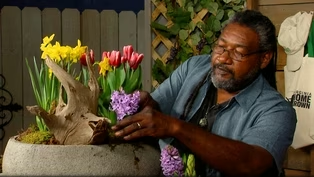
Clip: S26 Ep1 | 6m 54s | Learn how to make an easy spring planter using potted perennials (6m 54s)
Providing Support for PBS.org
Learn Moreabout PBS online sponsorship

- Home and How To

Hit the road in a classic car for a tour through Great Britain with two antiques experts.












Support for PBS provided by:
Virginia Home Grown is a local public television program presented by VPM