
Georgia State Railroad Museum, Hour 1
Season 30 Episode 4 | 52m 24sVideo has Closed Captions
Catch ROADSHOW’s stunning season-topping treasure in this first hour from Savannah, GA!
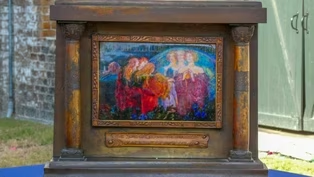
Catch ROADSHOW’s stunning season-topping find in this first hour from Savannah, GA! Treasures include a 1901 Alexander Fisher enamel, a 1992 Olga de Amaral “Lost Image VII” tapestry and a signed 1936 “Gone with the Wind” first edition.
Problems playing video? | Closed Captioning Feedback
Problems playing video? | Closed Captioning Feedback
Funding for ANTIQUES ROADSHOW is provided by Ancestry and American Cruise Lines. Additional funding is provided by public television viewers.
Support provided by:


Georgia State Railroad Museum, Hour 1
Season 30 Episode 4 | 52m 24sVideo has Closed Captions
Catch ROADSHOW’s stunning season-topping find in this first hour from Savannah, GA! Treasures include a 1901 Alexander Fisher enamel, a 1992 Olga de Amaral “Lost Image VII” tapestry and a signed 1936 “Gone with the Wind” first edition.
Problems playing video? | Closed Captioning Feedback
How to Watch Antiques Roadshow
Antiques Roadshow is available to stream on pbs.org and the free PBS App, available on iPhone, Apple TV, Android TV, Android smartphones, Amazon Fire TV, Amazon Fire Tablet, Roku, Samsung Smart TV, and Vizio.
Buy Now

ANTIQUES ROADSHOW's 2026 Production Tour
Enter now for a chance to win a pair of free tickets to one of the three stops on ANTIQUES ROADSHOW's 2026 Tour. Sweepstakes entry deadline is April 6.Providing Support for PBS.org
Learn Moreabout PBS online sponsorship♪ ♪ CORAL PEÑA: "Roadshow" found the sweetest treasures in the Peach State when we visited the Georgia State Railroad Museum.
I've got a basketball signed by the '92 Dream Team.
I see why people cry on "Roadshow."
(both laughing) ♪ ♪ PEÑA: The Georgia State Railroad Museum is more than a whistle stop for "Antiques Roadshow" today.
We've set up at the former Savannah Repair Shops, where steam-powered trains once chugged in for maintenance.
Completed in 1855 for the Central Railroad and Banking Company, the site was transformed into a museum over a century later, and has been managed by the Coastal Heritage Society since 1990.
Check out the treasures that made our experts stop in their tracks.
♪ ♪ My mother bought it for me when I was a child, in, like, 1951 or '52.
It's probably 73 years old.
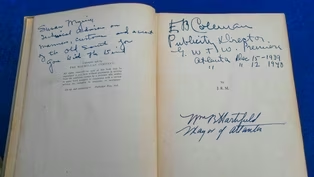
GUEST: This is my grandmother's copy of "Gone with the Wind."
She was born in 1900, and she was friends with Margaret Mitchell.
They were childhood friends, grew up in Atlanta.
And so when the book came out, she bought it new.
I guess she asked Margaret Mitchell to sign it for her, and she did.
So, it's an autographed copy by the author.
Let's take a look, because it's not just Margaret Mitchell in here signing.
Okay.
We've got Margaret Mitchell inscribing to your grandma?
Yes.
After about six months, she was so swamped she refused to sign anymore, which is good for us, on the collecting side of things.
Mm-hmm.
And then over here, we have some, some Hollywood greats.
We have the movie stars' names, the ones who were living who went to the centennial premiere, which was in 1961.
So we have the autographs of Olivia de Havilland and Vivien Leigh, who won the Academy Award, and David Selznick, who also won the Academy Award as producer of the movie.
They played the movie for the centennial of the beginning of the Civil War, so 1961.
There are some very interesting points about this book.
Points are ways that we determine the edition of a book.
And, for "Gone with the Wind," it was very popular.
Went into second edition almost immediately.
And the way we can tell is this copyright date.
This one says May 1936.
And that means-- (clicks tongue) for sure, 100% first edition.
Great.
So that, that has-- that's important for value.
There are more signatures... Yes.
So on that page, it looks like my grandparents went out to a Confederate veterans home and met with some very old Confederate veterans who signed the book as kind of a representation of what the book was about.
I think they thought it was important to document these people.
And then here, there are signatures of people that were formerly enslaved that were still living.
Yes.
I think my grandfather dated... both of those two pages, like 1939, 1940.
So just a couple years after the book, and a year after the movie.
The signatures in the back really speak to the epic nature of the story itself.
And of course, the time period that it's trying to cover.
The fact that there are people that fought in the Civil War on the Confederate side, and people that were formerly enslaved writing their names in here, it's just sort of a testament to what an important work this was.
It was a big story for the city of Atlanta.
The other thing is this photo, which is fabulous, because it's got Margaret Mitchell.
Which-which one is she in that photo?
Yeah, she's in the front, in the center.
That's a picture when my grandmother and great-grandmother and great-uncles were on a-- a house party out in the country with Margaret Mitchell.
And we think that's maybe her first husband before they were married.
It's a 1920 photograph, so they were-- they were 20 years old.
So it's an early... And she's wearing pants.
I read that her skirt caught fire when she was little, and her mom was so afraid, that she dressed her in pants and they called her Jimmy.
Interesting.
(both laugh) Which is just the cutest thing.
Have you ever thought about, about value of a signed first edition of "Gone with the Wind"?
We've thought about it.
We were guessing $1,000, if-- we're happy if it's that or more.
Okay.
Well, all of those special features of your grandmother's copy, an auction estimate would be $20,000 to $30,000... Wow.
...for your little book.
That's fantastic.
If I would've been happy with $1,000, I'm 20 to 30 times happier.
(laughing): I like that.
(both laugh) It's kind of a long story, but, uh, it was in a house and I rescued it from what it turned out a couple weeks later to be certain doom.
And to be honest, for all the research I've tried to do, I... I really can't figure out what it is.
I don't know if it's a game or if it's something for writing.
I'm not really sure.
The most interesting thing about it is it never happened.
Since the 1976 Winter Olympics, they were supposed to be in Denver, Colorado, but the city defunded it.
That's about the extent of what I know.
I think... it was Helsinki, but that might be totally wrong.
So, I just kind of wanted to get a little bit more info on it.
I thought it was pretty neat.
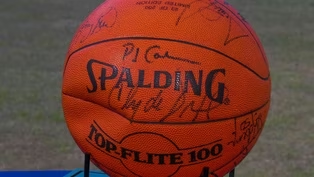
GUEST: I've got a basketball signed by the '92 Dream Team.
My father-in-law immigrated to the States; he's Dutch.
and he did that in the early '90s.
Um, and he's been telling me that he has a basketball signed by Michael Jordan and the Dream Team.
And I never believed it.
Last week, I told him that we were going-- going to the "Roadshow," because we're big fans.
And here it is.
I-- it's been in his attic since then.
He just said he got it as a gift from a friend (chuckling): when he moved here.
Hey, that's a pretty good gift.
Yeah.
This is a basketball signed by the 1992 Dream Team from the '92 Summer Olympics in Barcelona.
This ball would've been made available at the 1992 Tournament of the Americas in Portland, Oregon.
It was a qualifying tournament before the Summer Olympics in Barcelona.
It's a limited edition.
200 of these were made available.
When it comes to the Dream Team-- Michael Jordan, Scottie Pippen, Larry Bird, Clyde Drexler, David Robinson, Charles Barkley-- I mean, it is-- as a nerd... It's the... (laughs) It's like the Avengers of basketball assembling on the court.
Yeah.
Yeah.
The Dream Team they're, literally, when you talk about domination, they were straight steamrolling the competition.
Averaged a 44-point lead for every game.
In the final gold medal game versus Croatia, I remember the score being 117 to 85.
So even in the end, it was just total annihilation.
They were incredible.
And being in the '92 Olympics, this was the first time FIBA-- International Basketball Federation-- allowed for players... Right, right.
...from the NBA competing in the Olympics.
When it comes to a package, this being a known edition, you really can't get any better.
In terms of marketing, as an auctioneer, this is a slam dunk for collectors today.
Wow.
Conservatively, at auction, you would easily see this ball in the $30,000 to $40,000 range.
(chucking) That's amazing.
What a gift, right?
(laughing): Yeah, what a gift.
PEÑA: The Central Railroad and Banking Company became the Central of Georgia Railway Company in 1895.
NORA FLEMING LEE: The railroad was really critical to Savannah and to Georgia.
It was developed in order to transport the goods from the interior of the state, from farms and plantations, to the port.
Savannah is a port city.
Uh, and so then those goods would go on a ship and be transported across the ocean or to other parts of the country.
In 1963, the Central Georgia ultimately closed the repair facility, and it was left vacant, um, for many years.
And these properties really fell into disrepair.
And so when the property was being demolished for the very valuable Savannah Grey brick and scrap metal that was here, the city of Savannah stepped in and halted demolition and were able to save it.
And we've operated this property as a museum ever since.
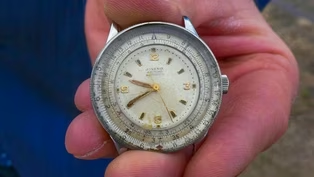
I brought a wristwatch my dad gave me in high school that has a slide rule around the outside.
When I was taking trigonometry, he was a Methodist preacher and couldn't afford good things.
So he gave you quite a gift.
He did.
Have you worn it or used it since?
Not so much.
Okay.
It's made by Juvenia, a very fine Swiss watchmaking company.
They were founded in 1860.
This particular model is called the Arithmo.
Comes from the word "arithmetic."
Okay.
They introduced this in 1945.
It's in a stainless steel case.
It's a 17-jewel automatic self-winding movement.
This was a calculator.
This company, Juvenia, they proclaim theirs to be the best.
Solid, nice construction.
The rotating bezel.
So you can do your calculations by moving it around.
Currently it's not moving; it's not working.
It's probably gummed up, which is very common with these watches.
It happens.
And a cleaning and an overhauling, it'll be working just fine again.
This watch today, retail, this will sell for between $7,000 to $8,000.
Wow.
It's priceless to me, 'cause my dad gave it to me, but that's, that's wonderful to know.
And I made an A in trig, so... it helped.
(laughs) I guess it worked, it did its job.
It-it did its job.
So, this is what I believe might be a animation cell from Disney's masterpiece "Fantasia."
I picked it up in a, uh, antique and bookstore in Philadelphia, where we're from.
And it was this shabby little store, it had great, wonderful treasures.
I picked up so much stuff over the years.
And I thought this was just a sketch, and then I took it home, opened it up, and it's translucent; it's on a translucent film, which looked like a good sign.
So, we'll see.
Yeah, we're just happy to be here, we love it.
"Fantasia" is my favorite movie.
So I know this guy's Chernabog from the "Night on Bald Mountain."
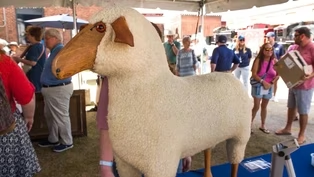
So, me and my mom were yard sale-ing one day, and we were on one side of the highway and she saw the lamb across four lanes of traffic, and we did maybe a little bit of a dangerous U-turn.
(chuckling): And, uh, we jumped out of the car and the guy told us it was five dollars.
So... yeah, we took it home.
So, I would say that this is a, a sheep designed by Hanns-Peter Krafft.
Okay.
And he's, uh, has an apt last name, since this is a wonderful piece of craft work.
Oh, wow.
Um, it was made in Germany, and it is done, uh, with this wonderful, uh wool, boiled wool.
And, uh, the-- all of the legs are original in their, uh, ash, uh, wood.
Um, with his ears in leather... Mm-hmm.
...and those glass eyes.
He's so, uh... (chuckling): Alert.
It's a spirited, wonderful, fun object.
Well, you can see these, um, really, um, in a retail setting in the $4,000 range.
Oh, wow.
Yeah.
You might just try to get his tail attached... Mm-hmm.
...so you don't lose his tail, because that's important.
(chuckling): Okay.
Um, his muzzle is a little dirty, and that's good.
So, a lovely, wonderful five-dollar yard sale find.
Amazing.
Absolutely.
Thank you so much.
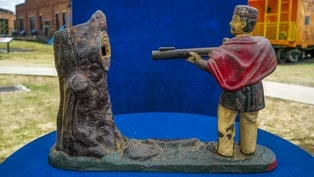
GUEST: I brought in a cast iron mechanical bank.
I got it in western New York.
A friend of mine who's an antique dealer, he borrowed money from me... Okay.
...and we were making a business investment into a friend of his.
And a few months later, his friend died, and so did the business.
He's kind of felt guilty a little bit about it, so once in a while, he'll give me a few items.
So what can you tell me about the bank itself?
Well, it's a shooting bank.
It'll shoot a penny from the rifle into the tree.
First, you cock the... holder back... You slip a penny on there, and see how the head went down?
Now you hit the toe.
(clinking) What did you find when you looked it up?
The J.E.
Stevens Creedmoor bank.
Creedmoor bank.
Okay.
Yeah.
How about the age of the bank?
Do you have any idea?
Well, the original ones came out in 1877, as I am aware.
Okay.
But then they made reproductions after that.
Sure.
The entire basis of the design of the mechanical bank, was to make saving money fun for children.
That way they wanted to save the money.
So, by introducing a movement, it created a toy, an action.
Your research was spot on.
The Creedmoor bank was made by a Connecticut company, J.
& E. Stevens, and we see it quite often.
It's a fairly common bank, a very popular bank.
1877, 1880, that's the time frame we see that bank and associate with that bank.
However, there are slight differences between this bank and the Creedmoor bank we normally see.
They did make a few variations of this style shooting bank, with the figure wearing a different hat.
And then right here on the front is a base plate.
That's often where we'll see Creedmoor Bank, the New Creedmoor Bank, Volunteer is another name.
I'm happy that yours is blank.
And even though your paint is very thick, a bit drab in color, I believe the paint to be completely original.
Oh, nice.
The casting is also a little crude.
A little more crude than I'd expect from the American cast iron manufacturers.
This one, instead, is a cast iron mechanical bank, but made in Europe, either in Germany or in Austria.
This bank was a few years later, circa 1890.
This is actually much, much rarer than a Creedmoor bank by J.
& E. Stevens.
Oh, wow.
Yes, much better.
Much better example here.
I'll turn it around, so we can see the back side of the bank as well.
Another characteristic which is different is the color of his uniform itself.
It's almost in a reverse painted colors.
We have a red robe, and he has white pants.
Uh, normally we'll see a gray, red and blue, but in a different configuration than that which he's wearing.
Now, this bank is quite dirty.
Mm-hmm.
I do believe it will clean up very nicely with a little... time and energy.
Uh, but you have to be careful when you're doing it, you don't want to disrupt the original paint.
Now, a normal J.
& E. Stevens Creedmoor-- there are thousands of them out there.
Of course, condition is king, but you can pick up a Creedmoor bank around $300 to $500 range.
When it comes to the variations, they're much scarcer and hard to come by.
The paint on this example is quite chipped and worn.
However, it's authentic, and I would value this with an auction estimate of $1,000 to $1,500.
Well, that's good news.
That's awesome.
Yeah, it's cool.
GUEST: My husband is a retired surgeon.
He had a patient who gave it to him at the end of her life.
He had taken care of her for many years, and it was a thank you from her to me, for all the hours that he had spent with her in the hospital and making house calls.
And when was that?
Hm... 2019.
She said that her husband had had it made for her.
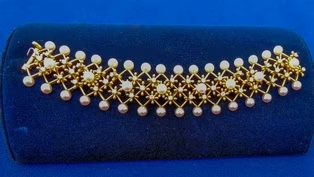
The bracelet is made by Jean Schlumberger by Tiffany & Company.
Mm-hmm.
It's in 18-karat gold, some full-cut diamonds and cultured pearls.
It is made in New York, and it came in this Tiffany box that is original to the bracelet.
It's stamped "18K" with the maker's mark on the clasp.
He was from France.
He began working for Tiffany in the 1950s, and created this amazing sort of lattice-work bracelet.
His main goal was to have natural motifs and naturalistic, organic designs.
It was just a beautiful sort of way of approaching jewelry.
The name of the bracelet is Heliodor, or "Gift of the Sun."
It's actually articulated all in the center.
These little pearls, everything sort of rocks back and forth.
Right.
Some rock back and forth a little faster than the others, but depending on what you're doing, whether you're sitting or dancing, they might just jiggle a little bit more.
Yeah.
The design would've come out of Approximately... the late '50s, '60s.
I believe the style was reinstated, but it's hard today to really ascertain the exact date as to when this particular bracelet was made.
It would require a little bit more research.
These are iconic bracelets.
At auction, conservative value would be between $20,000 and $30,000.
Wow.
(chuckles) And people covet his jewelry designs.
Wow.
So it's quite a collectible piece.
It is beautiful.
Thank you so much.
PEÑA: A roundhouse is a building where locomotives are maintained and repaired.
TERRY KOLLER: The turntable behind me is essentially the heart of a roundhouse.
Without a functioning turntable, you can't get the locomotives in and out of the roundhouse.
So why a roundhouse?
It's the most efficient way to house and repair and maintain a large fleet of steam locomotives.
So this turntable had to be expanded twice in its history.
The original turntable was only 50 feet long.
It was also manually operated.
What that meant was the steam locomotive had to be centered on the table and perfectly balanced.
Each end of the turntable had a handle that stuck out.
And you would have a couple of men on each end that would push on that handle.
They could actually turn the locomotive manually.
Later, the turntable was steam-powered, air-powered, and now it's electrically powered.
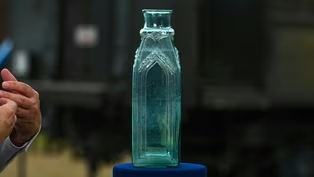
♪ ♪ That's a, uh, a pickle jar that originated in Dahlonega, Georgia.
At one point, it was used to serve the Yankee soldiers pickles at the end of the Civil War.
When it was over, soldiers left, and my great-great-grandmother wound up marrying one of 'em and took off with him.
Oh, my goodness.
How was the family feeling about that?
I'm sure it all worked out for the best, 'cause here I am.
And... (laughs) So how do you know that the Union Army ate pickles out of this?
There was a, uh, document in there that was written by my, uh, great-great-grandmother.
She detailed what took place at the, uh, Mint City, as it was known, as Dahlonega.
The first thing I look at when I look at a piece of glass like this... I look at, at the coloration and what it is.
But I also look all around all four sides to make sure that there's not any broken places in it.
But, you know, the kicker on this is to look up under the bottom... and see if it has wear.
Yeah, there is some.
Look right there.
You see all that wear?
Right.
This bottle was molded, and it was made in a factory.
There's no way to know for sure which factory made it, but I'm 99% sure that it's an American bottle.
This is the size bottle that would've sat on the countertop in a country store in the 1860s or '70s.
Right.
If you look at the pattern, it's called cathedral, but it goes right along with the gothic style of decorative arts that was real popular in America and England in the 1840s and the 1850s.
And the color is called light aqua.
But the thing that really makes this neat is that story.
So if we went out of here today, we could probably find one of these bottles for sale, retail for $300 or $400.
But I think with that story, to somebody who values that history, it's probably more like a $1,000 bottle.
Mm.
I would've thought if I walked into an antique store, it'd be $40 or $50, and, uh... Okay.
...that would've been my thought.
Well, we can add a zero, at least.
Well, that's good news.
GUEST: It is... an enamel by Alexander Fisher that was purchased by my husband's grandfather in 1926.
You brought this wonderful enamel plaque... Mm-hmm.
...set in its original architectural bronze frame.
Yes.
He did sign the plaque, and dated it 1901.
He was an Englishman, born in 1864.
He died in 1936.
And he was a master of the enameling technique.
Fisher won a scholarship to attend the National Art Training School in London, where he studied in the mid-1880s.
And part of that then became a traveling scholarship to go on and study enameling in France, uh, and Italy.
But I think it was with the French masters that he really developed the techniques that he brought back to both create works with and to teach others about.
After his studies in the mid-1880s, he came back to London and established his own studio where he both created enamel and taught enameling.
This form of enameling is painted enamel, and the depiction comes from the, the verse from Genesis under it-- "The sons of God saw the daughters of men, that they were fair."
It's a magnificent, magnificent example of his work.
And you have this letter from Fisher, dated 1926, in which he writes how special this work is.
"P.S.
I am so glad the enamel is a pleasure to you.
"It was a great effort as a piece of enamel.
There's nothing like it in the world."
While we know there are other Fisher enamels out there... Right.
That, that says something, that he said that 100 years ago.
Despite the very minor condition issues, it's a magnificent item.
This truly is a museum-quality work of art.
Do you have an idea of what it would cost originally?
we don't have a receipt, but we were told he paid $8,000 for it.
And in about what year?
1926.
Okay.
When the letter was written.
Well, that would've been a lot of money... Mm-hmm.
...back then, but that's appropriate, because, again, at the time, he was an important creator of these things.
Mm-hmm.
This should be insured for $100,000.
(softly): Oh, wow... Whew.
(chuckling): That's quite a bit, yeah.
Wow.
(laughing): I guess better up the insurance a little bit.
(laughs) Wow.
Well, this is a letter, uh... uh, written to my wife's foster uncle in 1957, when, uh, Kennedy, uh, did the commencement speech at University of Georgia.
He didn't get to talk to him when he came there, but, he-he wrote him a letter and said he was sorry he missed him, and they-they discussed what they did in World War II.
Well, uh... I do a lot of thrifting and estate sales, and I just... This is from a, a home in Williamsburg, Virginia.
Uh, an old lady, her mom-- it was her mom's, and she-- her mom passed, and that's pretty much all I really know about it, is that it was her mom's.
It was probably about $80.
GUEST: Christmas of 1978.
My mother and dad decided that instead of giving us a bunch of stuff that wouldn't last, they would give us some art.
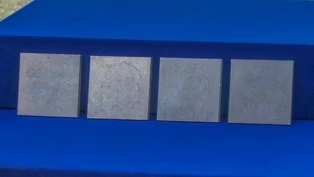
And so, these four squares are a sculpture from Carl Andre.
And of course, when they gave them to me, I had no idea who Carl Andre was.
(chuckles) I took them back to college with me.
I took them to graduate school after that.
When I tried to explain it to, to my fraternity brothers or friends, they said, "they look like drink coasters to me," (chuckling): and they have been used... as-- as drink coasters.
Came back, moved back to Savannah, got married, had four children, and I sort of forgot about it.
And then, last year, I read in "The New York Times" that he, that he died, and so I remembered that I had them.
So, they are by Carl Andre.
He was the leading minimalist artist.
Right.
And we're showing them this way, but, let's show the way it's really supposed to look.
I have the receipt, but I don't have it with me.
The picture with the receipt has a picture of it arranged like that.
So, I've assumed that that's the way it was meant to be.
His work is meant to be flat on the ground.
Right.
And the larger works can be ten, 15-feet square.
He felt that people should be able to walk on them.
Wow.
This Minimalist movement, it was a reaction against Abstract Expressionism, and the idea was to reduce art to the most simple, basic forms.
He was very prominent.
He had exhibitions in major museums-- the Guggenheim, the Tate.
He's quite controversial in his personal life.
I read a little bit about that in the... You read about it.
...in the, in the "Times" obituary.
Right.
Carl's wife was Ana Mendieta, and she was a very prominent Cuban artist.
She was well known for her "earth-body" series.
His wife died, and he was tried for secondary murder.
And, uh, he was acquitted.
But many, many people in the art world felt that he was guilty.
And-and as a result, every time he showed after that-- this was in the 1980s-- there'd be huge protests saying that... Right.
...he really was guilty.
He went off to Europe, he-he stopped showing, and his career was really in decline.
Do you know who your father bought it from?
After I got more interested in it, I found out that the art director had introduced him to a friend of his, Angela Westwater, in-in New York.
Mm-hmm.
And she was a very prominent art dealer at that time.
Right, right.
So, uh, it has that really great provenance.
And I understand you have some, you have all the materials... I-I do-- we-we do.
And-and I can't remember how much he might have paid for 'em.
If I had to guess, I'd probably say maybe $2,000 or $3,000.
Mm, yeah.
His work is very desirable, very, very collectible.
I think an insurance valuation would be in the $10,000 range.
Probably shouldn't use them as drink coasters anymore.
(laughs) Unless it's a really fine wine.
(laughs) This I actually ended up finding at a rag house.
And it had a piece of paper in the pocket, and it has a stamp here from Marseille, and I ended up looking everything up, amazingly, found a lot of information.
It was made for the archers in a parade for a town in France's tricentennial.
And I actually found a video of the guys marching in it, so I have a great story.
It's beautiful and it fits me like a glove, so.
(both laugh) She wears it around the house.
I do wear it around the house.
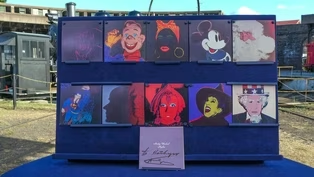
(laughs) GUEST: This is an Andy Warhol collection of prints.
My grandmother met Andy at an-- one of his exhibits in Sacramento, California, and had him sign the front of this collection for my mother, Kathryn.
Uh, and that's about all I know.
Mm-hmm.
I'm nervous.
(laughter) Well, so Andy Warhol is one of the most desirable American artists, not just for the 20th century, I think overall.
This is one of the most iconic groups that Andy Warhol put together later in his career.
It's called, "Andy Warhol Myths."
So, um, in this case, it is really terrific that he signed the cover of this group, as well as the image of Howdy Doody.
What I thought the most striking image actually is that Andy Warhol included himself in the group of portraits.
You get the shadow on the wall, and him sort of looking into the picture.
Mm-hmm.
These are essentially postcards.
And the group was an advertisement for large poster-sized lithographs that were numbered and signed.
This was done in 1981, and then unfortunately he passed away in 1987.
It was a collaboration between Warhol and his gallerist Feldman, who was the publisher of the cards, as well as the lithographs.
Have you ever had them appraised?
No, they've been sitting in storage in my mother's house Mm-hmm.
And, um, I've only heard about them.
Okay.
(chuckling): This is, like, the longest I've spent time with them.
Right.
With them and seeing them and looking at them.
Yeah.
Uh-huh.
At auction, I would place an estimate of about $2,000 to $3,000 on this group of cards.
Okay, great.
Thank you.
Thank you for bringing those in.
Oh, yes.
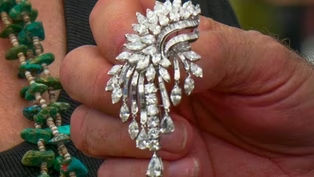
GUEST: I brought in a brooch that could also be worn on a pendant.
I've had it for approximately four years, and it was given to me by my former fiancé.
He passed away about two years ago.
It belonged to his mother.
Now, he was 95 when he passed away.
And so you can imagine how long this has been with her.
So I was thrilled to have it.
When the jewelry moves, when you're walking, when you're dancing.
Oh, yes.
It's scintillating and catching the light.
I love the use of the baguettes.
Kind of ribbon-like.
And then you have marquise-cut stones.
Yes.
You have pear-shaped stones.
And it's all set in platinum.
Most people who come in to see me in my regular everyday life and they have this brooch or something like this, they always come in and they tell me, "I have a piece of Van Cleef & Arpels jewelry."
And if you turn around... And you look at the back, it looks like it says, "Van Cleef."
It's signed "Van Clief," right.
Really?
This is his full name, Elwood George "Bud" Van Clief.
He was a jeweler from the same state that I come from, New Jersey.
Okay.
He was born in Union City.
Mm-hmm.
In the early 1920s.
He had an office in New York and a manufacturing facility, at 609 Fifth Avenue.
And he was in the business for 50 years.
Oh, that's a long time.
And he made a lot of fabulous jewelry like this.
Obviously.
I think this was probably made in the early 1960s.
You can find comparable things like this for sale.
And they're around $40,000 to replace this today.
Beautiful price.
Yeah, I mean, look, if it was at auction... Yeah.
I would probably put it in for $12,000 to $18,000.
I see.
If it was Van Cleef... Oh, I know.
(chuckles) It'd probably be $60,000 to $80,000... Right.
...for-for an auction estimate.
Yes.
Retail would be $100,000 and over.
But you still... It's not.
It's not, but it's still fabulous.
It is!
It looks very Hollywood.
GUEST: Okay, what we have here is 1964 Crucianelli 702-V.
It was made by the Crucianelli company in Italy.
And they were most famous for actually making, uh, accordions.
And it's pretty comparable in appointments to Gibson of the period, though it was much cheaper at the time.
And-and it sounds like a million bucks, so.
Um, they said that this guy... ...was, like, they didn't know how some-somebody could taxidermy this toad.
And this guy might be worth at least $100.
Which is blowing my mind, but when I got him at the store he was either $24 or $20.
Ribbit, ribbit.
GUEST: In 2021, my father-in-law passed away and my husband inherited this artwork.
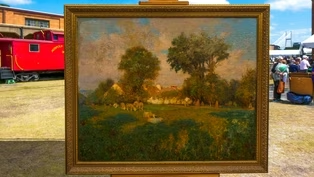
The artist is Alexis Jean Fournier and as we went through a-a collection of things of my in-laws we also saw some other pieces, uh, that had his name, uh, his picture and so it-it really had me interested in digging and so I did an ancestry dive, and come to find out the artist, Alexis Jean Fournier, was married to my husband's great-aunt, Emma Frick; was his first wife.
This is a wonderful oil painting.
It's by Alexis Jean Fournier, as you know.
He was born in St.
Paul, Minnesota, uh, on July 4, 1865.
He trained first in Minneapolis and then, as so many 19th century American artists did, he went to Paris to train.
And he went first to the Académie Julian.
He then traveled around.
Paris and northern France.
And he was especially interested in the Barbizon painters.
And over the 1890s and the 1901s, he did a whole series of paintings.
He called the series "The Home and Haunts of the Barbizon Masters."
And given the architecture and the style, we know that that's clearly something that would have been painted in France, probably would have been painted in the 1901s, as part of that series.
What makes it special is its light.
That light is just beautiful, but it's a light that's more, very late 19th century or in early 20th century.
And so that's part of the key to knowing about when it would be dated.
It's had a troubled past.
And it's had some condition issues.
Okay.
And you know what?
When you're 100 years old, you end up with condition issues.
(chuckles) But if you look closely, you can see there's a fair amount of retouch.
If we look up here, you can see sort of some discolored areas.
Mm-hmm.
It's especially obvious here if we look along the edge, you can see where it's been retouched.
The other thing that's going on, especially with the sky, is the painting is starting to cup.
So instead of lying flat on the canvas, the edges are just starting to cup up.
Right now, it's pretty stable, but at some point, you will probably lose more paint.
Condition affects value.
Other than condition, the thing we tend to harp on is provenance.
Mm-hmm.
This was in the f-- the artist's family.
Yes.
Mm-hmm.
You can't get better provenance than that.
In its current condition, if it were to be brought up at auction, we'd estimate it at $20,000 to $30,000.
Okay.
I would recommend conservation.
When everything is properly, uh, laid back down and consolidated, you're probably looking more like $35,000 to $55,000 for an auction estimate.
Okay, wow.
♪ ♪ PEÑA: Another integral part of the operation of the repair shops was this 125-foot-tall smokestack.
The smokestack exhausted the smoke and, uh, hot gases from the forges in the blacksmith shop and also the boiler in the boiler and engine house.
It did this through Bernoulli's principle, which is a movement of air from high pressure to low pressure.
So those fires in the forges and in the boiler create a high pressure system.
And at the top of the stack, there's a low pressure system.
The air's cooler, the breeze is blowing, and it sucked that smoke off of those fires and exhausted it up into the air to keep that out of the shop complex so it was a little bit more comfortable, uh, for people to work here.
This was the height of technology in the 1850s when this facility was built.
GUEST: I brought a belt that I acquired in-in the 1980s.
I really wanted to know more about the belt.
APPRAISER: Okay.
Where did you buy it?
I bought it at a pawn shop.
Really?
(chuckling): Yes, I did.
And where was that?
In Atlanta.
Oh, wow.
Yeah.
And what drew you to it?
It reminds me of items that I collect from North Africa.
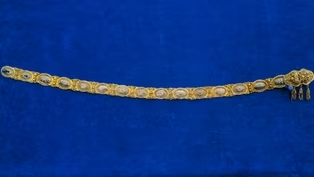
Well, it is, in fact a Ottoman.
Ottoman.
So that means it's from, uh, Turkey and more specifically, the Caucasus region.
It's silver, silver gilt.
Also, niello-worked, which are these beautiful oval panels here, picked out in black.
It's also got filigree on it.
And each one of these panels is cast and made individually and then worked together with a pin along each one.
So it creates a belt shape.
And niello work is characteristic of pieces from this region and from this time.
So each one of these has a slightly different decorative element to it.
You have a-a little foliate motif in a sort of star shape.
You also, interestingly, have a stylized tughra mark on several of them.
And that is the symbol for the Ottoman sultan who lived in Istanbul.
And it is marked behind the buckle in Arabic or script.
How much did you pay for it when you bought it?
Well, when I bought it, I bought it for the weight of silver.
Oh... Okay.
So, I paid less than a hundred dollars for it.
Interesting.
Okay.
Yeah.
But I think this is worth much more than the silver content.
I think a-a retail price for this today should comfortably sit within $1,000 to $1,500.
Very good, thank you.
Yeah.
You're welcome.
Thank you very much.
I played it when I was in my 20s.
Um, I bought it in, uh, Miami.
It has a-a repair sticker inside from a Miami, uh, violin maker, uh, but an even older one, uh, dated, uh, 1899.
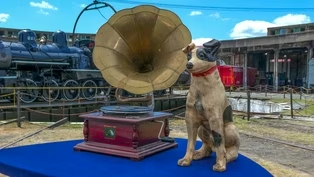
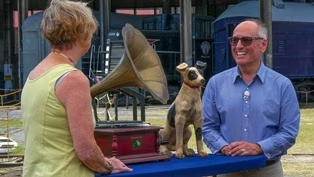
GUEST: This is a gramophone.
APPRAISER: Mm-hmm.
We picked it up maybe 25 years ago in Ljubljana, Slovenia.
Okay.
We had just completed a week-long hiking tour of the Slovenian Alps... Wow.
...and it was Sunday morning, and, um, they had, like, a flea market set up... Sure.
...with booths and tables along the river.
And this was all polished and shined up and caught the sun.
And it caught my husband's eye... Ah... ...and, uh, it was going to go home with us.
Okay.
We think we paid around a hundred dollars for it, but we're not sure.
Okay.
Right.
And we know that we made the vendor's day because within ten minutes, he had folded up shop and went home.
And I have to settle a bet between you and your husband?
My husband has always been convinced that it's got to be authentic because it came from Europe.
(chuckling): Right.
Uh, I know that there are all kinds of knockoffs that look exactly like this that are worth about $100 apiece.
So you can settle that for us.
(laughing): Okay.
Well, I'll try to do my best.
So I remember when I first did the first season of "Roadshow."
These gramophones would come in and they were always a big hit.
Uh-huh.
Now the markets have changed since then.
And there are also real ones and later productions.
Uh-huh.
I think you're both right.
I want to settle this.
Oh, you're a diplomat.
I know, I-I did not want to offend anyone.
(chuckles) But there's a couple of things that I want to point out.
Okay.
First of all, this label in green.
That is a later reproduction of the piece.
Okay.
I would date this in and around the 1940s.
Okay.
The other part of it is the back mounting that's holding up the whole horn is either replaced or a later production.
Okay.
You also have this dog and tell me the story about this.
(chuckles) That dog I found at an outlet store in Savannah.
This is Sparky.
He should have his head cocked and the sound of my master's voice.
Right.
The mold maker thought that the-the dog was defective because his head was cocked.
Wh-- ah.
So he changed the mold and made all of them with their-- so I have a Sparky with his head on straight and he's probably not worth very much because of that.
(chuckling): Well, his name is actually Nipper, not Sparky.
Oh!
Oh!
So it was Nipper.
And even on the record you can actually see that he is there with his head cocked.
Right.
And that's Nipper.
Also he has the black spot around his eye, which he shouldn't because... Oh, okay.
...that-- Nipper never had that.
And also the way that this is painted, you could see that there's the paintbrush.
They painted outside of the lines.
So this is the knockoff Nipper.
(laughs) So this is the knockoff.
Uh-huh.
This is a later production-- however, with everything together, with the gramophone and the reproduction Nipper, (laughs) I would put an auction estimate in the $800 to $1,200 price range.
Really?
Yes.
Okay, so am I right or is my husband?
(both laugh) That is the question.
I think you're both right.
Okay.
This painting was bought at, um, in Sumner, Georgia at an antique shop.
My son bought it for 37 bucks.
I don't know anything else about it other than, um, that.
We inherited it from my grandmother, and, um, we have a-a picture of it from the early 1890s in the home that it was living in at the time in Wisconsin.
APPRAISER: It's so nice to have a picture of a clock in its original setting.
Really places it timewise.
My aunt and uncle told me that, that it had been in the family since the 1800s.
Do you know about its origin at all or where it came from?
I do not.
Okay.
Do you know who made it?
No, never had it appraised at all.
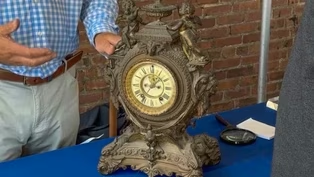
Okay, well this is a figural clock, and it was made by the Ansonia Clock Company in New York.
And it really was made to sort of be less expensive than a French clock, but it's still a beautiful thing.
It's one of these clocks that's worth fixing because it'll be a good timekeeper for years to come.
So it's worth putting money into the movement and having it restored.
I can see that the movement is-is a little bit, uh, grungy or dirty.
Hasn't been attended to in a long time.
(chuckles) So, so it might be time to get that done.
A clock like this, in a retail situation would probably be priced anywhere from, oh, $550 to $850.
Um, and you got to know that the market's down right now.
It used to be more valuable, and I'm sure it will come back, but right now, these figural clocks are a harder sell to younger generations.
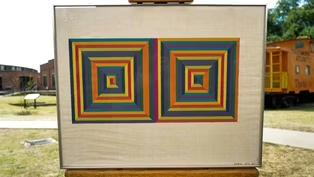
GUEST: I actually found it, uh, at a thrift store.
I think it may be attributed to the artist Frank Stella.
And how much did you pay for it?
$3.99.
So what you have here is a color screen print with pencil marks by Frank Stella, a great post-war abstract artist.
Recognized it right away, a very modern mid-century look.
And Frank Stella was a pioneer of abstraction.
In the 1960s, he was one of the first artists to do non-objective painting.
And this is a print version of some of the paintings he did.
It's a 1967 screen print called, "Fortin de las Flores."
And it comes from a portfolio called "Ten."
It included ten works by ten different artists.
Works by Roy Lichtenstein, and Robert Rauschenberg.
Really, at the time, the cutting edge artists.
Published by the Leo Castelli Gallery in New York.
And it was published to honor their tenth anniversary.
It was printed in an edition of 200.
It's initialed and dated and numbered in the lower right in brown ink.
And has the emboss mark of the printer, lower left.
The colors are really strong, it's-it's got a great color.
It has pop, and it's on this great graph paper.
So this is a color screen print, which is a print made through screens individually printing each color and they're separated by fine lines that were done by pencil.
Someone would have done that by hand.
It's well-documented as a screen print of Frank Stella.
It's in many museum collections, including the Museum of Modern Art.
Frank Stella rose to prominence in the late '60s in New York.
And this is also from '67.
So this is an early work by him, so it's really a great example.
This is a Kulicke frame.
It's a classic mid-century design frame that was actually pioneered at MoMA.
Kulicke was a frame maker, he was also a painter, but he was a frame maker who pioneered this-- this frame was cutting edge in the '60s (chuckles) and quickly adapted by many contemporary artists and galleries.
Do you have any sense of the value?
Somebody had mentioned, uh, like $2,000 to $5,000 for Frank Stella.
So if it's more than what I paid for it, then I'm happy.
Well, I think it's in good condition.
We see that through the bright colors.
Mm-hmm.
There's a little dust inside the frame.
It's dirty.
(laughs) But I'm glad you didn't touch it.
I would estimate it at auction at $5,000 to $7,000.
Nice.
That is wonderful.
I'm thrilled.
I got it at an estate sale a few years ago.
I don't think more than five bucks.
(laughs) I have no information about this thing, other than it's pretty and I like it.
(laughs) We inherited it from my mother, and it was by far the most expensive piece of art she purchased.
I believe it was, um, 1992.
And she paid $16,200.
Okay, so not nothing.
(laughing) Not nothing.
Especially for her.
Um, she liked having women artists in her house; uh, um, their artwork, anyhow.
And this we knew was a woman from Chile, and it's something that always got a lot of attention.
And who is the artist?
Olga de Amaral.
Yes, so Olga de Amaral, um, is a-a quite well-known fiber artist and actually from Colombia, not Chile.
Oh, really?
And is still living and actively working.
She is 93 years old, still has her Bogota workshop.
This work is signed on the reverse.
So we do have a date, May 1992.
It comes from her series called "Lost Images" or "Imagen Perdida."
That was a series of about 17 works, um, at least that many are known and some are in museum collections.
Really?
Um, and it was a traveling exhibition at the time that went to several venues throughout the U.S., including the Allrich Gallery in San Francisco, where your mother had acquired this.
And where was this piece displayed?
In her bedroom, actually.
Um, and she spent the last years of her life in bed, so it was significant.
It was an important piece for her.
When this came in, I kind of couldn't believe what I was looking at.
I did not think I would get this close to a work by de Amaral.
Get out of here.
So, thank you!
(laughing): This is really exciting.
Really?
And what do you think this-this material is?
Well, it looks like leather, but I'm sure it isn't.
So... Exactly, it's not leather.
It definitely has that look to it.
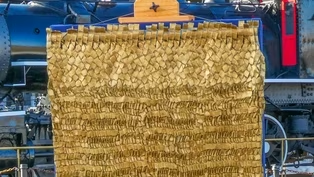
It's cut strips of linen that she has gessoed, painted, and then gilded.
And before the last gilding, she's also pulled out threads in a, in a weaving process called drawn work.
And so she's cut and drawn these threads out to create little breaks in between each square of gold.
Now, going back to what your mother paid, remind me again?
$16,200.
Okay, so about $35,000 today.
That's not nothing.
That's a-a decent price.
(laughs) Taking into consideration that it does need some conservation, I'm going to be very conservative.
Conservative.
Conservative.
(chuckles) In this condition, untouched, I would say easily, comfortably... ...an estimate at auction of $150,000 to $250,000.
Yikes.
All right!
(laughs) That's... ...it's worth, uh, doing the, um, doing the work on it.
Definitely, I think you wouldn't need to spend more than a few thousand to get it really in tip top shape.
Would that change the, uh, value?
Oh, yeah.
Again, I'm going to say conservatively, I'd add another $100,000 to that.
$250,000 to $350,000.
I see why people cry on "Roadshow."
(laughs) I would insure it for $500,000.
Because her works have gone for well above that number at auction in recent times.
Oh, my.
They're very sought after.
Thank you.
Thank you very much.
PEÑA: This episode of "Antiques Roadshow" PEÑA: And now it's time for the "Roadshow" Feedback Booth.
And this is my grandfather's watch.
It's about 100 years old.
And it's just a family heirloom.
And it wasn't worth much, but it's worth the world to me.
This Charles Lindbergh chair is one of a kind, but the-- and heavy to carry.
But this ring is worth more than it.
It's $2,000 and it was a lot lighter.
The item we thought was going to be a million-dollar winner for us was about $150.
But since I paid a dollar, that's fine.
This was a wonderful 50th anniversary trip.
We appreciate it.
Yes, and I brought this ring watch, it's worth a couple hundred dollars and found out this was a reproduction.
And I brought this cup and they told me it's only worth about $12, so.
We had a great time though.
Yes.
This is my antique rattan hat.
And I asked how to keep it clean, and they said it don't matter because it's only worth $50.
(chuckles) Womp, womp!
(laughs) Um, I brought this clock that belonged to my grandfather, and it's worth about $100.
(chuckles) And I brought Tom-- he's priceless.
(chuckles) We've wanted to come to the "Antiques Roadshow" for a long time.
And we brought these timepieces, and we had... ...the time of our lives.
Thank you, "Antiques Roadshow!"
PEÑA: Thanks for watching.
See you next time on "Antiques Roadshow."
Appraisal: 1901 Alexander Fisher Enamel Plaque with Letter
Video has Closed Captions
Clip: S30 Ep4 | 2m 44s | Appraisal: 1901 Alexander Fisher Enamel Plaque with Letter (2m 44s)
Appraisal: 1967 Frank Stella "Fortín de las Flores" Screenprint
Video has Closed Captions
Clip: S30 Ep4 | 2m 51s | Appraisal: 1967 Frank Stella "Fortín de las Flores" Screenprint (2m 51s)
Appraisal: 1977 Carl Andre 4 "Aluminum Square" Sculpture
Video has Closed Captions
Clip: S30 Ep4 | 3m 5s | Appraisal: 1977 Carl Andre 4 "Aluminum Square" Sculpture (3m 5s)
Appraisal: 1981 Andy Warhol-inscribed "Myths"
Video has Closed Captions
Clip: S30 Ep4 | 2m 9s | Appraisal: 1981 Andy Warhol-inscribed "Myths" (2m 9s)
Appraisal: 1992 Tournament of the Americas "Dream Team" Signed Ball
Video has Closed Captions
Clip: S30 Ep4 | 2m 9s | Appraisal: 1992 Tournament of the Americas "Dream Team" Signed Ball (2m 9s)
Appraisal: Alexis Jean Fournier Landscape Oil Painting, ca. 1910
Video has Closed Captions
Clip: S30 Ep4 | 2m 59s | Appraisal: Alexis Jean Fournier Landscape Oil Painting, ca. 1910 (2m 59s)
Appraisal: American Bisque Baby Elephant Cookie Jar, ca. 1945
Video has Closed Captions
Clip: S30 Ep4 | 1m 4s | Appraisal: American Bisque Baby Elephant Cookie Jar, ca. 1945 (1m 4s)
Appraisal: Ansonia "Lydia' Figural Mantle Clock, ca. 1890
Video has Closed Captions
Clip: S30 Ep4 | 1m 28s | Appraisal: Ansonia "Lydia' Figural Mantle Clock, ca. 1890 (1m 28s)
Appraisal: Cathedral Pattern Molded Jar, ca. 1850
Video has Closed Captions
Clip: S30 Ep4 | 2m 27s | Appraisal: Cathedral Pattern Molded Jar, ca. 1850 (2m 27s)
Appraisal: European Creedmoor-style Mechanical Bank, ca. 1890
Video has Closed Captions
Clip: S30 Ep4 | 3m 21s | Appraisal: European Creedmoor-style Mechanical Bank, ca. 1890 (3m 21s)
Appraisal: Hanns-Peter Krafft for Meier Sheep, ca. 1980
Video has Closed Captions
Clip: S30 Ep4 | 1m 21s | Appraisal: Hanns-Peter Krafft for Meier Sheep, ca. 1980 (1m 21s)
Appraisal: "His Master's Voice" Gramophone Group
Video has Closed Captions
Clip: S30 Ep4 | 3m 16s | Appraisal: "His Master's Voice" Gramophone Group (3m 16s)
Appraisal: Jean Schlumberger for Tiffany & Co. Bracelet
Video has Closed Captions
Clip: S30 Ep4 | 2m 2s | Appraisal: Jean Schlumberger for Tiffany & Co. Bracelet (2m 2s)
Appraisal: Juvenia Arithmo Calculator Watch, ca. 1955
Video has Closed Captions
Clip: S30 Ep4 | 1m 42s | Appraisal: Juvenia Arithmo Calculator Watch, ca. 1955 (1m 42s)
Appraisal: Olga de Amaral "Lost Image VII" Tapestry
Video has Closed Captions
Clip: S30 Ep4 | 3m 42s | Appraisal: Olga de Amaral "Lost Image VII" Tapestry (3m 42s)
Appraisal: Ottoman Silver Gilt & Niello Belt, ca. 1875
Video has Closed Captions
Clip: S30 Ep4 | 1m 47s | Appraisal: Ottoman Silver Gilt & Niello Belt, ca. 1875 (1m 47s)
Appraisal: Signed 1936 "Gone With the Wind" First Edition
Video has Closed Captions
Clip: S30 Ep4 | 3m 36s | Appraisal: Signed 1936 "Gone With the Wind" First Edition (3m 36s)
Appraisal: Van Cleef Diamond & Platinum Brooch, ca. 1960
Video has Closed Captions
Clip: S30 Ep4 | 2m 25s | Appraisal: Van Cleef Diamond & Platinum Brooch, ca. 1960 (2m 25s)
Preview: Georgia State Railroad Museum, Hour 1
Video has Closed Captions
Preview: S30 Ep4 | 30s | Preview: Georgia State Railroad Museum, Hour 1 (30s)
Providing Support for PBS.org
Learn Moreabout PBS online sponsorship
- Home and How To

Hit the road in a classic car for a tour through Great Britain with two antiques experts.














Support for PBS provided by:
Funding for ANTIQUES ROADSHOW is provided by Ancestry and American Cruise Lines. Additional funding is provided by public television viewers.