
The Debate Over Taxing Wealthy Illinois Residents at a Higher Rate
Clip: 4/7/2026 | 11m 58sVideo has Closed Captions
In 2024, a nonbinding referendum passed with more than 60% of Illinoisans in favor of such a tax.
The Illinois Economic Policy Institute says the income generated could fund public schools or offer property tax rebates to homeowners. Critics argue such a tax could open the door for increased taxation on thousands of small businesses.
Problems playing video? | Closed Captioning Feedback
Problems playing video? | Closed Captioning Feedback
Chicago Tonight is a local public television program presented by WTTW
WTTW video streaming support provided by members and sponsors.
The Debate Over Taxing Wealthy Illinois Residents at a Higher Rate
Clip: 4/7/2026 | 11m 58sVideo has Closed Captions
The Illinois Economic Policy Institute says the income generated could fund public schools or offer property tax rebates to homeowners. Critics argue such a tax could open the door for increased taxation on thousands of small businesses.
Problems playing video? | Closed Captioning Feedback
How to Watch Chicago Tonight
Chicago Tonight is available to stream on pbs.org and the free PBS App, available on iPhone, Apple TV, Android TV, Android smartphones, Amazon Fire TV, Amazon Fire Tablet, Roku, Samsung Smart TV, and Vizio.

WTTW News Explains
In this Emmy Award-winning series, WTTW News tackles your questions — big and small — about life in the Chicago area. Our video animations guide you through local government, city history, public utilities and everything in between.Providing Support for PBS.org
Learn Moreabout PBS online sponsorship>> As the state looks for ways to balance its budget, some advocates a resume, the call for a so-called Millionaire's tax.
A study from the Illinois Economic Policy Institute says a 3% surtax on Illinois earning more than a million dollars a year could generate up to 5 billion dollars annually by the year 2033.
But critics argue that could open the door for increased taxation on small businesses and potentially fall short of relieving the property tax burden.
Joining us, our Austin Berg, executive director of the Chicago Policy Center, which is part of the Illinois Policy Institute and Frank Manzo economists with the Illinois Economic Policy Institute names are similar.
Different organizations and Frank contributed to the so-called Millionaires Tax study.
Gentleman, welcome back.
Thanks for joining us.
Thanks Frank.
Your coauthor of the study.
Give us a brief overview of the report.
Please write and yeah, we did this report with the project for Middle class renewal at the University of Illinois.
So want to make sure that they have a shout out.
But >> what we found is that a millionaire's tax could generate 4 billion dollars per year, at least and that money would be lockbox and dedicated specifically for property tax relief or for historic investments in education and what we found and what the data shows is that that reform could cut property taxes for for 3 million, Illinois homeowners by up to 20%.
It would grow the economy and it would make the state more competitive with peers Austin, the Illinois Policy Institute in 2024, you all were critical of the millionaires tax win.
60 1% of voters approved of it in a non-binding referendum on the ballot.
>> What are some of your concerns with?
The so-called millionaires tax in Illinois?
Well, my biggest concern would be it's taking our biggest problem as a state and making it worse.
And that problem is 3 words, people, people, people.
>> Over the last decade, we've seen nearly a million taxpayers on that leave Illinois and it's really hard to comprehend that number.
It's as if the 7 largest cities outside of Chicago.
Talk in Naperville, Aurora, Springfield, down the line.
We're just raced off the map that took 88 billion dollars in income with them.
And the IRS just released data just a couple of weeks ago showing who was leaving.
In fact, the group that's leaving the fastest twice the rate of other groups.
It's the highest income group measured by the IRS.
It's people making over $200,000 for every one person who comes in making that amount to leave.
So if we had just broken even on that number, if we hadn't lost those million people, we've been generating 5 billion dollars more in income tax revenue today.
That's a healthy way to grow our economy.
So concerns in that it's going to drive people away even more people absolutely make it So, frank, 3% surtax on millionaires.
How's it different from the progressive tax proposals that we've heard before, like in the 2020 fair tax bill, how to work differently.
So, yeah, it would be different in that.
It's a surtax small surcharge on people who have made income over a million dollars.
That's the first one.
You know that the previous fair tax was I think the as $250,000 or more would pay higher taxes is just.
>> This is 40,000 households and the state.
Less than one percent of the population paying a higher tax rate.
But the main difference is that the money would be lockbox and dedicated specifically for property tax relief for Illinois homers.
That's the main difference.
you know, mean, if there if there are other differences, we want to hear those as No, goes directly to a meaningful tax relief or for middle class and working class families.
I mean, Illinois is a high-tech state for the middle class.
There's no doubt about that.
It is a low tax state for for wealthy households and that's the difference.
Reform like this that actually delivers relief to the middle class and working families that that drive economic growth and drive spending can have a really a substantial impact on the state and grow our economy.
And this will be a 3% flat tax versus a graduated tax where after a certain income level, the tax the tax changes again, I mean, it is graduating and that it's at once you you know, one millionth and first dollar you have to pay a 3% tax on top of the of the state income tax.
Austin.
How are your concerns about how it will operate and whether or not it operates similar to Well, for one, I think when people hear millionaires, they immediately think sort of like gold, Rolex and pinstripe suit when, in fact, in Illinois.
>> This would also affect pastor incomes of people who what are called escorts.
These are landscapers, HVAC, you know, plumbing.
These are traits people.
making good money on past through businesses and working really hard to do it.
There's about 22,000 small businesses that would be subject to and I can't emphasize this enough.
Virtually all of our jobs growth in Illinois comes from those small businesses.
It's not coming from big corporations.
Those big corporations actually wouldn't be paying this.
It would be the escorts, the small businesses.
That's one concern.
I also think there's a bit of a bait and switch or on the property tax question.
hiking income taxes lead to lower property taxes, we would have low property taxes in Illinois.
We have a record high income taxes in Illinois.
We also have higher property taxes than every state with 0 income tax.
So I don't think that Illinois trust lawmakers with those promises, which is why they rejected the fair tax amendment in 2020.
Okay.
So Frank, as you mentioned, the report, you will sort of lock box earmark the of the revenue from this.
It's just 3 potential uses for the revenue that would be generated by.
>> A potential millionaires tax one would be providing property tax relief for homeowners in the form of rebates.
For those who qualify for the Homestead exemption to fully fund the evidence, base funding model and make it that education investments.
It's running behind right now in freezing school, property taxes and provide edge and provide additional education funding.
So a little bit of little called A little column B now and tell us a little bit about how these options would work.
So, yeah, there are We have different options are in our report because our different proposals and General Assembly right now and voters have been asked twice about a millionaire surtax to fund property tax Relief Fund schools.
So we want to provide multiple different options.
>> Either way, the state's economy grows by billions of dollars create 1000 jobs.
And the reason is that, you know, millionaires are that's going to very little effect on migration.
Talk about that earlier.
Millionaires are growing as a person as share of the of Illinois's economy.
And since 2019, the number of millionaires people making 1 million dollars or more per year has grown by 36% where and oh, by the way, in the last for decades there, their incomes have doubled after you adjust for inflation, whereas for the rest of us population and earnings have barely budged.
There's a growing sector of of the of the population in part because the tax code right now favors these individuals.
And so but what we find is that the the this report or this reform would could fully fund schools and improve our our graduation rates for for 2 million students or it could deliver substantial property tax relief.
Rebates of up to 20% for the average household for 3rd for 3 million homeowners across the state.
That's what the data shows.
Austin, is that feasible?
I don't think so.
And we can look to Massachusetts.
It's the most recent state to enact really like in the last 2030, years to enact a quote, unquote, millionaire's tax.
>> And data just came out 2 weeks ago showing the results and they have been shockingly bad for the state of Massachusetts after they passed this millionaire's tax.
The Cyrus data showed the first full year after it was implemented.
4 billion dollars left the state.
Remember, I said people, people, people drives people to other states.
I'm not asking people to shed a tear for millionaires.
I'm asking people to realize that we need to attract more of that investment to our state, Massachusetts.
drove people away.
70% of that 4 billion dollars came from high income earners.
And this is the most shocking part.
The full pie in Massachusetts.
All of the income that's called AGI Adjusted Gross income.
It shrank as a total pie actually shrink, making the state much, much weaker.
It's harder to fund schools heard from libraries harder to fund parks when your total income as a state is shrinking.
And I do not think Illinois should be copying that model.
Frank.
You look like you and Russ Behind a bizarre.
so Massachusetts is the most recent state.
As you mentioned, they're millionaires tax, raise 3 billion dollars last year.
So if you want all these taxpayers, you expect tax revenue to decline.
>> this reform raised 3 billion dollars in new revenue just last year alone and that money went to schools and went to tuition free community college and it went to infrastructure, including public transit and that state, Illinois could replicate that model because the states that have millionaires tax as their economies have grown at the same rate as states that do not have a millionaire's tax over the past few years.
So Austin in 2024, the Illinois Policy Institute for your part at the time you all found at the state spent 5.2 billion dollars more than its revenue.
>> Suggestions to rein in some of the state spending include a cap on state spending, adjusted for nominal GDP and strengthening the budgeting for results commission to limit excess spending.
break down.
What could the state be doing better to reign in spending versus raising revenue?
The business said the same thing.
If you called into a radio show on financial advice, what would they say?
Well, stop making bad decisions, start putting a structure in place to make better financial decisions.
We end up in these deficits every year because the state's growing spending far faster than taxpayers can afford.
>> And what we've suggested in which state Democratic and Republican states have adopted.
It's called a smart spending cap.
So it allows you to grow spending at a reasonable rate.
The rate of economic growth, population growth.
But anything beyond that usually need to go to voters to get them to approve So we think that's a smart, reasonable compromise to keep spending from growing out of control and to keep the cost of government reasonable.
That one of our biggest cost drivers for cost of living in Illinois for changes enough.
>> I mean, what I would suggest as as the same thing, put it to the voters as opposed to leave it in the hands of politicians and this constitutional amendment to impose a small surtax on millionaires to to deliver property tax relief could go to the voters who would lock box the revenue and say forever and perpetuity.
The revenue needs to go to this specific purpose property tax relief or funding public schools, which would stem the growth of property taxes.
If you do that and put into the voters and some politicians who want to win, you every year could just decided to change what their what they give money to.
That is the right move.
And so I agree.
But in the hands of voters.
>> According to Institute on Taxation and Economic Policy, the Trump administration's one big beautiful bill gave a and this is according your report as well.
gave a earners making or exceeding Annette $939,000.
Roughly $66,000 in tax cuts nationally.
41,500 in Illinois.
And as we've discussed, you know, one of the one of the main concerns with the millionaires tax is e migration of those millionaires out of state.
Frank early leaving other states.
>> Well, you know, that's that's a tax cut for people.
Basically may earn million dollars or more.
And, you know, I if you could ask around, but I don't think most people would say that the economy is doing particularly well following those tax cuts.
They have tens of thousands of dollars money that now that they didn't have prior they can afford pay a little bit more to to fully fund our schools are to deliver meaningful relief to to regular everyday people.
And now it's not.
It's not a huge burden on those folks.
In fact, millionaires are the research shows that they're called.
They refer to him as embedded.
Elise, what that means is that they're more likely to be married, more likely children are more likely to have business obligations and those in their states that they can't leave directions.
They're highly mobile.
They're leaving Illinois, taxing these people more would make them choose other states more than they currently are.
We need more of
 New
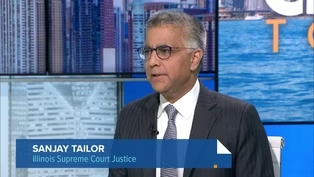
NewOne on One With Illinois' Newest Supreme Court Justice
Video has Closed Captions
Sanjay Tailor is the first Asian American justice on the state's highest court. (7m 51s)
Providing Support for PBS.org
Learn Moreabout PBS online sponsorship
- News and Public Affairs

Top journalists deliver compelling original analysis of the hour's headlines.

- News and Public Affairs

FRONTLINE is investigative journalism that questions, explains and changes our world.











Support for PBS provided by:
Chicago Tonight is a local public television program presented by WTTW
WTTW video streaming support provided by members and sponsors.