
Sitting down with Life Remodeled president, a look at Detroit Policy Conference panel on education
Season 54 Episode 14 | 26m 46sVideo has Closed Captions
Nonprofit works to improve Detroit neighborhoods and a talk on the state of education in Michigan.
The president of the nonprofit Life Remodeled talks about his organization’s new projects and initiatives. Plus, we’ll bring you a conversation from this year’s Detroit Policy Conference, presented by the Detroit Regional Chamber, about the state of education in Michigan and its impact on the future workforce.
Problems playing video? | Closed Captioning Feedback
Problems playing video? | Closed Captioning Feedback
American Black Journal is a local public television program presented by Detroit PBS
Sitting down with Life Remodeled president, a look at Detroit Policy Conference panel on education
Season 54 Episode 14 | 26m 46sVideo has Closed Captions
The president of the nonprofit Life Remodeled talks about his organization’s new projects and initiatives. Plus, we’ll bring you a conversation from this year’s Detroit Policy Conference, presented by the Detroit Regional Chamber, about the state of education in Michigan and its impact on the future workforce.
Problems playing video? | Closed Captioning Feedback
How to Watch American Black Journal
American Black Journal is available to stream on pbs.org and the free PBS App, available on iPhone, Apple TV, Android TV, Android smartphones, Amazon Fire TV, Amazon Fire Tablet, Roku, Samsung Smart TV, and Vizio.
Providing Support for PBS.org
Learn Moreabout PBS online sponsorship- Just ahead on "American Black Journal" the president of the nonprofit Life Remodeled is here to talk about his organization's new projects and initiatives.
Plus we'll bring you a conversation from this year's Detroit Policy Conference about the state of education in Michigan and it's impact on the future workforce.
Don't go anywhere.
"American Black Journal" starts right now.
- [Announcer] Across our MASCO family of companies our goal is to deliver better living possibilities and make positive changes in the neighborhoods where we live, work, and do business.
MASCO, A Michigan company since 1929.
Support also provided by the Cynthia & Edsel Ford Fund for Journalism at Detroit PBS.
- [Announcer] The DTE Foundation is a proud sponsor of Detroit PBS.
Through our giving we are committed to meeting the needs of the communities we serve statewide to help ensure a bright and thriving future for all.
Learn more at DTEFoundation.com.
- [Announcer] Also brought to you by, Nissan Foundation and viewers like you.
Thank you.
(upbeat music) - Welcome to "American Black Journal."
I'm your host Stephen Henderson.
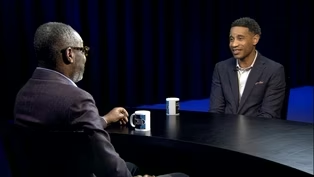
Since it's creation in 2010 the nonprofit organization Life Remodeled has focused it's work on revitalizing Detroit neighborhoods in addition to repairing homes, removing blight, and leading beautification projects, the agency has also renovated and repurposed several existing schools in our city.
Now the organization is moving ahead with some new projects and a new approach to it's mission.
Here to tell us more is the president and CEO of Life Remodeled, Diallo Smith.
Welcome to "American Black Journal."
- Stephen, thank you for having me.
- [Stephen] So, I wanna start here and I want you to explain... - Yeah.
- To the viewers what Life Remodeled is and how it works but before you do that, I wanna say something about this approach.
This is a city where we talk about neighborhoods all the time.
We talk about it being a city of neighborhoods but so many institutions and so many people don't really treat our neighborhoods quite that way and in many ways I think they don't really know what that means.
I really think Life Remodeled is a kind of sterling example of how you can bring meaning to that, that this is a city of neighborhoods and that it needs to be a city of thriving neighborhoods.
So, explain the model and how it works and what you guys have been doing since 2010.
- Well, thank you for that and I agree.
Detroit is a city of neighborhoods and we are at our best when our neighborhoods are thriving and for us fundamentally before I talk about the what we do, I always like to start with our why.
And that is, we believe unequivocally that Detroiters have all the talent and all the ambition that they need but many don't have access for opportunities to thrive.
- Right.
- And so, our approach is ultimately about being able to remove the barriers and in many ways create bridges for those thriving opportunities.
We do that through a comprehensive long term model called E3M.
Sounds cool.
But what that stands for is Economic, Educational, and Environmental Mobility.
- Yeah.
- So, when we think about, when we thought about, what is it gonna look like for us to restore that dignity?
Restore hope, but also drive some very strong metrics that represent growth, we knew one, we had this great example of, of a cleaning blight up in neighborhoods, right?
And so, we mobilized thousands of volunteers to remove blight, to remove environmental hazards, and to quite frankly bring city and suburbs together, right?
In a way that's reflected with that.
So, that's part of our environmental mobility profile.
The reason I think that that is quintessentially important as you know, we're a city that was built for 2 million people.
- Yeah.
- Now, we're hovering around 650, 665 thousand right now, I take my mother for example, on her block, both to her left and across the street are empty lots.
- Yeah, yeah.
- And so being able to serve and really help our neighbors and our residents be able to have a very strong aesthetic in their neighborhood is important for pride but we also knew that there's a lot of large vacant infrastructures that are in our neighborhood.
I grew up as an east sider and some of the schools that I used to walk by at the time that were open and thriving are now closed.
- Are gone, yeah.
- They're gone and what we found when talking with community members, when those schools closed they really sent a dagger to the heart of the community.
- Yeah, yeah.
- Right?
And so, what better way we thought than to reintegrate pride and hope than to find new purpose for those school buildings.
So, both on the west side and on the east side we're, we've repurposed two active school buildings that were formally vacant to what we call opportunity hubs.
So, people ask, okay what's an opportunity hub?
Well, it is a place that really is about aggregating economic mobility by bringing the best and brightest nonprofits in the region together, putting them under one roof, and helping us work collaboratively to bring investments, resources, and services to that immediate neighborhood.
And so, we've been doing that on the west side since 2017 and now on the east side... - You're about to... - We're about to open this year.
- Yeah, yeah.
- With the old Dominican High School.
- Right.
- Which used to be the Winans Academy of Performing Arts.
- Right, right.
Those of us who are old enough remember when that was Dominican.
The work that you guys do... - Yeah.
- Doesn't take place without the community being involved with it.
I mean, that's kind of where you start is you go to these communities, you get people together, you talk to them about what's going on and what they want and then you kinda help them build, I guess the infrastructure to be able to move the needle.
You know, that's again a model that lots of people talk about... - Yeah.
- But, you guys seem to have been able to be effective at it.
What is it about what you're doing I guess that makes that work?
- You know, it's funny, I don't think that we're doing anything more than what I would want somebody to do for me if I was living in my neighborhood.
- Yeah.
- Right?
One, it's about establishing trust.
You know, Detroiters are resilient but Detroiters have also been through a lot and there's been a lot of, we're gonna do this, we're gonna do that, and then things start and don't finish, and or projects that started that wasn't, when it was done did not fit what it's original intent was.
And so, there's some lack of trust and consternation there and so I think recognizing that and honoring that is a big part of what we do on a continual basis but the other part is really to be Frank, we are not the geniuses.
The Mrs.
Jones and the Mrs.
Smiths that have been living in their neighborhood for 50 years, the teachers who work in that community, the small business owners, the faith leaders, they know more about their neighborhood... - Yes, yes.
- Than we ever do.
So, it makes sense for us to be able to tap into their genius, tap into their history, and to tap into their ambitions and the visions that they have for their neighborhood's future and see how we can work alongside with them in making that vision a reality.
- Yeah, yeah.
Let's talk about this new site over on the east side and the kind of realignment of the mission.
- Yeah.
- Around it, what's gonna change?
- You know, it's interesting.
When we first started our Durfee Innovation Society on the west side in 2017 you start something without really, you think you know what's gonna happen but you don't really know, right?
And, and we've just been able to experience so many great success stories there.
More than we ever thought.
When we first moved over in that neighborhood in 2017 it had some of the highest crime rates in the city, now it has some of the lowest crime rates.
The house, the home value of the surrounding neighborhood has increased by 36%, right?
So, a bunch of great things and that made us think, you know this is a model that could be replicated on other parts of the city.
- You could pick it up and drop it someplace else.
- Yeah, our east siders were always like, hey when are you guys gonna come over and do something over here?
And so, we had an opportunity to acquire the former Dominican high school and allow for the community members to name it Anchor Detroit, or asked for the community members to name it and they named it Anchor Detroit.
Because they want for their neighborhood to represent stability and to represent a future.
What's gonna be different I think is the approach that we're taking to use our comprehensive model to cultivate what we call thriving class neighborhoods.
Neighborhoods that are economically resilient.
Neighborhoods where people can raise their children.
Neighborhoods where people can build wealth, reinvest in their neighborhoods, and then ultimately find a future for the neighborhoods and so we're really looking to scale our model by assuring that all of the surrounding community members have a chance to really take full advantage of the resources that are in our opportunity hubs in a way that's gonna make them economically, educationally, and environmentally mobile.
- Yeah, yeah.
You know, I've had conversations with mayors and urban planners and all kinds of people who work on neighborhood revitalization and they all kind of agree that the things you need for a neighborhood really to thrive are, you need a school, you need a grocery store... - Food, yeah.
- And you need jobs for people.
How close are we in some of the places where you're working to actually seeing that come together?
- Yeah, I mean I think it's on a continuum.
- Yeah.
- And I think that we have to look at it that way.
When we're talking, we're not talking about neighborhoods and communities that reached the tipping point of disinvestment last year.
- [Stephen] Yeah, right.
- We're talking about disinvestment over decades.
- Over, I mean my lifetime, really.
- You know, I was, I remember the neighborhood that I grew up in when I was young, it was highly populated.
We had a dispopulation of working class families, many of them in the professional class and for different reasons as I'm sure you've talked about on this show the complexion of those neighborhoods including the one that I grew up in changed.
And so, I think that the first thing to do is to really have a long term view.
This is not gonna be a flash in the pan type of agenda.
- Yeah.
- This is gonna be a comprehensive we're all in on creating change in this neighborhood position.
The other thing that I think is quintessential is we have to address the income inequality problem... - Yeah, yeah.
- Within the city.
You know, we could talk about building our commercial corridors and we should.
Certainly we could talk about bringing more retail into the city and we should.
We can also talk about affordable housing and we absolutely should.
However, if people's household income... - Yeah.
- Does not increase, then they're not gonna be able to afford to support the new retail corridors.
- That's right, yeah.
- They're not gonna be able to be able to support some of the things that we wanna see happen in our neighborhoods so for us we're placing a large premium on workforce development.
- Yeah, yeah.
- And creating those... - Get people ready for jobs... - For jobs.
- That we hope to attract.
- And education.
- Yeah.
- You know, I think with our young people, we work with five area schools and I can sense both from the students and from the parents that they're ready, you know?
They're, they're not scared.
In fact, they don't like the label that has been placed on many of our Detroit schools, that they're lacking or they're under prepared or they can't learn well, or they have no ambition for the future.
None of those things are true.
In fact, the opposite are true.
I think what's missing is opportunities and access for them to thrive coupled with investments and resources, right?
- Yeah.
- And so, I think when we can couple both of those at the same time.
Aggressive workforce development opportunities which is what our opportunity hubs provide... - [Stephen] Yeah.
- Along with aggressive educational investments that support our kids both in school and out of school, then you start to see that neighborhood begin to change because people have pride in their community... - [Stephen] Yeah.
- They're like, hey you know my neighborhood's going some place.
- [Stephen] It's working.
- And we are a part of the change.
It's not a necessarily a top down approach.
It's a very organic community driven approach which I think for Life Remodeled that's been the key for our success.
- Yeah, yeah.
Well, congratulations on all the work and thanks for being here on "American Black Journal."
- Thank you, sir.
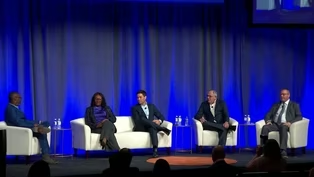
- Creating a more prosperous Detroit region was the focus at this year's Detroit Policy Conference presented by the Detroit Regional Chamber.
The event brought together hundreds of business leaders, government officials, and community change makers to talk about solutions to the area's most urgent issues.
I had the opportunity to moderate a panel about education that was titled, "The House Is On Fire" solving Michigan's education crises.
Here is a portion of that conversation.
Is that where we are?
Is the house literally on fire?
And Sarah, I'll start with you.
Does it feel like we're acting like the house is on fire with regard to educational and income outcomes?
- Well first if I wanted to be petty I would say, the house might be on fire but the senate is not.
However, in the spirit of civility and collaboration... - [Stephen] Not that house but whatever.
- Trust me, I got 'em all day but in honest, I don't think that the house is necessarily on fire.
I think the house is unfocused.
You know, I've spent most of my professional life in the college access space and in the policy space and what I can tell you is I've dedicated my life to making sure that first generation college students like me actually had a seat at the table and when we look at our policy makers long before I was in the legislature, think the Grandhom years, the Snyder years, now in the Whitmore administration, the pendulum keeps swinging.
We go from everyone needs to go to a four year institution or no one needs a college or a skill trade, right?
We keep going back and forth without the amount of focus we really need.
I was there when we would compare ourselves to Massachusetts, then it was Tennessee, now it's Mississippi.
The reality is this stuff isn't that hard if we have policy makers, education leaders, community organizers, and yes even students at the table to create the policy initiatives that we know actually work.
Which is more accountability, persistence, alignment, as you mentioned, but ultimately we have to be focused around one big goal and I was excited when this governor did just that.
She declared that in order for us to meet our labor market demands, let's have a goal of 60% of our people getting additional piece of paper after high school by the year 2030.
That has focused our resources, our policy initiatives, and what I know we're gonna talk about today is, how do we take that big goal and focus us into the next generation and the next era of leadership?
So, we're not on fire, we're just lacking focus.
- Yeah, yeah.
So, Jeff, if we role with the metaphor that maybe it's on fire, I feel like BLM over the years has been maybe not the fire department but certainly the one ringing the bell, right?
Saying, there's smoke and there's some flame over there, we oughta respond to it.
I wanna have you talk over that time and I know you haven't been at BLM that whole time but I can think back to 2011 or 2012, reports from BLM about how bad things were with education, with incomes, and setting these really inspiring goals about how we could get to a better place.
The dawn of the Snyder administration I felt like was this moment of alignment about those things and here we are 15 years later and things are worse.
What could be different this time?
What could we do that we didn't do that last time?
I heard what you were saying when you were speaking but what are the specific things that make this not the same old alarm that we've been hearing?
- Yeah, and certainly, I've been at Business Leaders for Michigan now for 5 years and the data tells us that we did make progress after the Great Recession, right?
We were 50th in many categories in the Great Recession on a huge number of business fundamentals, of how you do growth, of how individuals are succeeding in the economy and we have come up from that but I think the challenge is that many of our fundamentals need to be addressed.
And so I'll give you another analogy that we talk about a lot, which is, it's maybe not the house is on fire, but it's been a slow boil, right?
And we've kind of seen ourselves slide backwards.
It's hard to look at and step back and part of the purpose of the data presentation I just made was to look at 25 years of the slide backwards, right?
On education.
In any one year you're not seeing that, right?
It's hard to tell you've had a huge difference.
In any one district it's hard to tell because I guarantee there are good teachers, there are good administrators, people are getting a lot of the supports they need in the schools but as we look back, as we compare with other districts we're falling behind.
So, the urgency that we need to have in this year, right, the bell and alarm ringing we have to have is, we are now a bottom 10 state for education.
Mississippi is a top 10 state in literacy.
So, the states that we always said, oh well, they're never gonna compete with us.
We're always gonna be better with them, they have said enough and they're changing trajectory.
We have not been able to get those clear goals as Senator Anthony said, that we align both parties with.
That can sustain a strategy for 10 years.
That's been our challenge.
- Yeah, yeah.
Greg, I know the chamber does a lot of work with your leadership really looking at education in Michigan and sounding the alarm when it's appropriate.
I'm really curious though for you, what stands out about this moment and the opportunity that we might have to go in a different direction?
What are you seeing in the work that you guys do in K12 especially?
- Well, I've been at this a long time and we haven't fixed it, so I guess it's my fault.
Interesting, so we just put out our state of education and talent report and we also documented this fall in per capita income and what was interesting is, so it's been falling as Jeff said, this didn't happen overnight and as we've said, hey, now we've gone from 34th to 38th in per capita income, people kinda shrugged.
When we hit 40, somehow round numbers seem to capture people's imagination and so when we released the report back in November, we did some interviews, people, that is resonating with people.
When people understand there's a problem I think it was a wake up call.
So, 40th in per capita income resonates in a way maybe 37th doesn't but we also know there's no path back to 18th or 16th or where we were in 2000 or 1999 without being highly educated.
If you stack up states or regions and rank them by their per capita income that's what their post secondary attainment rate is.
There is no such thing as a state that is not highly educated or a region that's not highly educated that is prosperous.
So, we have a challenge ahead of ourselves.
We hear a lot this debate about whether people should focus on CTE and skill trades or college.
One of the things we put out in our report is we track, we look back 10 years, what happened to students all over metro Detroit, not just the city of Detroit, metro wide, there were 100 9th graders 10 years ago, 10 years later, so 4 years of high school and 6 years after high school an opportunity to complete some kind of education, only 35 of those hundred have completed any kind of formal post secondary education.
So, we're already missing two thirds of the potential workforce, the talent pool.
So, rather than debate about more skill trades, more higher ed, it's more of everything.
- Yeah, yeah.
Don, you see this from the vantage point of a college campus.
A college campus right here in the city of Detroit.
Really curious what you see among the students that you have there at U of D and again, what the opportunity is.
What is it that we're missing in terms of what we could be doing that we haven't that turns us in a different direction?
- Um, sure, I think with us, I would say we're very different from most of my colleagues.
I like saying the University of Detroit Mercy is playing offense and many of my colleagues are playing defense.
Where most of my colleagues see challenge after challenge, I see a lot of opportunities and I think the only thing that stands in the way of that is your imagination and we're very entrepreneurial, very innovative.
We've had three consecutive years of record new student enrollments, the largest since U of D merged with Mercy in 1990.
Winter over last year, we're up another 360 or so students.
Our brand awareness has increased significantly, not only in southeast Michigan, throughout the state, throughout the region, throughout the country and we see that with outcomes based rankings with "The Wall Street Journal."
There's 5200 college campuses in the country and the last three years we went from number 52 in the country, number 43 this year, we're number 36 in the nation.
Number 2 Catholic University in the Midwest, number 3 Catholic University out of 200 in the nation.
We're also ranked number 22 on best value of all national universities on return on investment.
We're ranked in the top 220 or so research universities by Carnegie and Ace and we're also ranked one of the top 50 colleges or universities that educate the largest number of first generation students.
So, of the, Senator, of the 6000 students at my university, three, and we're urban university, three within the city, McNichols Law and Jefferson and then Dental in Court Town and we opened our first suburban campus for optometry school out in Novi but half of our students are first gen, half of the students are Pell eligible and I was telling Greg for this current year based on our Titan Edge program about 40% of the total number of undergrads are going tuition free.
As a combination of the federal and state aid that they bring plus the merit need based financial aid that U of D is actually providing to them and so again, I think you're only limited by your imagination and we've gotten very aggressive at creating partnerships and pathways for things that we wanna be involved in.
- [Stephen] Yeah, yeah.
- [Jeff] In large part... - [Stephen] Yeah go ahead... - Because of the work of people like Senator Anthony, because of the work of university leaders, tuition is not a barrier to higher education... - That's correct.
- At this point anywhere in Michigan.
- Correct.
- The Michigan Reconnect Program gives anybody over the age of 25 without a degree a free college tuition at any community college, a skill certificate, the Michigan Achievement Scholarship, Pell eligibility.
Tuition is not the barrier that I think many people believe.
- And just to build on it.
That's a recent development.
So, you know we sometimes kind of focus on everything that we get wrong in Michigan and our problems but thanks to Senator Anthony's leadership, the governor, and bipartisan support, we passed those financial supports for students.
- That's gonna do it for us this week.
You can find out more about our guests at americanblackjournal.org and you can connect with us anytime on social media.
Take care and we'll see you next time.
(upbeat music) - [Announcer] Across our MASCO family of companies, our goal is to deliver better living possibilities and make positive changes in the neighborhoods where we live, work, and do business.
MASCO, a Michigan company since 1929.
Support also provided by the Cynthia & Edsel Ford Fund for Journalism at Detroit PBS.
- [Announcer] The DTE Foundation is a proud sponsor of Detroit PBS.
Through our giving we are committed to meeting the needs of the communities we serve statewide.
To help ensure a bright and thriving future for all.
Learn more at DTEFoundation.com.
- [Announcer] Also brought to you by Nissan Foundation and viewers like you.
Thank you.
(upbeat music)
 New
NewCreating a more prosperous Detroit region
Video has Closed Captions
Clip: S54 Ep14 | 12m 12s | A discussion from the Detroit Policy Conference about Michigan’s education concerns. (12m 12s)
 New
NewNonprofit organization “Life Remodeled” focuses on revitalizing Detroit neighborhoods
Video has Closed Captions
Clip: S54 Ep14 | 11m 59s | Life Remodeled president discusses the nonprofit’s efforts to improve Detroit neighborhoods. (11m 59s)
Providing Support for PBS.org
Learn Moreabout PBS online sponsorship
- News and Public Affairs

Top journalists deliver compelling original analysis of the hour's headlines.

- News and Public Affairs

FRONTLINE is investigative journalism that questions, explains and changes our world.











Support for PBS provided by:
American Black Journal is a local public television program presented by Detroit PBS