
Nonprofit organization “Life Remodeled” focuses on revitalizing Detroit neighborhoods
Clip: Season 54 Episode 14 | 11m 59sVideo has Closed Captions
Life Remodeled president discusses the nonprofit’s efforts to improve Detroit neighborhoods.
The President and CEO of Life Remodeled, Diallo Smith, talks with host Stephen Henderson about his nonprofit's work in Detroit neighborhoods. Smith explains how his organization repurposes vacant school buildings into Opportunity Hubs that house several nonprofit groups. Plus, he talks about his organization's latest project on the city's east side.
Problems playing video? | Closed Captioning Feedback
Problems playing video? | Closed Captioning Feedback
American Black Journal is a local public television program presented by Detroit PBS
Nonprofit organization “Life Remodeled” focuses on revitalizing Detroit neighborhoods
Clip: Season 54 Episode 14 | 11m 59sVideo has Closed Captions
The President and CEO of Life Remodeled, Diallo Smith, talks with host Stephen Henderson about his nonprofit's work in Detroit neighborhoods. Smith explains how his organization repurposes vacant school buildings into Opportunity Hubs that house several nonprofit groups. Plus, he talks about his organization's latest project on the city's east side.
Problems playing video? | Closed Captioning Feedback
How to Watch American Black Journal
American Black Journal is available to stream on pbs.org and the free PBS App, available on iPhone, Apple TV, Android TV, Android smartphones, Amazon Fire TV, Amazon Fire Tablet, Roku, Samsung Smart TV, and Vizio.
Providing Support for PBS.org
Learn Moreabout PBS online sponsorship- Welcome to "American Black Journal."
I'm your host Stephen Henderson.
Since it's creation in 2010 the nonprofit organization Life Remodeled has focused it's work on revitalizing Detroit neighborhoods in addition to repairing homes, removing blight, and leading beautification projects, the agency has also renovated and repurposed several existing schools in our city.
Now the organization is moving ahead with some new projects and a new approach to it's mission.
Here to tell us more is the president and CEO of Life Remodeled, Diallo Smith.
Welcome to "American Black Journal."
- Stephen, thank you for having me.
- [Stephen] So, I wanna start here and I want you to explain... - Yeah.
- To the viewers what Life Remodeled is and how it works but before you do that, I wanna say something about this approach.
This is a city where we talk about neighborhoods all the time.
We talk about it being a city of neighborhoods but so many institutions and so many people don't really treat our neighborhoods quite that way and in many ways I think they don't really know what that means.
I really think Life Remodeled is a kind of sterling example of how you can bring meaning to that, that this is a city of neighborhoods and that it needs to be a city of thriving neighborhoods.
So, explain the model and how it works and what you guys have been doing since 2010.
- Well, thank you for that and I agree.
Detroit is a city of neighborhoods and we are at our best when our neighborhoods are thriving and for us fundamentally before I talk about the what we do, I always like to start with our why.
And that is, we believe unequivocally that Detroiters have all the talent and all the ambition that they need but many don't have access for opportunities to thrive.
- Right.
- And so, our approach is ultimately about being able to remove the barriers and in many ways create bridges for those thriving opportunities.
We do that through a comprehensive long term model called E3M.
Sounds cool.
But what that stands for is Economic, Educational, and Environmental Mobility.
- Yeah.
- So, when we think about, when we thought about, what is it gonna look like for us to restore that dignity?
Restore hope, but also drive some very strong metrics that represent growth, we knew one, we had this great example of, of a cleaning blight up in neighborhoods, right?
And so, we mobilized thousands of volunteers to remove blight, to remove environmental hazards, and to quite frankly bring city and suburbs together, right?
In a way that's reflected with that.
So, that's part of our environmental mobility profile.
The reason I think that that is quintessentially important as you know, we're a city that was built for 2 million people.
- Yeah.
- Now, we're hovering around 650, 665 thousand right now, I take my mother for example, on her block, both to her left and across the street are empty lots.
- Yeah, yeah.
- And so being able to serve and really help our neighbors and our residents be able to have a very strong aesthetic in their neighborhood is important for pride but we also knew that there's a lot of large vacant infrastructures that are in our neighborhood.
I grew up as an east sider and some of the schools that I used to walk by at the time that were open and thriving are now closed.
- Are gone, yeah.
- They're gone and what we found when talking with community members, when those schools closed they really sent a dagger to the heart of the community.
- Yeah, yeah.
- Right?
And so, what better way we thought than to reintegrate pride and hope than to find new purpose for those school buildings.
So, both on the west side and on the east side we're, we've repurposed two active school buildings that were formally vacant to what we call opportunity hubs.
So, people ask, okay what's an opportunity hub?
Well, it is a place that really is about aggregating economic mobility by bringing the best and brightest nonprofits in the region together, putting them under one roof, and helping us work collaboratively to bring investments, resources, and services to that immediate neighborhood.
And so, we've been doing that on the west side since 2017 and now on the east side... - You're about to... - We're about to open this year.
- Yeah, yeah.
- With the old Dominican High School.
- Right.
- Which used to be the Winans Academy of Performing Arts.
- Right, right.
Those of us who are old enough remember when that was Dominican.
The work that you guys do... - Yeah.
- Doesn't take place without the community being involved with it.
I mean, that's kind of where you start is you go to these communities, you get people together, you talk to them about what's going on and what they want and then you kinda help them build, I guess the infrastructure to be able to move the needle.
You know, that's again a model that lots of people talk about... - Yeah.
- But, you guys seem to have been able to be effective at it.
What is it about what you're doing I guess that makes that work?
- You know, it's funny, I don't think that we're doing anything more than what I would want somebody to do for me if I was living in my neighborhood.
- Yeah.
- Right?
One, it's about establishing trust.
You know, Detroiters are resilient but Detroiters have also been through a lot and there's been a lot of, we're gonna do this, we're gonna do that, and then things start and don't finish, and or projects that started that wasn't, when it was done did not fit what it's original intent was.
And so, there's some lack of trust and consternation there and so I think recognizing that and honoring that is a big part of what we do on a continual basis but the other part is really to be Frank, we are not the geniuses.
The Mrs.
Jones and the Mrs.
Smiths that have been living in their neighborhood for 50 years, the teachers who work in that community, the small business owners, the faith leaders, they know more about their neighborhood... - Yes, yes.
- Than we ever do.
So, it makes sense for us to be able to tap into their genius, tap into their history, and to tap into their ambitions and the visions that they have for their neighborhood's future and see how we can work alongside with them in making that vision a reality.
- Yeah, yeah.
Let's talk about this new site over on the east side and the kind of realignment of the mission.
- Yeah.
- Around it, what's gonna change?
- You know, it's interesting.
When we first started our Durfee Innovation Society on the west side in 2017 you start something without really, you think you know what's gonna happen but you don't really know, right?
And, and we've just been able to experience so many great success stories there.
More than we ever thought.
When we first moved over in that neighborhood in 2017 it had some of the highest crime rates in the city, now it has some of the lowest crime rates.
The house, the home value of the surrounding neighborhood has increased by 36%, right?
So, a bunch of great things and that made us think, you know this is a model that could be replicated on other parts of the city.
- You could pick it up and drop it someplace else.
- Yeah, our east siders were always like, hey when are you guys gonna come over and do something over here?
And so, we had an opportunity to acquire the former Dominican high school and allow for the community members to name it Anchor Detroit, or asked for the community members to name it and they named it Anchor Detroit.
Because they want for their neighborhood to represent stability and to represent a future.
What's gonna be different I think is the approach that we're taking to use our comprehensive model to cultivate what we call thriving class neighborhoods.
Neighborhoods that are economically resilient.
Neighborhoods where people can raise their children.
Neighborhoods where people can build wealth, reinvest in their neighborhoods, and then ultimately find a future for the neighborhoods and so we're really looking to scale our model by assuring that all of the surrounding community members have a chance to really take full advantage of the resources that are in our opportunity hubs in a way that's gonna make them economically, educationally, and environmentally mobile.
- Yeah, yeah.
You know, I've had conversations with mayors and urban planners and all kinds of people who work on neighborhood revitalization and they all kind of agree that the things you need for a neighborhood really to thrive are, you need a school, you need a grocery store... - Food, yeah.
- And you need jobs for people.
How close are we in some of the places where you're working to actually seeing that come together?
- Yeah, I mean I think it's on a continuum.
- Yeah.
- And I think that we have to look at it that way.
When we're talking, we're not talking about neighborhoods and communities that reached the tipping point of disinvestment last year.
- [Stephen] Yeah, right.
- We're talking about disinvestment over decades.
- Over, I mean my lifetime, really.
- You know, I was, I remember the neighborhood that I grew up in when I was young, it was highly populated.
We had a dispopulation of working class families, many of them in the professional class and for different reasons as I'm sure you've talked about on this show the complexion of those neighborhoods including the one that I grew up in changed.
And so, I think that the first thing to do is to really have a long term view.
This is not gonna be a flash in the pan type of agenda.
- Yeah.
- This is gonna be a comprehensive we're all in on creating change in this neighborhood position.
The other thing that I think is quintessential is we have to address the income inequality problem... - Yeah, yeah.
- Within the city.
You know, we could talk about building our commercial corridors and we should.
Certainly we could talk about bringing more retail into the city and we should.
We can also talk about affordable housing and we absolutely should.
However, if people's household income... - Yeah.
- Does not increase, then they're not gonna be able to afford to support the new retail corridors.
- That's right, yeah.
- They're not gonna be able to be able to support some of the things that we wanna see happen in our neighborhoods so for us we're placing a large premium on workforce development.
- Yeah, yeah.
- And creating those... - Get people ready for jobs... - For jobs.
- That we hope to attract.
- And education.
- Yeah.
- You know, I think with our young people, we work with five area schools and I can sense both from the students and from the parents that they're ready, you know?
They're, they're not scared.
In fact, they don't like the label that has been placed on many of our Detroit schools, that they're lacking or they're under prepared or they can't learn well, or they have no ambition for the future.
None of those things are true.
In fact, the opposite are true.
I think what's missing is opportunities and access for them to thrive coupled with investments and resources, right?
- Yeah.
- And so, I think when we can couple both of those at the same time.
Aggressive workforce development opportunities which is what our opportunity hubs provide... - [Stephen] Yeah.
- Along with aggressive educational investments that support our kids both in school and out of school, then you start to see that neighborhood begin to change because people have pride in their community... - [Stephen] Yeah.
- They're like, hey you know my neighborhood's going some place.
- [Stephen] It's working.
- And we are a part of the change.
It's not a necessarily a top down approach.
It's a very organic community driven approach which I think for Life Remodeled that's been the key for our success.
- Yeah, yeah.
Well, congratulations on all the work and thanks for being here on "American Black Journal."
- Thank you, sir.
 New
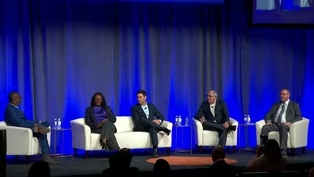
NewCreating a more prosperous Detroit region
Video has Closed Captions
Clip: S54 Ep14 | 12m 12s | A discussion from the Detroit Policy Conference about Michigan’s education concerns. (12m 12s)
Providing Support for PBS.org
Learn Moreabout PBS online sponsorship
- News and Public Affairs

Top journalists deliver compelling original analysis of the hour's headlines.

- News and Public Affairs

FRONTLINE is investigative journalism that questions, explains and changes our world.











Support for PBS provided by:
American Black Journal is a local public television program presented by Detroit PBS