
Neon, Stained Glass, Mosaics: Hidden Backdrops of SoCal
Season 9 Episode 3 | 29mVideo has Closed Captions
Hidden in plain sight, neon, mosaics and stained-glass shaped Los Angeles’ backdrop.
Art is everywhere in Los Angeles, even in places you might overlook. From the century old Judson Studios to glowing neon signs and a massive mosaic saved from demolition, Nathan traces how artists and craftspeople have shaped the city’s visual identity across generations, revealing how art, design, and architecture intersect across Southern California.
Problems playing video? | Closed Captioning Feedback
Problems playing video? | Closed Captioning Feedback
Lost LA is a local public television program presented by PBS SoCal
Neon, Stained Glass, Mosaics: Hidden Backdrops of SoCal
Season 9 Episode 3 | 29mVideo has Closed Captions
Art is everywhere in Los Angeles, even in places you might overlook. From the century old Judson Studios to glowing neon signs and a massive mosaic saved from demolition, Nathan traces how artists and craftspeople have shaped the city’s visual identity across generations, revealing how art, design, and architecture intersect across Southern California.
Problems playing video? | Closed Captioning Feedback
Where to Watch Lost LA
Lost LA is available to stream on pbs.org and the PBS app.
Providing Support for PBS.org
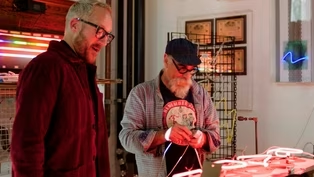
Learn Moreabout PBS online sponsorshipPaul Greenstein: Now, there's no guarantee that this will work because I have never tested this sign out.
Hey!
It works.
Nathan Masters: Whoa!
Ha ha!
Mary Platt: This mosaic is 40 feet wide, 60 feet tall.
Nathan: Yeah.
Mary: It weighs about 3 tons.
Nathan: Three tons?
Mary: Yeah.
Nathan: And I'm sure it did not travel in one piece.
Mary: No.
David Judson: Kind of hold it at a vertical.
Nathan: A vertical.
David: Yeah.
And then press it down.
There.
Now, there it is.
[Clack] Oh, that sounded good.
[Snap] Both: Oh!
[Laughter] [Music] Announcer: This program was made possible in part by a grant from Anne Ray Foundation, a Margaret A. Cargill Philanthropy, the City of Los Angeles Department of Cultural Affairs, and the Roy + Patricia Disney Family Foundation.
Nathan: Most of us move through Southern California without really seeing it.
Not the landmarks--those are hard to miss--but the artistry woven into the everyday fabric of the city--terrazzo sidewalks, terra cotta cladding, the ornate ironwork of a century-old streetlight.
The visual backdrop of Los Angeles is richer than you might realize, and the people who made it that way deserve to be seen.
Let's start with the brightest thing in the room.
For decades, Los Angeles laid claim to a proud piece of neon history.
In 1923, as the story goes, a businessman named Earle C. Anthony installed two glowing signs in downtown L.A.
to advertise his Packard car dealership--the first neon signs in America.
Neon enthusiasts Dydia DeLyser and Paul Greenstein decided to go looking for the evidence.
Dydia DeLyser: I just started looking everywhere-- at UCLA in the geography department.
I knew about the Air Photo Archive, so I went there because this sign supposedly was on the roof of a building at the corner of 7th and Flower.
Nathan: After layering aerial photographs of the same location taken over successive years, Dydia discovered no evidence of a neon sign at that corner until 1925.
Dydia: So it's not the first one.
It's not in 1923.
Nathan: Well, who was first?
Dydia: Ingersoll.
Nathan: OK.
Ha ha.
Dydia: They were a lot earlier.
This is a replica of the first commercial neon sign anywhere in the world.
Nathan: And it wasn't in L.A.
Dydia: And it wasn't in Los Angeles.
Nathan: Ohh.
Ha ha.
Dydia: This was made in Newark, New Jersey in 1909.
Nathan: 1909!
So it's not even close.
Dydia: It's not even!
So it doesn't even matter if it's '23 or '24 or '25.
It's not even close.
Nathan: So you dispelled this myth, but I don't know if the internet has noticed, because if you Google "first neon sign in America," it says "The first neon signs in America were two Packard signs installed by Los Angeles car dealer Earle C. Anthony in 1923."
That's right.
That's the Google AI overview.
Dydia: So the AI plagiarist is still drawing from all those same sources.
It's incredibly difficult to overturn a myth that has been so widely established.
And now AI is making that even harder.
Nathan: Old myths die hard.
But even if Los Angeles wasn't the first to embrace the glow, it did more than make up for lost time, ultimately earning a reputation as the city of neon.
The collections of Glendale's Museum of Neon Art make a pretty compelling case.
Neon is something that has become part of the visual fabric of the city.
It still is today, and yet it's something that it really pops, right?
Its bright color.
And yet sometimes we don't take notice of it.
Like, how is that possible?
How can you square that circle?
Corrie Siegel: Yeah, it's such an interesting thing because it's highly visible.
It's designed to be visible, but it also has become so much a part of our lives that it kind of disappears in plain sight.
Nathan: There is this common misconception, or we could say myth, that Los Angeles was the originator of neon in the United States.
Corrie: Los Angeles is in many ways associated with neon.
We came of age when neon was really kind of the height of technology, the height of class.
We have a lot of neon from there.
Nathan: So I see some signs around here.
Some of these are spectacular.
Some of them seem to represent some of the more pedestrian ways we see neon.
I mean, you'll always see these "vacancy" or "no vacancy" signs.
And then I think probably the most common neon sign that I see at least are beer signs, right?
I love that here you have an old classic and sadly retired L.A.
beer brand, Eastside.
Corrie: Yeah, yeah.
So if you're familiar with the Brewery Art Colony, that's where Eastside Beer comes from.
So that's pretty exciting that we have that piece of L.A.
history.
Nathan: I take it that this is one of the older signs that you have.
Corrie: Yes.
So this is a sign from the 1920s from Lincoln Market.
It was in Pasadena.
It was a Japanese-American establishment.
Nathan: And what is distinctive about this sign that tells its age?
Corrie: When this sign was built, it was-- neon was really classy, and you would sort of gild the edges of it, basically.
So we have all these like, flourishes here, and then the text itself is raised from the sign.
So in the 1920s, they thought, "OK, how do we make our signs visible?
We're going to build them out so you can read them."
But then as time went by, they realized, "We can just paint it, and it's visible enough."
Nathan: The people who made these signs, were they thinking that they were making public art, too?
Corrie: There was a lot of pride in the people that made these signs.
And even when we take down a sign, people will stop by and they'll say, "My grandpa worked on this"; "I know someone who knows someone who worked on this."
So it becomes this collective art piece.
They're creating some of the biggest monuments we have in Los Angeles.
And it's this kind of humble, you know, maybe just to advertise food or something like that.
But it gives meaning to a neighborhood and to a community.
And also, a lot of immigrant communities asserted their Americanness, their contemporariness by having neon signs.
It became part of each person's identity.
Nathan: And you have other examples of that around here, too?
Corrie: Definitely.
So we have a really strong collection of neon from Little Tokyo, and I can show it to you if you want a peek.
Nathan: Yeah.
Let's take a look.
Yeah.
Corrie: Both of these signs are from Little Tokyo.
We have Matsuno Sushi, which is, some people say it was the first sushi restaurant in the United States.
Nathan: Oh, wow.
Corrie: I love the aesthetics of the sign.
Nathan: So neon sort of arrived with a bang, and it was a big phenomenon.
You'd see it all over the city, but eventually it kind of went out of fashion.
Corrie: That's right.
There's a lot of different reasons for that.
One is during World War II.
Because there were air-raid fears, a lot of signs were turned off, and neon can last for a really long time.
It can last for over a hundred years in the tube.
But the transformers, they don't last as long.
So when World War II ended, there's a lot of flickering signs.
You can think about noir film, "It's a Wonderful Life," these people with a Mid-Atlantic accent thing.
You can tell by the look of the place, there was no good in the flickering neon.
So there's that aspect and association.
Alongside that, there is also this boom of neon.
So after World War II, a lot of people took the G.I.
Bill and they learned how to make neon signage, because neon was a pretty reliable way to make income.
Even during the Great Depression, the U.S.
government actually incentivized making your storefront modern, and they paid for people to do neon projects.
So a lot of soldiers came back from the war and they thought, "Oh, this is like, this is an honest living that I can make for my family.
I'm going to learn how to make a neon sign."
So neon signs exploded, but also connotations with Las Vegas and nudie clubs and gambling.
So there became this association with urban decline and immoral behavior, and the landscape became kind of moralized and seen through this lens that neon was trashy.
Nathan: And some municipalities even banned neon?
Corrie: Yes.
So there is the American Beautification Act, which, across the United States, was interested in taking down specific forms of signage.
And many different municipalities banned neon, including Glendale.
Glendale was a huge neon city.
You look at old historic photographs, and it's a fantasy of neon light.
But all that was taken down in the '80s.
Nathan: And irony of ironies, we're here in Glendale in the museum that celebrates neon.
Corrie: Yeah!
Nathan: But it's come around a bit, right?
I mean, is it experiencing some sort of a renaissance?
Corrie: Yeah.
I think one thing that happened that I think is really beautiful, it's about the way we see history and about the power of artists, is in the 1980s, and actually, even before that-- '70s and '60s-- artists were seeing that neon was becoming maligned.
So artists like Bruce Nauman and Mario Merz, other people were using it to say something about their place within culture.
And also a lot of people in counterculture, a lot of people in the LGBTQ community were embracing the signage that was sort of being discarded.
And that's when Melrose came into being.
So the "War Baby" sign behind you, that was from a boutique in Melrose.
So neon became punk, neon became counterculture.
Neon became cool because it was not cool.
And artists started taking and saving it.
So that's the origin story at the Museum of Neon Art.
A bunch of artists, a bunch of outcasts that saw something that was being forgotten by culture, and they wanted to save it.
Nathan: Before it became an urban spectacle, neon was a laboratory curiosity, a gas so rare, it took decades to harness.
And it's a story that begins more recently than you might expect.
When was the gas discovered?
Paul: The gas was discovered in the late 1890s by these two scientists, but it was so hard to process that it was really, really, really unavailable.
Nathan: It's interesting, though, that this is a gas that in some ways is part of just the visual fabric of the 20th century, right?
Neon.
It's hard to imagine the 20th century Both: without neon.
Paul: Yeah.
Nathan: But it wasn't discovered until the 1890s.
Paul: The rise of neon is in conjunction with the rise of cars... Nathan: Right.
Paul: which is the 1890s.
Nathan: Yeah.
Paul: So it's around the same time.
So they both kind of fed off of each other.
Nathan: A happy coincidence in some ways.
Paul: Yeah, yeah.
What we have here is we have a sign that's probably from the early '30s.
It says "Radio," and you see it has a big radio lightning bolt through it.
Nathan: I love that lightning bolt.
Yeah.
Paul: Isn't that cool?
It's really a nice one.
Meanwhile, what I've brought is I've brought a repaired piece of glass.
Nathan: Ooh!
Paul: And if you don't mind doing a little do-si-do.
Nathan: Yeah, let's do it.
Paul: Let's switch it over.
Nathan: OK.
Paul: OK.
I'm going to ask you to put your hand right here and hold it.
Nathan: Right here?
Paul: Yeah.
Nathan: OK.
Paul: And I'm going to wire this one up.
Now, we're gonna do-si-do again.
Let's switch sides.
And we're gonna do the same thing over here.
Nathan: This is not plugged in right now.
Paul: This is not plugged in right now because you'd see me dancing.
Nathan: Ha ha!
Right.
Paul: Because this sign is really old, originally, the connectors were made with things called a Fahnestock clip, which radio people will know what that is.
It's a little spring clip that connects wires.
So we're using copper wire.
Some people use steel.
Copper is the only thing that really works well.
You make a loop.
So you're going around the ear on the... Nathan: Oh, like that.
Paul: Yeah.
Now, you cross over with the long one.
Now, just as a kind of a bellwether, these type of glass stands were invented in 1927 in Long Beach, California.
And they are still in use today.
Nathan: Wow!
Made to last, huh?
Paul: Made to last.
Now, there's no guarantee that this will work because I have never tested this sign out.
Hey, it works.
Nathan: Whoa!
Ha ha!
Paul: It's just electrons moving, and that's what we see as light.
Nathan: So the electricity is just exciting the gas inside.
Paul: Correct.
Nathan: Yeah.
Paul: It shouldn't ever leak.
Nathan: Yeah.
Paul: Theoretically, this is good for 100 years, 200 years, 300 years.
Nobody knows.
Now you've fixed your first neon sign.
Nathan: Yeah.
All right!
Thanks for letting me have a hand in it.
Paul: No problem.
Nathan: Neon announced itself.
It was designed to be seen, to dazzle, to demand attention.
The art of Millard Sheets took a different approach.
Embedded in the walls of neighborhood bank branches across California, it waited quietly for someone to look.
Mary: So I'm going to take you across the street here so we can get the full effect of this amazing, very large Millard Sheets glass mosaic.
Nathan: Yeah.
It's big.
Yeah, we got to take it all in, right?
Mary: It owns this space, I'll tell you that.
Nathan: It does.
Scattered across Southern California on busy boulevards and strip malls, on street corners you've passed countless times are monumental works of public art by an artist most people can't name.
The Home Savings & Loan mosaics were commissioned by banker Howard Ahmanson, who believed that art could anchor a financial institution in its community.
The artist was Millard Sheets, the leader of a Renaissance-style workshop of designers and craftsmen whose collaborations transformed neighborhood bank branches into vivid histories of the places they served.
So Millard Sheets, he might be, you know, at the same time, the best known but also the least known artist in Southern California.
Mary: Right.
Nathan: I mean, like, everybody knows his work, but very few probably know his name.
Mary: That's true.
And we're doing our best to change that here at the Hilbert Museum.
We had an amazing opportunity to rescue this mosaic from its original place in Santa Monica at the old Home Savings building there, where it was beloved for many years.
This was a building that was being repurposed.
The owner wasn't sure if he was going to tear it down or turn it into something else.
And so the opportunity came up for somebody to take this mosaic.
And there's very few places that can really rescue-- This mosaic is 40 feet wide, 16 feet tall.
Nathan: Yeah.
Mary: It weighs about 3 tons.
Nathan: Three tons?
And I'm sure it did not travel in one piece.
Mary: No.
If you look closely at it, you can kind of see puzzle pieces cut through it, so it didn't come down in millions of pieces.
It came down in larger pieces, but there were still over 500 of those.
Nathan: Sort of like jigsaw pieces.
Mary: A jigsaw puzzle.
Nathan: Yeah.
Paul: And, you know, many times when they're moving a mosaic, they'll cut it just in a grid.
But that destroys a lot of the tiles.
Nathan: Right, right.
Mary: 'Cause these were all little glass tiles from Italy.
They're Murano glass.
So our guy, Brian Worley, who actually had worked on the original installation of this mosaic in Santa Monica as a teenager, came back in his 70s... Nathan: Wow.
Mary: to work on the reinstallation of it here.
Nathan: So Howard Ahmanson, he was the head of the Home Savings & Loan.
It was a major banking chain.
Mary: Yeah.
Nathan: And he wanted to promote public art, but it was also genius branding, right?
Because now the Home Savings branches are instantly recognizable.
Mary: Yeah, that's what he wanted to do was, like, show people "We're part of your neighborhood," you know?
And so if it's Fullerton or if it's Anaheim or if it's, you know, any number of places in Los Angeles, you know, it would reflect their history.
Sometimes it would be about their history, sometimes it'd be about what's going on today.
Nathan: The range of stories these mosaics tell is remarkable, and they are, almost without exception, celebratory ones.
At Sunset and Vine in Hollywood, Sheets wove together the romance and imagery of early filmmaking.
On Harbor Boulevard in Anaheim, he traced the city's roots in orange groves and old California, and the reach of Sheets' work extends beyond Southern California entirely.
In San Francisco, his sweeping composition at Van Ness and Lombard takes in everything from the city's native roots to its modern skyline.
Mary: You know, this one, obviously, is just people having fun on the beach, which is you can't get more California than that.
It was so appropriate for Santa Monica.
Many people said this was their favorite of the mosaics that he did.
Nathan: Yeah.
Mary: And it certainly is one of the larger ones.
He thought it was a little too large for the building it used to be on.
Nathan: I read an oral history where he said this was one of his lesser favorite buildings, right?
Mary: Yeah.
He thinks the people, you know, were a little stiff-looking.
But also, his main complaint, I think, was that it just kind of overwhelmed the building that it was on on Wilshire.
Nathan: We often, as shorthand, refer to these as Millard Sheets works.
Mary: Right.
Nathan: But there was actually this entire studio or company of artists and artisans and craftsmen behind this.
Mary: You know, Millard and his workshop, he almost had, like, a Renaissance workshop of artists and designers and stained-glass designers and sculptors working with him on all of these Home Savings projects.
There were over 160 of them... Nathan: 160?
Mary: ...throughout California and also in other states.
He would do the designs, and then Susan Hertel or someone would actually translate it into stone, and then other people would put it together.
He was really looking at how does color play into what people are seeing and how they're taking the scene in and leading the eye around the painting.
And here he's leading the eye, like, really across the surface of the whole 40 feet of this mosaic from the sailboats over here to the rocks.
He's guiding your eye across it, and he was just a master at doing that.
Nathan: And they all-- or most of them, they told stories.
They told stories about the history of the site.
Mary: Yes.
Nathan: Now, so these were made in the prior century, what youngsters might call the 1900s.
right?
Right?
Mary: Yes.
The 1900s, way back.
Nathan: But, you know, the way we tell history has changed since then.
I wonder, like, are any of these becoming outmoded in the stories they tell?
Mary: Well, I mean, I think that as a person of the mid-20th century, you know, he was sort of working in that mode.
And maybe today we want to see more people of color in the mosaic, and I think an artist today would do that.
Nathan: Even while this might be a restoration success story, we could look at it as a preservation failure, right?
I mean, this came from a historically-protected building, and this was a historically-protected artwork.
Mary: It was installed in Santa Monica in 1969.
And unfortunately, that's around the time period where California buildings start being looked at as being old and "We got to move on."
Nathan: So art forms and styles, they have these cycles, right?
Like, neon arrived with this bang.
It was flashy and everybody loved it.
And then it kind of faded into, well, general distaste among the public, right?
It was out of fashion.
Have you seen that same sort of cycle with the Millard Sheets works?
Mary: The mosaics are enduring, and I think they're classic.
And I think, you know, unlike things like neon, is going to go in and out, I think, of fashion, but mosaics and murals endure.
And particularly here in Los Angeles, you know, we're kind of a city of murals from the Chicano murals that we have and, of course, these iconic pieces.
And sometimes they're fleeting.
You know, sometimes they're up for ten years and then they get painted over.
And that's unfortunately, part of art history, too, is we lose them.
And so we're in the business of keeping them.
Nathan: Yes.
These should really be preserved in the places where Millard Sheets put them.
Mary: In a utopian world, yes, they would be.
And we were happy that we could--we were able to step in and sort of rescue this one.
Nathan: So that backdrop that we grew up with in Southern California, you know, future generations will also experience.
Mary: They will experience it, and hopefully, it won't disappear completely.
Nathan: The Sheets mosaics are a mid-20th century phenomenon born of a particular moment in L.A.
's history, when a banker and an artist decided that monumental art belonged in everyday places.
At Judson Studios, the tradition runs deeper.
More than 125 years old, it predates the Hollywood Sign, the freeways, and almost everything else we associate with modern L.A.
David, hi.
David: Hey, Nathan.
How are you?
Nathan: Thanks for having me.
Good to see you.
David: Thanks for coming.
Nathan: The building is amazing.
David: Yeah.
Thank you.
I say it's Californian.
It's a little mix of everything.
Nathan: Yeah.
In the 1890s, a portrait painter and art teacher named William Lees Judson came to Southern California seeking better health and found his home.
Along the Arroyo Seco between Los Angeles and Pasadena, a thriving community of artists and craftsmen had taken root, and Judson fit right in.
In the Arroyo-adjacent village of Garvanza, now known as Highland Park, Judson helped establish USC's College of Fine Arts and served as its founding dean for more than two decades.
Judson is best remembered, though, for the stained-glass studio he founded with his three sons in 1897.
When the art school relocated to USC's main campus two decades later, the glassworks moved in, and the building's been known as Judson Studios ever since.
I met up there with David Judson, the fifth-generation steward of his great-great-grandfather's legacy.
So you have corporate archives here going back quite a ways.
David: We moved in here in the 1920s.
So our records are kind of a little sketchy before 1920.
Initially, we used logbooks, and then we kind of moved to files late '20s, early '30s and then after the war.
My grandfather was a very good record keeper.
These are a little bit of the earlier ones.
Nathan: Wow.
This looks quite old and fragile.
David: So this is the ledger.
Yeah.
And so rather than keeping files-- this is basically kind of the accounting.
And so you never know what you're gonna find in here.
So here you can see, um, Grauman's Theatre in July of 1923.
Nathan: OK.
Yeah.
David: And then right below Grauman's Theatre... Nathan: "Charles Chaplin"!
OK.
Judson sort of represents this older L.A.
culture that, I guess, in the popular imagination was in some ways supplanted by the arrival of the movie industry.
But there's a connection here between those two.
David: Absolutely.
If we go to 1925, we have Mabel Ennis from the Ennis House, Frank Lloyd Wright's Ennis house.
Nathan: Yeah.
David: And we have Barnsdall... Nathan: Oh, yeah.
David: which is the Hollyhock.
So it's kind of fun to be able to look through these.
Yeah.
Nathan: So if there was some question about whether there's this piece of stained glass, so did Judson Studios do that, even if you don't have, like, a file on it, you could actually find an entry in here and suppose reasonably, with some reasonable certainty, that, Oh, you were involved with it.
David: You would need to know exactly the owner, who the owner was, and what year it was, right?
And that's when our earlier, the logbooks, these are very specific.
So it can be a little tricky to track it down.
Nathan: Sure, sure.
David: Yeah, we stumble upon these old records and find really interesting things.
Nathan: In some ways, you could say that Judson stained glass is just hiding in plain sight all around us in Southern California, right?
It's not just churches.
It's places where you might not expect it, like movie theaters, on Broadway.
It's obviously such a visually arresting artwork.
So how is it that it sometimes goes unnoticed?
David: Well, it's part of the fabric, right?
And oftentimes if you don't notice it, it's kind of doing its thing, right?
It just feels like the aesthetic of the space that you're in.
And so... Nathan: It's woven into the fabric of our surroundings... David: Exactly.
Nathan: of the buildings that we inhabit.
David: Exactly.
And so the idea is that it's kind of a continuous design that blends in with all the materials of a structure or, you know, whatever a designer was doing or the architect.
They want that to kind of feel like it's part of the building.
But if you've lived in Los Angeles and you've seen a lot of buildings, you've definitely seen Judson Glass.
Nathan: Where else are you going to see Judson stained glass?
David: Yeah.
So you can see it at the Natural History Museum.
So there's a major dome.
The library.
So we did the globe that's in the Central Library downtown.
It's pretty prevalent everywhere.
Nathan: Judson Studios is part of what we might call the Arroyo culture, or I think what Robert Winter called it the Arroyo Set, right?
David: I think the Arroyo Guild was really kind of set up to kind of support each other.
This idea that you could make your living by making things by hand was really still, even then, kind of a struggle.
Nathan: Yeah.
David: And so I think that was as a way to kind of support each other and also live a life that they felt was kind of representative of contributing something to the environment and to their own personal lives and that kind of thing, drawing on this William Morris philosophy of that not only should it be beautiful but it should be practical as well.
Nathan: Do you consciously try to carry on this legacy?
David: Yeah.
I think that's what we're kind of leaning into, this idea that things are still made by hand here, right?
We could put you to work here and try your--You want to try--?
Nathan: I mean, I have zero experience, but please.
It sounds amazing.
Thank you.
David: Let's try.
Nathan: So I'm a complete novice.
I've never even really touched stained glass before.
David: OK, so cutting glass is fairly straightforward.
You're basically going to scratch the surface of the glass.
So you're not cutting the glass.
You're scratching it.
Nathan: OK.
David: OK?
So you just start.
You want the screw facing out.
Nathan: OK.
David: OK?
And then you're just going to press down with as much pressure as you feel, like, comfortable with.
Nathan: OK.
David: And then just pull it down all the way across the other side.
Nathan: Am I holding that correctly or...?
David: You put it in between these two fingers.
Nathan: Ah.
Like that?
David: Yeah.
There you go.
There you go.
Nathan: This feels awkward.
David: It is awkward.
It takes a long time to get used to, but... Nathan: And I hold this down?
David: Yep.
Hold that.
Kind of hold it at a vertical.
Nathan: A vertical?
David: Yeah.
And then press it down.
There, now--there it is.
[Clack] Oh, that sounded good.
[Snap] Both: Oh!
[Laughter] Nathan: It's kind of like magic.
I love it.
David: Amazing.
Well, that's a good--good-- good first attempt.
Nathan: OK.
Ha ha!
[Music] David: So back here is where we keep all the glass.
Nathan: There's a lot of glass.
David: Ha ha!
So yeah, like I said, we have about 600 different kinds of glass that we keep in stock.
Nathan: This doesn't look brand-new.
David: No.
Ha ha!
This window came from a church in Hawaii, believe it or not.
Nathan: Wow!
David: Yeah.
Nathan: This had to travel across the Pacific to get here.
David: Exactly.
A little salty.
This is an old Belgian window.
It's a little over 100 years old.
Nathan: OK.
So when you restore it, you completely get rid of the lead.
I mean, that's actually the most important part of the restoration, right?
You're replacing the lead.
David: Exactly.
Yeah.
Because we don't have a drawing, we take a rubbing of it.
So by taking a rubbing of it, it'll show us exactly where the lead lines are.
And we annotate it, obviously, for all the sizes and that kind of thing and any breaks that--you know, so if there's a piece of broken glass, we can address that.
We want to keep as much of the original material as possible.
Nathan: So about 100 years is the lifespan of a...?
David: Yeah.
Nathan: So now this will be good for another 100 years in Hawaii and then... David: And hopefully, longer.
This is the oldest part of the building, and it's a good place to be in the summer because it's underground.
And now we're doing what we call cementing the window.
It's waterproofing it, and then it's also patina-ing the leads and the solder.
This is the last room.
Nathan: So this is really the last step, though.
You gotta get it out of here and you got to get it to where you're gonna install it.
David: A lot of times, we're doing the installation, and if we're not installing it ourselves, we're often training folks to do it.
Yeah.
Nathan: Because this is very specialized knowledge that-- you don't find a lot of outfits that are gonna be able to do this.
David: No.
Nobody wants to touch it.
[Laughter] Nathan: Right.
David: At a construction site-- new construction-- they don't want to see us until they're basically leaving.
Nathan: Yeah, yeah.
David: So we're usually the first ones in to get it out if it's restoration and the last ones in to install it.
Nathan: Wow.
Your trucks must have pretty good suspensions, huh?
Nathan: Yeah.
Exactly.
Nathan: Yeah.
OK.
You invest in that.
David: And lots of cushion on the bottom.
Ha ha!
Nathan: Yeah.
Yeah.
The work of Judson Studios today is essentially the same work David's great-great-grandfather took up in 1897.
That continuity, that insistence on making things well by hand for the long run is what links a Judson window to a Sheets mosaic and to a neon sign saved from a Glendale parking lot.
The backdrop has been there all along.
We just have to know where to look.
Until you set foot in a neon museum, you don't realize how loud neon can be.
Corrie: That's true.
Yeah, you're hearing that hum and the animators.
[Music] Announcer: This program was made possible in part by a grant from Anne Ray Foundation, a Margaret A. Cargill Philanthropy, the City of Los Angeles Department of Cultural Affairs, and the Roy + Patricia Disney Family Foundation.
Neon, Stained Glass, Mosaics: Hidden Backdrops of SoCal
Video has Closed Captions
Preview: S9 Ep3 | 30s | Hidden in plain sight, neon, mosaics and stained-glass shaped Los Angeles’ backdrop. (30s)
Providing Support for PBS.org
Learn Moreabout PBS online sponsorship










Support for PBS provided by:
Lost LA is a local public television program presented by PBS SoCal