
June 26, 2026
6/26/2026 | 55m 54sVideo has Closed Captions
Bojan Pancevski; Wafa Mustafa; Waad Al-Kateab; Cal Newport
The WSJ's Chief European Political Correspondent Bojan Pancevski reveals the inside story of "The Nord Stream Conspiracy" in his new book. Co-directors of "Maybe Tomorrow" Wafa Mustafa and Waad Al-Kateab join to discuss their new film about the search for lost loved ones in Syria. Prof. Cal Newport unpacks why he thinks the AI industry is "doom trolling."
Problems playing video? | Closed Captioning Feedback
Problems playing video? | Closed Captioning Feedback
June 26, 2026
6/26/2026 | 55m 54sVideo has Closed Captions
The WSJ's Chief European Political Correspondent Bojan Pancevski reveals the inside story of "The Nord Stream Conspiracy" in his new book. Co-directors of "Maybe Tomorrow" Wafa Mustafa and Waad Al-Kateab join to discuss their new film about the search for lost loved ones in Syria. Prof. Cal Newport unpacks why he thinks the AI industry is "doom trolling."
Problems playing video? | Closed Captioning Feedback
Where to Watch Amanpour and Company
Amanpour and Company is available to stream on pbs.org and the PBS app.
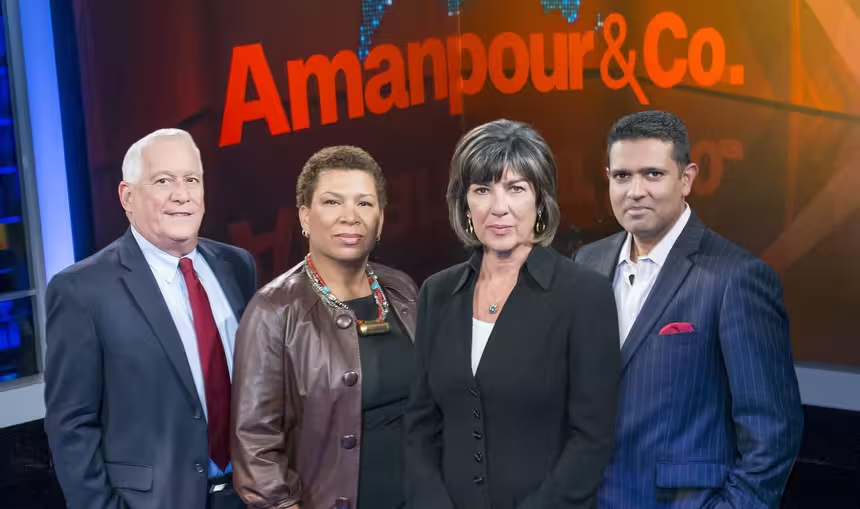
Watch Amanpour and Company on PBS
PBS and WNET, in collaboration with CNN, launched Amanpour and Company in September 2018. The series features wide-ranging, in-depth conversations with global thought leaders and cultural influencers on issues impacting the world each day, from politics, business, technology and arts, to science and sports.Providing Support for PBS.org
Learn Moreabout PBS online sponsorship>> Hello, everyone, and welcome to Amanpour & Company.
Here's what's coming up.
>> If one bomb explodes, the mission will be incomplete.
They have to lay eight bombs in total.
>> Ukraine takes the war ever deeper inside Russia.
And almost four years after the Nord Stream Pipeline sabotage, I speak to journalist Boyan Pancevsky about the shadow war being waged far from the front lines.
Then... I had a father.
He existed.
He lived with me.
I knew him.
And it's not just in my mind.
After Assad's fall, thousands of Syrian families are still searching for their missing.
Filmmakers Wafa Mustafa and Wired Al-Khatib speak to me about their powerful new documentary, Also ahead.
AI companies trying to convince their customers that the products that they are creating are potentially going to cause massive devastation.
Is the AI industry overselling fear?
Hari Sreenivasan speaks to leading computer science professor Cal Newport about the power of doom trolling.
(upbeat music) - Amanpour & Co is made possible by Committed to Bridging Cultural Differences in Our Communities.
And by contributions to your PBS station from viewers like you.
Thank you.
- Welcome to the program, everyone.
I'm Christiane Amanpour in London.
Summer is officially underway, but in Russian-occupied Crimea, residents are facing fuel shortages, rolling blackouts, and cancelled summer camps.
It is all part of a new phase in Russia's war as Ukraine expands its campaign into the invader's heartland.
A growing fleet of Ukrainian-produced drones is targeting the supply routes that keep Putin's war machine running.
Ukrainian officials say the goal is to isolate the Russian-annexed Crimean peninsula and make Putin's war difficult to sustain.
President Zelensky says the pressure is working.
"The majority in Russia is already complaining to Putin that his war has no end in sight.
All the current difficulties for the Russians should bring them closer to the idea that this is their war, and it is not just a stone from the sky, and that their war must end.
The expanded campaign comes after Ukraine launched its largest drone assault on Moscow since the war began.
And now, the Wall Street Journal reports the Kremlin is pressuring Belarus to open another front as Russia struggles on the battlefield.
And as this war increasingly resorts to sabotage and covert attacks on critical infrastructure, one of its biggest mysteries remains unsolved.
Shortly after the 2022 Russian invasion, explosions ripped through the Nord Stream gas pipelines beneath the Baltic Sea.
Investigators are still trying to figure out who was responsible.
Wall Street Journal chief European political correspondent, Boyan Panchevsky's thrilling new book, "The Nord Stream Conspiracy" reveals the inside story.
He tells me about one of the most consequential acts of sabotage in recent history, and the secret team most likely behind it.
Boyan Panchevsky, welcome to the program.
- Thanks for having me on.
- So this Nord Stream explosion, for anybody who's deep into the weeds of this whole big story, they'll remember it.
And even those not deep into the weeds, just remind us though, set the stage for what happened on that day when it basically exploded.
- This was the 26th of September, 2022, shortly after the beginning of the full-scale invasion of Ukraine.
And it was reported that the world's largest pipeline system, offshore pipeline system, had lost pressure.
And the next day, the footage, now iconic, was released by the navies of Sweden and Denmark, showing this gigantic kind of bubbling in the middle of the Baltic Sea and essentially signaling that the pipelines had been blown up.
So that was a literal explosion.
It was the greatest ever recorded man-made release of greenhouse gas into the atmosphere.
And it was a geopolitical explosion because this was a piece of critical infrastructure and extremely controversial at that because a lot of people opposed the construction of the pipelines because they believed it would make Western Europe and Germany in particular addicted to Russian gas exports.
Which to an extent we discovered that they were.
You write in the book it was arguably the greatest act of sabotage in modern history and you've just explained what happened.
The biggest release of greenhouse gases, a huge geopolitical shock and a political crisis over how to source energy.
What went through your mind the minute you heard about this?
What do you think?
Who'd done it?
- Well, essentially, I sort of really found out what happened on the second day when I saw the footage on my mobile phone.
And that's when I started working on the story, essentially, because I knew this was a sort of gigantic story.
It was obviously a sabotage, I think, from day one.
That was perfectly clear.
And interestingly, my first instinct was that it was the Ukrainians, which proved to be true later, as I found in my investigation.
But, you know, there were lots of theories kind of flapping around.
Some people were briefing to an extent intentionally that it could have been Russia.
So they were directing the media in the direction of investigating potential Russian authorship of this.
Others in the camp that doesn't really support Ukraine blamed the CIA.
There was a big story around whether or not it was the CIA.
It was kind of obvious it must have been a state actor.
So I had been reporting from Ukraine since 2014 from the front lines, but also from the capital, etc.
And I was intimately acquainted with the operation of Ukrainian special services and I knew exactly what they were capable of and how bold were they in their actions.
And I think that suspicion proved to be correct later on.
Tell me a little bit then about who you discovered were responsible for it.
How did they talk to you about it?
Well, the people who orchestrated and executed this operation were members of an elite unit of Ukraine's armed forces at the time.
The masterminds were veteran special services operatives.
They come from the intelligence services.
They had become embedded in the army during the full-scale invasion, and they and some officers around them kind of conceived the plot and the plan.
And eventually, they hired or rather recruited civilian deep sea divers, so-called technical divers.
These are people who can go down 100 meters below the surface to the bottom of the ocean to operate there to lay the mines onto the pipeline.
And the reason why they did this was because they couldn't find people with that skill set within the special forces.
As I found out in my research, it's actually a very rare skill set.
People like the Navy SEALs or the SPS in the United Kingdom don't really go to the bottom of the ocean.
They have different tasks, you know, put mines on ships or for the body of water.
So it was quite a challenge.
And in the end, they settled for what is known as proxies in the intelligence world, i.e.
people who are not trained, who don't come from the army or from the intelligence, but rather they are ordinary civilians with extraordinary skills and motivation.
Well, you know, it became known internally as Operation Diameter.
And amongst this team, you say, of course, were the four divers and a female diving instructor.
And you write that this female diver was perhaps the reason the attack was a success.
Why do you say that?
Well, this was told to me by her fellow crew members and her superior officers.
Essentially, she was the sole female member of the entire operation, of the entire team.
And she's an extremely experienced deep sea diver and an instructor, diving instructor.
She had worked all around the world and she's extremely bold and a strong character and there was a point where they ran into a storm during their mission in the Baltic because the mission unfolded in the latter part of September 2022 when the weather is pretty unpleasant at times in the Baltic and there was a gale force storm and the crew kind of voted to abandon the mission because they felt it was already a case of risking their lives and they thought this was becoming too dangerous.
They had to do something already life threatening and then the storm was an extreme kind of hazard.
And the woman kind of motivated the men on board to actually persevere because she I think told them that she could do it herself if they would let her and they don't really have to go down, etc.
And so they felt kind of, I presume, embarrassed.
And, you know, she was a great motivator in that she showed a bit of leadership.
That's the account that was shared with me from different sources on the boat and also the people in the headquarters.
So in that sense, she did JMX.
And what they thought, Boyan, when she said, "I'll go down on my own," you write that this female diver was perhaps -- well, not just that it was successful, but that she was incapable of fear and everything else, and described as positively mad.
So you've just explained why that -- how that is.
So, in this unbelievably hostile environment, climate-wise, just describe to us the mechanics.
They went down.
Where is the pipeline?
Is it on the bed of the -- is it dug into the seabed?
And what did they have to do, the human effort, to get it disrupted?
Well, the pipeline is -- runs over -- almost over 1,000 miles beneath the Baltic Sea.
It connects Russia and Germany.
And the operation -- I mean, the bombs were laid at a depth of around 80 meters.
To go down at that depth, you require a special skill set and the ability to breathe a different mixture of gases, because breathing oxygen at that level is actually toxic for the human body, so you have to add nitrogen and helium, etc.
And of course to operate on that kind of pressure, you have to imagine the surface of the water is extremely troubled in the sea.
They used a small sailing yacht, which was thrown around by the gale force wind, and then they had to dive in that environment.
The Baltic Sea is extremely polluted, and because of various reasons, the water is kind of dark and opaque and obscure, and you can't really see too far.
At the very bottom, there's pitch black darkness, and you can only see as far as your kind of torch light allows you to.
Essentially, you can just about extend your hand and you can see that far.
So it's absolute darkness.
You know, you can imagine claustrophobic and pretty horrible and then you're breathing in this mixture of gases and you have and the clock is ticking, right?
They couldn't spend more than around 20 minutes at the bottom because the period of climbing up then extends exponentially.
There is a period called decompression.
They have to slowly, slowly, slowly come up back to the surface.
So once you're down there, the clock is ticking.
And you can imagine the stress levels, you know, the cortisol levels of these people.
So it was quite a feat.
And then you have to kind of stick the bomb onto the pipeline.
And it was a kind of complicated contraption and ultimately activate the timer.
And once they activated the first timer, the very first bomb, then the clock was really ticking.
They didn't have, there was no way back because one bomb, if one bomb explodes, the mission will be incomplete.
They had to lay eight bombs in total.
Wow.
I mean, it just seems so incredibly, as you describe it, so difficult and so personally stressful.
But this is, you know, we haven't got to the why yet, and you're going to tell me about the why, but this Nord Stream has been controversial even before the full-scale Russian invasion.
We know that every administration since George W. Bush's second term opposed its construction.
Biden promised to bring an end to it if Russia attacked Ukraine.
You remember President Trump was scathing about Angela Merkel's red light or rather green light towards Nord Stream, etc.
Poland, the UK didn't much like it.
That was because they thought it gave, it had them over a barrel, right?
Putin had them over a barrel.
- Well, essentially they believed that Nord Stream was a geopolitical project rather than a commercial project.
The former Chancellor Angela Merkel maintained that this was a purely commercial project.
It's part of the private economy.
There's no need to worry.
And it provides cheap gas for Europe's biggest industrial powerhouse, Germany.
And in fact, it did work like that.
So in a sense, both parties were right in the end.
In my book, I described the explosions as a kind of a crescendo of 20 years of policy and policy debate that went down with smoke, both with the attack on the pipeline and the full-scale invasion, because the idea behind the pipeline, really, from a German perspective, was to make... you know, it was policy turned steel and concrete, because the idea was that if you become so entangled commercially with a formerly hostile power like Russia or the Soviet Union before, conflict will become impossible.
The idea was to remove that tension, that potential of conflict, by becoming economically intertwined.
But the people who actually blew up the pipeline told me it played the exact opposite role, because once you build this pipeline, you pave the way to war.
And Putin kind of launched a full-scale invasion, because he was convinced he can do whatever, the gas will keep flowing, the oil will keep flowing.
To an extent, he was right.
Even after the launch of the full-scale invasion, the European Union continued, and Germany, to buy hydrocarbons from Russia because it's a zero-sum game.
You can't just shift overnight when you don't have other suppliers.
So from that perspective, it's extremely interesting.
I found that both sides had a point, you know, like, you know, you could argue both sides.
- These guys obviously believe that they were heroes of the resistance against the war.
Tell me how they spoke to you about what they did, and crucially, and this is still sort of an open question, how much did the Ukrainian government know?
How about the head of the armed forces at the time, was General Zelensky?
How about President Zelensky?
What did they know and was it greenlit?
So the motivation first, it was pretty simple.
Their idea was to cut the revenues that the Kremlin was receiving from the sale of hydrocarbons that fed into the war chest of Vladimir Putin.
They felt that Russia is using the money it got from sales of gas and energy, etc., to fund the war on their territory.
So that was pretty straightforward.
The secondary motivation was to break the bond, the geopolitical bond, between Moscow and Western capitals, including Berlin, which was personified in a way embodied in this pipeline.
It was an operation of the military forces.
The highest ranking officer who approved the mission was indeed the then commander of the armed forces, General Valery Zelensky, who is now an ambassador to Great Britain.
President Zelensky denies knowledge of this operation.
He continuously denied knowledge in the past couple of years since the first news was leaked that Ukraine may have been behind this.
His advisors are also denying this.
People around General Zelizny say that General Zelizny did in fact brief at one point the President that this operation among many was underway.
So, you know, we may never find out.
General Zelizny may choose to speak about this publicly at some point.
We don't quite know.
But for the time being, you know, these people claim that the President was informed, but the President denies that in the strongest of terms.
But I think what is important to say, I spoke both to the people who carried out the attack, as well as with the German investigators who are hunting them.
And to an extent, my investigation was corroborated by the official investigation in Germany, and I believe a suspect has been apprehended by Germany, and they accuse this person of being involved in an operation.
And the German prosecutors will say this was an operation that was conducted on behalf of Ukraine.
It really is fascinating, and there's still sort of unknowns, but also the real split in how different nations view the two and the seven, well, the seven, the people, the whole team.
A lot of allies of Ukraine, you know, believe that, well, you know, they did what they had to do.
And actually, towards the end of your book, they talk about they would do it again.
And apparently, Putin has already this month said that the remaining intact pipeline could start pumping gas tomorrow.
And in your epilogue, the general, the man you name as a general, told you, "By all means, let them fix it so we can blow it up again."
Were you surprised when you heard that?
No, not at all.
I wasn't surprised at all.
That's the spirit that reigns in those quarters.
And I think it's absolutely true, and I know this from my own reporting, that as soon as the Trump administration started negotiating with the Kremlin over a possible settlement in Ukraine, the Russians brought up the issue of Nord Stream.
They publicly even spoke about it.
Sergey Lavrov, the foreign minister, very early on last year said that that's one of the conditions they're working towards, reopening the pipelines.
Putin recently said, as you said, that it only takes a press of a button to restart the intact one line of the pipe is still relatively intact.
It's only damaged, a little bit damaged.
Ultimately, the pipelines can be fixed.
There is a consortium of sorts in the United States led by American businessmen.
They seek to acquire the pipeline to kind of Americanize it, to make it an American company property in order to restart the gas trade.
So this saga is by no means over, and I don't believe that the Russians are ready to give up on this project.
Well, Bojan, it's fascinating.
And just to end by what an elder statesman of Ukraine's intelligence community told you, that the perpetrators will one day, they will be given the medals they all deserve.
So you can see how various different sides think of the people who did this.
And Boyan Panchevsky, thank you very much.
It's a really fascinating story.
It was my great pleasure.
Thank you for having me on.
Now Vladimir Putin is not only facing serious setbacks in Ukraine, he also lost a major ally when Bashar al-Assad was forced to flee Syria.
For the families of Assad's victims, however, the end of his regime has not brought the answers they need.
More than a decade ago, on this program, we broke the story of a Syrian military defector known only by the codename Caesar.
He had smuggled out thousands of images that provided some of the first irrefutable evidence of the Assad regime's systematic torture, starvation and execution of detainees.
Today, tens of thousands of Syrian families are still searching for their missing loved ones.
My name is Wafa Ali Mustafa.
I'm a Syrian journalist.
My father was arrested and forcibly disappeared by the Syrian regime.
I was shocked that this could be my life forever.
"Rebel forces in Damascus have declared the capital city free of long-time ruler, Shah al-Assad."
Now that is from the documentary "Maybe Tomorrow", a story of loss, love and of a daughter who refuses to let her father be forgotten.
I spoke with Wafa Mustafa and the acclaimed filmmaker Wadah Khatib about this powerful new film.
Wadah Khatib and Wafa Mustafa, welcome to our program.
Thank you.
Wafa, you were only 23 when your father was arrested and he basically disappeared and you were all forced to leave Syria.
We really see your spirit, his spirit through the film, but I wanted you to tell me a little bit about your father, what he meant to you, what he meant to the whole family.
Thank you so much for having us and for this opportunity to talk about my father, but also of course to talk about all of Syria's disappeared.
My father, Ali Mustafa, he was called Abu Samad by his friends, and you know Abu Samad comes from resiliency, and he was a very, very powerful, very tough guy, but he was also at the same time very kind.
He was a young man with big dreams.
He always fought for freedom and justice even before the Syrian revolution started.
He was a great lover.
He loved my mom in a very amazing kind way.
He taught us a lot, me and my two other sisters.
He taught us a lot about how much it's important to sacrifice for our communities, how to be selfless and how to believe that freedom and change are possible, even when they seem very, very impossible in a country like Syria.
>> And, Wad, you have been very well known not just for your daily reports for Channel 4 during the actual war by Bashar Assad, but then, of course, for "Sama," which was Oscar-nominated.
And it's a very personal journey that you recreate.
What made you, Wad, decide to take on Wafa's story, also in a personal sort of diary way?
Yeah, thank you so much again for having us.
I think I've known Wafa since we were both born.
Our both mothers were friends since they were at school and we've been very close to families, to each other.
We were born in the same city, raised up in a very similar situation.
And when I made For Sama, I think the first thing I thought of after the film was going around the world was really Wafa's story.
And I thought about it in the same way how I wanted to tell my own story and own it and be able to fight all the loss that we had through different ways.
So I contacted Wafa and I thought, let's do this together.
I believe that Wafa has a lot to say to the world and she will say it in a very different way.
But I thought through cinema and films we can do something a little bit different and hopefully it stays more to fight all this ignorance and waiting and also everything Assad was trying to do which really erased everything that was going on in Syria.
Your father, Wafa, apparently said, according to your mother in the film, "Write things down, document things so that your memory doesn't block things out."
Tell me about that.
What that meant to you, "Write things down, document them"?
To be honest, I was raised, like Waad said, in a similar environment, where both our families were quite political in a country like Syria, where politics could kill you easily, could cause you imprisonment for decades.
And my father, I would say, it took me years thinking about this question, why did he encourage us a lot to write and document?
I mean you can imagine at the beginning of the revolution, I was 21 and to be honest I thought, you know, I mean how long it could take, right, for a regime change.
I thought, you know, it will be maybe a few months maximum, a year, and the world cannot just turn a blind eye to what's happening to us.
And I think of course my father knew better because he was an older, right, an older fighter and he wanted us to keep the memory.
I think now I know very, very well how much my father believed in the power of memory and in the power of documentation and in the power of preserving the narrative.
And I think, you know, maybe I've tried to do that in different ways throughout the past years.
You know, I've been to the UN Security Council, to the UN General Assembly.
I've been to different protests.
I've been to different events.
But I think that, you know, when we thought about this film, I think one of our main goals was to preserve the narrative about what has happened not only to my father, because this is a reflection of what has happened to millions of Syrians and millions of people, not only in Syria, but in many other countries.
Now, the Syrian Network for Human Rights says that over 177,000 Syrians were disappeared between 2011 and 2025.
That is the years of war by Bashar Assad on your communities.
Some of this disappearing is actually happening right now as well, even under the new Syrian government.
And many Syrians think justice has been slow, and actually there's some pushback against even those who are trying to have accountability for what's going on under New Syria.
Wad, how do you describe what's happening in New Syria today?
I call it New Syria, but post-Assad Syria.
I think this is really very important for us because part of why we wanted this film to happen is really to talk about what has happened to Wafa's father and to many other people, but also to ensure that this should not have a space in the new Syria that we want to.
And we know, of course, from the states that's going on around, from what's going on, we're not even there.
And the fact that, you know, today in a new country where, like, as you just mentioned, post-Assad, like, this appearance and people who've been kidnapped, been, like, going around Syria in different areas by the transitional, like, government today, but also by other parties who are also, like, involved today.
And for us, it's really, like, the Syria that we hope to see is a Syria where it's equal, it's safe, it's-there's freedom of speech.
It's everything we've been chanting for since 2011.
And, you know, talking about this pain that the families are going through that no one else should go through, not in Syria, but also not everywhere around the world.
I think part of the issue today is that in-force disappearance is dealt with as if it's a crime of the past, but it's not in the past.
Not only because many people like me still don't know the truth about what has happened to their loved ones and their perpetrators are still unfortunately living their lives and not being held accountable.
But as you said, because new cases are happening and to be honest, I think what we wanted to say through this film is that to show what we call the violence of waiting that the families of the disappeared experience, hoping that it will contribute to the efforts that are advocating for ending in first disappearance once and for all.
Wafa and Wired, because you're obviously the filmmaker, there's a really good scene, I found it really, really good in terms of accountability and justice in that whole court process, where you Wafa are filmed sitting in front of many, many pictures of the disappeared, you know, at the time when your father, you didn't know what had happened to your father.
It was the first ever criminal trial brought over state-led torture in Syria.
It's in Germany.
It's from the year 2020.
And I want to play this clip because it's you engaging with the defense lawyers, i.e.
the lawyers for the guys accused of this state-sponsored torture and disappearance.
Here's this scene.
This is my father.
And today he completes 2,522 days in Assad detention centers.
I don't even know if he's alive or not.
All people who protested in Syria, this is what we want, actually.
Freedom, justice, and a state of law.
But I just, I hope that he didn't deny it all and say that there was no torture.
I just want him just to acknowledge that it happened.
>> So, listen, I'm really struck by that, because there you were confronting the defense lawyer and asking him at least to give you that dignity and not to try to, you know, deny that that had happened.
Now, I don't know what they did in court and whether those on trial admitted that there was torture, but in the trial, the former colonel was sentenced to life in prison, and a former junior officer was sentenced to four and a half years in prison.
He then was released afterwards in 2025.
That surely must give you some confidence in the justice system.
I think this is, to be honest, this is a very difficult question.
I mean, I don't know what the justice system is because, you know, for years we've hoped, of course, as you see, I mean, in this scene, I've, you know, I went to Copland's, I've advocated for the disappeared, I've wanted just, you know, this very technical process to have this, you know, human side and to be reminded of, you know, the faces and the names of the disappeared and thus make it more accessible for the families who are not even in Germany and who do not really know what's happening in Copland.
But for years we've advocated for justice to be, you know, taking place in Syria by Syrians, by national authorities, of course after the fall of the regime.
But today, to be honest, you know, the way the transitional government is, you know, is approaching transitional justice is not assuring for me.
It's very, very concerning.
And unfortunately, you know, I would say that in a year and a half, we had two massacres, and there is, you know, random killings in different places.
There are random cases of enforced disappearances, and there are, which is very, very dangerous, I would say, there are, you know, economic settlements with, you know, Assad businessmen and other perpetrators and war criminals who were involved with supporting the Assad regime.
So I think the justice system for me today is the families and their efforts and their voices and their determination to still fight despite all the change but also the lack of change.
Just to say, justice is very slow and everything you're desperate for is totally justified, should happen, but it's very slow.
But this month, a major trial has begun in Austria against two former Assad intelligence officials.
So, in some lanes, it is being taken very, very seriously, the issue of justice and accountability.
But finally, and of course I have stayed away from any spoiler alerts about what happened to your father.
What did you find out?
So I'm not necessarily asking you to give away the plot.
You decide between yourselves.
But there is some very powerful scenes at the very end of the film, where at one point you go in, you see all sorts of documentation, but you also see some traces of your father.
So you know he was there for that period of time.
I'm gonna first ask Wyatt.
I don't know whether you were there, I don't know whether you were shooting that, Wyatt, but in terms of storytelling and what happened, tell me about that, because it was really chilling and really very, you know, edge-of-your-seat moment.
Yeah, so thank you.
I mean, first, I wasn't there, unfortunately, and I wanted really to be there not for the film but also to be with my friend on such a really sensitive situation like that.
To be honest, like, while we were talking about the film and seeing what was going on, our friend who was with Wafa Filming, it was more about really how to reflect the reality of what Wafa and other families are going through through this experience, which is unfortunately no closure.
And that really was part of, again, the effort for the transitional justice and the accountability that we are asking for is for answers, for truth, for people knowing what happened.
And in the film, you don't really know what happened, because Wafa until now doesn't know what happened.
And the fact that you know how the film can and should reflect, you know, what these families are going through.
It's a way of like, like a love to her dad, but also like, hoping that you know, this continuous effort of looking and searching for people who cannot just like, you know, move on and let go like, like, these are their beloved ones, these are people who are like, lived with them in their entire life and they cannot just, you know, like, let it go without a real answer, a real accountability as well.
So Wafa, and we don't have these pictures, people have to see this film to see this dramatic denouement.
How did you feel when you found scratchings, essentially, words from your father on the wall?
Very surreal, to be honest.
I mean, even when we were in Sheffield and we premiered the film and I watched it, it was, I mean, it was very, it still had the same impact on me.
It's very surreal, to be honest.
I, you know, it's very difficult, you know, the level of, because enforced disappearance is mainly about, you know, about memory and it fights your brain, you know, like for years, because it was very painful, for years I've had to fight myself every day to remind myself that I had a father, he existed, he lived with me, I knew him, and it's not just in my mind, you know, it's not just in my head, it's that painful, it makes you, to be honest, it forces you to, like, it makes you question whether you're hallucinating or not, so seeing the writings and seeing his words, which were, like, very, very sad and very painful, but also full of love and, you know, full of, like, you know, I mean, it's just heartbreaking that, to see that, you know, he was thinking about us, because for years, I think the only thing I had in my mind is that I hope my dad knows that I did not forget about him and that I did not let him go and that I will not give up on him and that I will make sure that everyone on earth knows who he was and what he believed in and what he deserved to see in this country and that he did not, and not any other Syrian, deserve to be tortured to death.
Wafa Mustafa and Wadah Al-Khatib, thank you very much indeed.
The film, "Maybe Tomorrow."
- Thank you.
- Thank you.
- We turn now to the growing debate over artificial intelligence.
The heads of some of the world's biggest AI companies have warned of catastrophic consequences from the technology they are building.
But computer science professor Cal Newport says that messaging is misleading.
And he's joining Hari Sreenivasan to discuss why he believes an AI industry should stop what he calls the doom trolling.
Cal Newport, welcome back to the program.
Your most recent piece says, "Dear AI companies, the doom trolling needs to stop."
What, first of all, what does that mean?
Who is it?
Who needs to stop doing what?
Well, doom trolling is my term for this completely strange and arresting and novel behavior of AI companies trying to convince their customers that the products that they are creating are potentially going to cause massive devastation or other negative consequences down the line.
I think OpenAI does this.
Anthropic in particular is a big practitioner of doom trolling.
And it was actually a recent report that Anthropic released talking about how they were concerned that Cloud Code was on a path towards recursive self-improvement that could lead them to lose control of AI altogether that finally had me snap and say this type of communication strategy, this has to stop.
What is the purpose?
What can be gained by using a message like this where maybe they feel like they're factual, but at the same time, how do you create a market for somebody who wants to use this product?
I mean, there's many possible explanations.
I don't know which one is the most prominent driving the strategy, but partially it does make your technology seem more important.
You care a little bit less about exactly how much revenue you're making.
When you consider this company might be producing the most powerful tool that's ever been built.
It's also a recruiting tool.
So in San Francisco culture, where a lot of the top engineers currently live, this numerous mindset of AI becoming this harbinger of a new digital end times is actually really prevalent.
So speaking this language could help you recruit.
It could also be, as some have suggested, regulatory capture strategy, where you say this is a dangerous technology that needs regulations, and you hope that those regulations are such that the big companies can abide by them, but it holds back your competitors from being able to make progress.
But I think more than any of those other explanations, it's just in the Silicon Valley culture to talk this way about AI.
I think they have completely normalized this idea that machines at some point are going to perhaps even replace humanity or significantly change our existence and that this is not necessarily a bad thing.
It's quasi-religious for a lot of people in Silicon Valley culture right now.
It's eschatological.
It is about the sort of future of what's going to happen.
And I think the rest of the country is just waking up now to just how sort of strange and eccentric these type of belief systems have been in Silicon Valley because now we all have to face them.
And we're saying, "What are you talking about?
You're going to destroy us all.
Why would you build this?"
But that's a completely normal idea if you're over in that part of the country.
Okay, you're a professor of computer science.
Should we be looking at this technology just like a technology?
Or, look, I mean, Sam Altman, the head of OpenAI, has compared this to, you know, nuclear power.
And that comes with a whole other set of risks and rewards that we think about.
I mean, is this that grand venture that we're about to go on where we need a completely different frame of looking at it than an operating system upgrade or a new tech gadget?
- I mean, I do think it's something we do need to be careful about.
But when I say we need to be careful about AI, I think about the long trajectory of this technology, not in particular the tools that are being built right now, which are typically large language models with various harnesses or programs connected to them.
But I think the right way for them to deal with this technology is like a normal technology.
Here is a product, here are the benefits, here are the costs, here's why we think those benefits are worth the cost.
And of course, we take full responsibility for any safety concerns.
If you approach the product that way, you're able to advance the technology without accidentally stumbling into something that could be more dangerous.
That's the way I want to see us talking about is product by product, treat this like a normal technology and we should all be very wary about potential dangers and harms, including the companies themselves.
These are things to take responsibility for, not things to just shrug your shoulders at and say, well, what can we do?
You know, just in the past few weeks, there's been this back and forth between Anthropic & Co, and the Pentagon, and there's been concern about this new model that they came out with, which they said was so dangerous that we're only going to give it to a few different companies around the world, and we want to make sure that everything's set up.
And then now, it almost seems like this campaign of saying that this is so powerful, this could crack the encryption of banks and find all these different vulnerabilities and holes has worked to a point where the administration says that no foreign national is allowed to use this tool, right?
Is this so dangerous that the kind of the regulations that they were asking for, did you get basically what you said you should?
I do think they got what they were asking for, right?
Now, I believe as a computer scientist who have studied these models that Mythos did not represent a revolutionary jump over previous models when it comes to its ability to find software vulnerabilities or exploit them.
That's a serious concern of models, but it was something that we've seen in every model going all the way back to GPT-2.
So I think they, to make this model seem more exceptional six weeks ago or seven weeks ago, whenever this was, I think they turned up the rhetoric on just how dangerous this was.
We can't release this model.
They had meetings at the White House to try to convince the White House how scary this model was.
They had meetings with reporters.
And then six weeks later, they said, "Oh, it's okay.
We added some guardrails.
It's fine again."
So, yeah, I think in some sense, the White House was maybe, you know, embarrassed or upset that, "Hey, you came to us and convinced us this was the most dangerous thing to have been, you know, released in years.
And now with sort of just minor standard guardrails are releasing it to the public, we feel like we were a little bit duped.
Now there's other things that are probably going on in this story, but that thread is one that we have to pull, is that if you tell people that you have summoned a superweapon, you don't also then get to say, "It's $20 a token or whatever, now we're going to release it to the public."
In a perfect scenario, if I had total trust and faith in the government to say, "You are looking out for my best interests and nothing else, and you've taken this very well thought out and careful approach to... I don't necessarily know if the people who are at the levers, whether it's this administration or the next one or the next one after that, can I separate their alternate agendas, their other interests from regulating this kind of a technology?"
Well, I share your concerns about the current administration, that clearly they're not implementing this sort of regulatory oversight in a consistent or transparent way.
There's all sorts of connections with the administration and Anthropics competitor OpenAI, so that's a confusing mess.
But I do think going forward in the future, is it possible to have consistent and transparent regulation of these type of AI models?
I think absolutely, because we do it with so many other sectors of the consumer product market.
I mean, you can't sell me a car if the government hasn't given it an official safety rating.
If you put something dodgy in dog food, we are going to push back and say this is unacceptable.
So I think it is possible, and I think it's time or will be time soon to move past this stance of this is somehow an exceptional technology.
I think that companies like to talk about this like they are the reluctant stewards of an inevitable technology and they're sort of just watching from afar as this thing develops like virologists watching COVID-19 spread across the country.
But this is not the case.
These are companies that are building specific products for specific business plans.
It's not an inevitable technology that they're stewarding.
It's products they're building.
And you need a third party, as we do with all other consumer products, to say if this is potentially very dangerous for the American public, we want to be involved.
And I want to say that danger should involve mental health.
I think we're completely underestimating the toll, the mental health toll in terms of anxiety and stress that the last two or three years of doom trolling has caused.
I get messages from people who are miserable because of this messaging they're hearing from these AI companies again and again, and that matters as well.
You know, in a way, the messaging we're talking about here has succeeded in shifting public opinion.
Right?
I mean, it seems like forever ago, but it wasn't that long ago.
When the first one of these generative AI models came out, people were like, wow, this is pretty cool.
And now it's like, okay, you're telling me that it's going to totally displace white-collar work.
You're telling me that this could potentially turn into that Terminator scenario.
You were telling me that it uses gobs and gobs of water and energy, and it's going to make my bills go up and make my water in the aquifer dirty.
Now the majority of people are cautiously skeptical.
Yeah, which I think is a tragedy.
Like, this should have been an exciting technology.
Large language models at scale are interesting.
They can parse human language.
They can produce structured language with a sort of prodigious fluency.
There's a lot of cool things we can and will build with this.
And instead, we terrified the whole country.
Now, the fact that they did this leads me to believe that this is not some grand game of 4D chess.
But again, it's a collision of worlds, a way of talking in Silicon Valley that doesn't play at scale.
Let me give you an example.
For most of the fall and coming into the winter, there was a relentless drumbeat on this message of white collar jobs are going away, right?
And it led to all this coverage of like, what are we going to do when there's no white collar jobs left, right?
Because they're all going to go away.
And then around the time Anthropic and OpenAI started talking to bankers about an IPO, we had this sudden turnaround this spring, where suddenly Sam Altman said, I was wrong about AI taking jobs, and I'm glad to be wrong.
You have Jensen Wang from NVIDIA saying, "This is stupid.
This is just CEOs trying to sound smart."
And we had even Dario Amadei said, "I know for two years, I've been saying 50% of new white collar jobs will be automated.
I didn't really mean that.
I meant parts of those jobs will be automated, not the jobs themselves going away."
So they switched hard on that message.
But then, because now you had a lack of whatever, interesting stories or fear, whatever they were looking for, they leaned hard into the recursive self-improvement AI superintelligence message.
So as one message went away, they found another one.
So it is pretty erratic.
You know, one of their concerns, the AI companies, and sometimes they wrap it and they wrap themselves in kind of a nationalist cloak and say, look, the genie's kind of out of the bottle in the sense that the technology is out there.
Our frontier models might have an advantage, but there are national competitors, specifically China, who's advancing at their own pace.
Is that a gap that we should be concerned about from both a kind of technological advantage for our national security as well as just, gosh, is there a kind of a cheaper, better mousetrap that's coming for free?
Well, I mean, first I would say that there is no accepted principle of consumer product safety that says you can release a product that's going to cause harms if another country is releasing that product as well.
We don't make exceptions for causing harm to the populace based on economic races or geopolitics.
So I don't really buy this argument.
We have to be pushing towards recursive self-improvement and losing control of AI because China might do it as well.
Geopolitical issues are not the job of individual companies to try to solve.
But I think there's a broader issue.
Yes, cheaper, smarter models are coming.
I see the frontier models that the major labs are working on equivalent to a Formula One race car.
It's the $20 million car that you build to try to show off how tech-forward your company is and maybe some innovations will trickle down a few years later to the sedan that the average person can buy.
But I think in the future, and this is just my technological prediction, we're not going to be using on a regular basis, these massive frontier models, these are just to show it's a leaderboard to show how advanced your company is.
For most of the uses we have for large language models right now from natural language searching to software development and support.
You don't need a 10 trillion parameter model like Claude Mythos to do this.
You could use a well-tuned 50 billion parameter model with a smart harness on it.
I think that is going to be the future.
I think these companies want to IPO before we get to that future, so they'll have the capital to actually adjust.
But there is disruption from below that's going to come.
I wonder if we didn't learn enough from our societal entanglement with social networks and social media, right?
Because when you say that, you know, look, we, most consumer products can't be released if we know that they're dangerous.
And here we are, even in the relatively early stages of generative AI, we already have cases of chatbots just really hallucinating in the worst way possible.
I don't know, what are we waiting 15 to 20 years to figure out what kinds of harms can be there?
I mean, how should we navigate this from a legislative perspective or from a global perspective?
- I mean, I think we did take way too long to understand it with social media, but now we finally are, and because of that, there'll be a much smaller window and a much smaller amount of sort of trust or leeway we're gonna give the AI companies, right?
So there's a similar playbook that both are trying to pull.
So in the heyday of social media in the 2010s, the playbook that the social media leaders used was to say, "This technology is inevitable.
"This is the evolution of communication.
"It's the digital town square.
We are just the stewards of this technology, but obviously it needs to be here and it's gonna have some harms, but to stop it would be like trying to stop the printing press."
We have finally had enough of that argument.
I think the recent losses in courts with Meta and Google and the hundreds of lawsuits that are coming behind those has shown that from a litigation perspective, the court system is saying, "You're responsible for harms.
You cannot hide behind, this is a fundamental communication technology that can't be restricted.
You can't fully hide behind the First Amendment.
I think that has profound implications for the AI leaders because they are also trying to say, "This is just an inevitable technology.
If it's not us, it'll be someone else, and we're just doing our best to try to steward it."
The courts could step in and say, "No, you're liable."
We're starting to see this.
There was an important ruling recently at a court in Germany that said LLM creators are responsible for the text that the LLMs produce.
You can't say that text was the LLMs, we just created it.
If that becomes an international precedent, we might have much tighter constraints on these AI companies much faster than it took for social media.
We trusted the Silicon Valley way too long as this is the future.
And we let so many harms build up over a decade to 15 years that I don't think we're going to make that same mistake again.
Do you see this trickling down into like, you know, I'm on WhatsApp groups with different parents about the influence of AI and technology and elementary and middle and high schools, right?
They're wondering like, wait, are we rolling this out too soon?
Is this actually going to stunt my child's ability to solve critical problems and have good ability to think?
So I wonder like what in the next five years, 10 years when students come to your classroom, is there going to be a difference in how they think about solving problems?
I mean, I do think it's an issue to which we need a national solution.
We shouldn't leave individual schools and school districts at the mercy of the sales forces of these ag tech companies that are all going to be telling them, if you don't sign a big deal to get Gemini access to your fourth graders or whatever, that somehow they're going to be left behind in the modern economy.
It's really difficult for individual schools and school districts to resist that.
So I think we need national standards from non-governmental agencies that are saying, this is what we actually recommend, because I do think it's a problem.
My biggest concern is actually writing.
I mean, I think that the production of words from on a blank page just using your brain is one of the most cognitively demanding and cognitive growth enhancing activities that we do.
And it's one of the core things we do in education to make your brain stronger.
To have a AI model right for you, I think it's like bringing a pulley system to the gym to lift the weight for you.
It completely defeats the purpose of the institution.
And so we need strong guidelines about when AI is and is not appropriate, because otherwise, we will just be taken down district by district, school by school by relentless ed tech marketing and sales.
What's an appropriate diet or what's an appropriate amount of skepticism, cynicism to have when they hear information about this technology?
I mean, I honestly think the reality right now is that if you're not a software developer or work in sort of like certain fields of mathematics, you really don't need to have much of an involvement in a large language model based AI tool in your life.
I mean, maybe you want to do some occasional natural language searching, right, where you want to explain your search query in like natural language.
But I think it's something that most people actually right now do not need to be engaging with that seriously, which I think is a real problem for the AI companies.
And I think kids don't need to have access to chatbots at all.
I would be incredibly wary about this.
This is not some skill that they need to become conversant in like typing, which requires a lot of training.
Using a chatbot is just typing in natural language.
There's no skill to learn.
The dangers are large.
The goal for a child is to develop their ability to think at this point, not to try to be efficient.
So I would be very wary.
See, look, if you don't have a major use for AI in your life, don't go searching for one.
You don't need it.
It's not your job to figure out for the AI companies why their tools are useful.
And I would keep my kids largely away from AI as long as they were still living within my house.
- Professor of Computer Science at Georgetown University, Cal Newport.
Thanks again.
- My pleasure.
- The jury is still very much out on that.
That's it for our program tonight.
If you want to find out what's coming up every night, sign up for our newsletter at pbs.org/amanpour.
Thank you for watching and goodbye from London.
 New
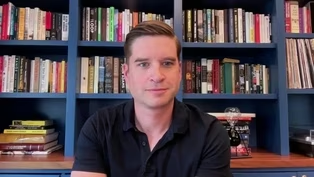
New"Doom Trolling:" Why AI Leaders Are Stoking Fear About Their On Tech
Video has Closed Captions
Prof. Cal Newport unpacks why he thinks the AI industry is "doom trolling." (18m 14s)
Providing Support for PBS.org
Learn Moreabout PBS online sponsorship New Episode
- News and Public Affairs

Top journalists deliver compelling original analysis of the hour's headlines.
 New Episode
- News and Public Affairs

Today's top journalists discuss Washington's current political events and public affairs.
 New Episode
 New Episode
 New Episode
 New Episode
 New Episode

 New Episode
 New Episode
 New Episode
 New Episode
Support for PBS provided by: