
A look inside secretive Hezbollah bunkers seized by Lebanon
Clip: 12/16/2025 | 7m 6sVideo has Closed Captions
A rare look inside Hezbollah's secretive bunkers seized by Lebanon's military
The Lebanese army is on a tight deadline to comply with an American demand to dismantle the military infrastructure of Hezbollah. Special correspondent Simona Foltyn and videographer Adrian Hartrick were given exclusive access to Hezbollah’s seized military installations and the army's efforts to retake territory long held by the militants.
Problems playing video? | Closed Captioning Feedback
Problems playing video? | Closed Captioning Feedback
Major corporate funding for the PBS News Hour is provided by BDO, BNSF, Consumer Cellular, American Cruise Lines, and Raymond James. Funding for the PBS NewsHour Weekend is provided by...
A look inside secretive Hezbollah bunkers seized by Lebanon
Clip: 12/16/2025 | 7m 6sVideo has Closed Captions
The Lebanese army is on a tight deadline to comply with an American demand to dismantle the military infrastructure of Hezbollah. Special correspondent Simona Foltyn and videographer Adrian Hartrick were given exclusive access to Hezbollah’s seized military installations and the army's efforts to retake territory long held by the militants.
Problems playing video? | Closed Captioning Feedback
How to Watch PBS News Hour
PBS News Hour is available to stream on pbs.org and the free PBS App, available on iPhone, Apple TV, Android TV, Android smartphones, Amazon Fire TV, Amazon Fire Tablet, Roku, Samsung Smart TV, and Vizio.
Providing Support for PBS.org
Learn Moreabout PBS online sponsorshipGEOFF BENNETT: The Lebanese army is on a tight deadline to comply with an American demand to dismantle Hezbollah's military infrastructure as part of a cease-fire agreement.
Israel dealt the terror group destructive blows over the last two years after Hezbollah attacked Northern Israel following the Hamas strikes of October 7.
Special correspondent Simona Foltyn and videographer Adrian Hartrick were given exclusive access to Hezbollah's military installations recently seized by the army south of the Litani River, as the military works to retake territory long held by the Iran-backed group.
SIMONA FOLTYN: We are with the Lebanese army a few miles north of the border with Israel, about to gain unprecedented access to one of Hezbollah's core areas of operation.
For the first time in decades, the Lebanese government is asserting sovereignty here.
On the edge of Yater Village, we disembark and leave the cars behind.
The rest of the trip must be made on foot.
Hezbollah's military installations are hidden from sight tucked away deep in the valleys.
CAPT.
CHRISTIAN ABOU CHAAYA, Lebanese Armed Forces: So we know that there is facilities from these telephone wires and these water pumps.
SIMONA FOLTYN: Captain Christian Abou Chaaya part of the army's engineering unit tasked with dismantling Hezbollah's weapons.
CAPT.
CHRISTIAN ABOU CHAAYA: We are going to see a rocket launcher.
The type is THAAD-2.
It has eight barrels with eight rockets.
SIMONA FOLTYN: When did you discover or when did you search this area?
CAPT.
CHRISTIAN ABOU CHAAYA: Last week.
SIMONA FOLTYN: Last week?
So this is pretty recent?
CAPT.
CHRISTIAN ABOU CHAAYA: Yes.
SIMONA FOLTYN: It's inconceivable that anyone but Hezbollah could have set foot here before the war, not the Lebanese army, not civilians, and certainly not journalists.
That these areas are now in the hands of the state speaks to decisive power shifts the war has brought upon Lebanon and the region.
We descend along the steep muddy slope down into the ravine.
The facility blends so seamlessly into nature, we might have walked past it.
But right there carved into the southern ridge of the mountain lurks one of Hezbollah's signature weapons.
So, this is a 240-millimeter rocket launcher that was hit in an Israeli air raid.
We don't know exactly when, but the strike did manage to take it out by damaging the fuse.
Now, the warheads, the rockets, are still inside and they're still active.
The site offers a rare glimpse into how Hezbollah operated.
The way this weapon system would have been used is, a Hezbollah fighter would actually have to come down here.
There was a generator in the back that they would have to turn on, then pull the rocket launcher out of this cave using these rail tracks, then enter the coordinates of the target they wanted to strike in Israel, and then use this starter over here to launch the rockets.
The weapon components were likely brought here one by one as Hezbollah secretly built its capabilities over many years.
But Israel managed to infiltrate the group and, in the span of a few short weeks, wipe out a significant portion of its infrastructure.
The Lebanese army is dismantling what's left.
CAPT.
CHRISTIAN ABOU CHAAYA: It's a part of our routine job.
Every day, we inspect a new area.
SIMONA FOLTYN: What are some of the challenges you face in this difficult terrain?
CAPT.
CHRISTIAN ABOU CHAAYA: The nature, the climate.
It's raining.
Now it's winter.
And not just the nature.
We have also -- we faced a lot of mines, IEDs, cluster munitions, so the work here is very dangerous.
SIMONA FOLTYN: Do you know if there might be other similar facilities around here?
CAPT.
CHRISTIAN ABOU CHAAYA: We will neutralize this one and go forward, but I think, yes.
From the dirt road, I think we should find something else down there.
SIMONA FOLTYN: The army has combed through 124,000 acres of land and seized more than 230,000 weapons across 460 Hezbollah facilities in the south.
General Jihad El Khazen is the deputy commander of the sector.
BRIG.
GEN.
JIHAD EL KHAZEN, Lebanese Armed Forces: We started this on the 5th of September, and we're still continuing that.
Until now, we have already completed between 90 to 95 percent.
SIMONA FOLTYN: The IDF claims that Hezbollah is rebuilding its military infrastructure, including south of the Litani River.
BRIG.
GEN.
JIHAD EL KHAZEN: There is no evidence now that Hezbollah is rebuilding its infrastructure.
SIMONA FOLTYN: The army has until the end of the month to complete the process south of the Litani River, the first of five phases to disarm the Iran-backed group.
The Trump administration has complained about lack of progress, which the army is keen to disprove.
They take us to another site where the engineering unit is about to detonate a rocket launcher.
CAPT.
CHRISTIAN ABOU CHAAYA: We are using here TM-57 mines, anti-tanks, because they contain a large quantity of explosive.
SIMONA FOLTYN: This facility was also damaged in an Israeli strike.
So what is the reason why you destroy these weapons, rather than storing them?
CAPT.
CHRISTIAN ABOU CHAAYA: So, usually, when we find an item, we check if it's in a good condition or not.
If it's in a good condition and it's safe to move, we just collect it and move, transport it to be inspected by a specialist.
If it matches with the weapon system, the army weapon system, we take it, we store it.
SIMONA FOLTYN: Would you say that most of the weapons you find are compatible with the army's weapon systems or not?
CAPT.
CHRISTIAN ABOU CHAAYA: Most of the weapons we find are not compatible with our weapon system, because our weapon system is Western, and most of the weapons that we find are Eastern.
SIMONA FOLTYN: Hezbollah was Lebanon's most powerful armed actor.
The destruction of its equipment means the country will be left with few defenses.
Safety protocol dictates that we must withdraw 500 yards as the engineers rig the site.
So we drive uphill to watch the explosion alongside the local population.
Many here remain loyal to the resistance, as Hezbollah is called here.
In the absence of a robust state, the group was seen as their protector, as the only bulwark against repeated Israeli incursions.
The army is trying to win their trust, an uphill battle in light of Israel's near-daily cease-fire violations and ongoing occupation.
BRIG.
GEN.
JIHAD EL KHAZEN: We need also that the Israeli side give some positive steps by withdrawing, by stopping all their attacks.
SIMONA FOLTYN: Squeezed between demands of the U.S.
and Israel on the one hand and concerns of Lebanon's Shia population on the other, the army is walking a tightrope, and they must walk it fast if they want to avert another war.
For the "PBS News Hour," I'm Simona Foltyn in Southern Lebanon.
A Brief But Spectacular take on the power of trees
Video has Closed Captions
Clip: 12/16/2025 | 2m 47s | A Brief But Spectacular take on the power of trees and creating a cooler future (2m 47s)
How the ACA subsidies work and who depends on them
Video has Closed Captions
Clip: 12/16/2025 | 7m 37s | How the Affordable Care Act subsidies work and who depends on them (7m 37s)

Jobs report reveals 'uneven economy,' analyst says
Video has Closed Captions
Clip: 12/16/2025 | 5m 42s | Jobs report reveals cooling labor market and 'uneven economy,' analyst says (5m 42s)
News Wrap: Nick Reiner facing first-degree murder charges
Video has Closed Captions
Clip: 12/16/2025 | 6m 26s | News Wrap: Nick Reiner facing first-degree murder charges in killing of his parents (6m 26s)
Sen. Cassidy on health care costs and expiring subsidies
Video has Closed Captions
Clip: 12/16/2025 | 8m 32s | GOP Sen. Cassidy on addressing rising health care costs and expiring subsidies (8m 32s)

What’s in the massive military spending bill
Video has Closed Captions
Clip: 12/16/2025 | 7m 34s | What’s in the massive spending bill giving the military more funding than requested (7m 34s)
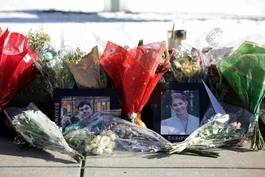
Why investigators are struggling to find Brown Univ. gunman
Video has Closed Captions
Clip: 12/16/2025 | 6m 48s | Why investigators are struggling to find the Brown University gunman (6m 48s)
Providing Support for PBS.org
Learn Moreabout PBS online sponsorship
- News and Public Affairs

FRONTLINE is investigative journalism that questions, explains and changes our world.

- News and Public Affairs

Amanpour and Company features conversations with leaders and decision makers.












Support for PBS provided by:
Major corporate funding for the PBS News Hour is provided by BDO, BNSF, Consumer Cellular, American Cruise Lines, and Raymond James. Funding for the PBS NewsHour Weekend is provided by...