
The AUXdacity
Echoes of Tomorrow
Episode 6 | 26m 46sVideo has Closed Captions
The AUXdacity cast explores music’s future, from AI sounds to VR concerts and new tech trends.
The AUXdacity cast explores music’s future, from AI compositions to VR concerts, highlighting new sounds, tech trends, and the ethical questions shaping creativity, access, and artistry in tomorrow’s industry.
Problems playing video? | Closed Captioning Feedback
Problems playing video? | Closed Captioning Feedback
The AUXdacity is a local public television program presented by SCETV
Support for this program is provided by The ETV Endowment of South Carolina.
The AUXdacity
Echoes of Tomorrow
Episode 6 | 26m 46sVideo has Closed Captions
The AUXdacity cast explores music’s future, from AI compositions to VR concerts, highlighting new sounds, tech trends, and the ethical questions shaping creativity, access, and artistry in tomorrow’s industry.
Problems playing video? | Closed Captioning Feedback
Where to Watch The AUXdacity
The AUXdacity is available to stream on pbs.org and the PBS app.
Providing Support for PBS.org
Learn Moreabout PBS online sponsorshipThis podcast is made possible through listener contributions to the ETV Endowment of South Carolina.
♪ Kennedy> Hey guys, welcome back to The AUXdacity !
I'm Kennedy alongside Courtney and we are stepping into the future of music.
From AI generated compositions, to virtual concerts and the rise of independent digital artists, the industry is evolving faster than ever.
Courtney> What does innovation mean for creativity?
Who controls sound in the digital age?
What's next for artists?
Kennedy> And we got my girl SheJay T.O., and she's going to be setting the tone for what's ahead on this episode.
T.O.> Bold voices shape the future of culture.
Toni Esther is a fearless female emcee whose sharp lyricism and commanding presence move the room.
Catch her performance at the end of the show.
Courtney> We have two incredible guests with us here today, we have Doctor Evans and Shekeese and let's just jump right into it.
Dr.
Evans, can you tell us a little bit about yourself so the audience can meet you?
Dr.
Evans> Yeah, Jabari Evans, Assistant Professor of Race and Media at the University of South Carolina, in the Journalism School.
A lot of my research thinks about how black youth use digital tools and technologies for their professional aspirations.
And so in this conversation, I'm probably going to talk mostly about musicians, but I also think about content creators, comedians, all types of different individuals, journalists, and how they're using these tools to sort of talk to audiences.
Beyond being a professor, I spent 20 years in the music industry as a songwriter, producer, and a performer.
Courtney> So you are the man for this conversation.
Dr.
Evans> I'm just old.
Live long enough, you know, you got a bunch of stories and journeys, you know.
Courtney> Well Shekeese, let's hear about you.
Sherard "Shekeese Tha Beast" Duvall I'm a Columbia, South Carolina native.
I grew up in a little neighborhood called Ridgewood, over there by, Eau Claire High School.
But I spent a lot of time in New York and Atlanta as a kid.
A lot of people know 'Shekeese Tha Beast' from my deejaying days, whether that's BET, MTV, as well as radio, satellite radio, I did all of that.
A lot of people know me from my "Love, Peace, and Hip-Hop" days, the hip-hop festival, Hip-Hop Family day.
And then a lot of people know me from the TV and film industry.
I've been a TV and film producer for about as long as I had a DJ career, now about 20 years, and everything from network TV to now having my own company, OTR Media Group.
And so, I'm a Columbia native son, Richland District One.
Columbia High School, class of 96'.
So, I love what y'all are doing here at ETV, And so thank y'all for having me.
Kennedy> Thank you for being here.
Man, I love music myself.
I've been listening to music for, like, since the crib.
Where do you think music is heading, like, in the next ten years or so?
Dr.
Evans> Music's heading where media is going more generally, media is becoming a much more fragmented landscape.
It's also becoming more datafied, right.
So, big data informs everything, now.
People don't make decisions without knowing the numbers and the analytics.
And I'm from the era of like, the A and R and actual human gatekeepers and talent development and all of that stuff and actual producers, not just beat makers, right.
But we're now in an era where we have algorithmic gatekeepers, and we have numbers that are telling us where to go and what to decide to follow, or what to decide to develop, what to decide to invest in.
And a lot of it is based on metrics, it's based on clout, it's based on, you know, how we see people, and judge them on the numbers.
You know, whether it's followers, whether it's downloads, whether it's, you know, how much money you're making per month or as a streamer.
You know, a lot of things are really identifiable with numbers.
And I think that's sort of a gift and a curse to a certain degree, because I think we're losing a certain level of grassroots, organic vibe to music and a vibe to even the business and the way in which things used to work.
You know, me and Shekeese actually know each other.
He used to promote shows, right?
And the way in which you would hear about shows, were through people like him, two-step flow.
Now it's literally, okay, let's buy some Facebook ads, let's buy some IG ads, let's, you know, let's just make sure that, you know, the minute I step off a plane, I'm from Chicago, but if I step off a plane anywhere and I have my location on, Instagram's gonna to tell me immediately... something that someone is doing.
Kennedy> Yeah, so would you say, like the algorithm is controlling the show?
Dr.
Evans> I mean, we're in the Truman Show right now.
Courtney> Deep cut, kids.
Dr.
Evans> No, I mean we're being controlled.
And I think for digital natives, they're not as resourceful.
And so they're in a space where, you know, the shortcut is the only way.
It's a microcosm of where we at right now, where we have folks with smarter phones and dumber instincts.
And, I think that transfers into the creative and cultural industries as well, where, you know, now you can pick up AI and make beat, you could pick up AI and even write a verse, you could pick up AI and get a voice that you don't have.
T.O.> So speaking of the AI, how easy they're making things and going back to what you said about the data, the algorithm, and we saw this happening if you came up in the era, you know, with radio.
And so do you think it's making, like you said, you have people that are pretty much lazy with it, so when you were a programmer back then, you had to rely on just your instincts, your ear, knowing what's going to be hot.
Not necessarily, the results of a diary coming back or the PPM readings coming back to tell you that this small group of people like this song, so we're going to push it.
Now, that's really all they rely on.
So do you think AI is taking away the skill set from those employees and literally making people lazy to the point where it's going to eventually eliminate the job?
Dr.
Evans> Yeah, I mean, to an extent, right.
I think there's always going to be some disruption that we can't foresee.
And I think the technology does things in ways that are predictable, but life isn't predictable.
Culture isn't predictable.
Hip-hop is, in particular, is known for improvisation, making something out of nothing.
Kind of, you know, there's always going to be a song, and an artist, or a movement that figures it's way out in a way that we didn't expect.
Courtney> Shekeese, I want to hear a little bit of your perspective on this, because I know you have some similar industry experience.
So where do you see music going?
Shekeese> You know, I think what T.O.
just said and a bit of what Jabari just said about the word organic, but T.O.
was referring to, you know, the, what I would call the artistry part of it, which is I think the other part of technology that we always have to remember is, technology can also democratize, things or access to resources that people didn't have before.
Which is a beautiful thing.
Like, I love going on Instagram and seeing a grandma DJ, at you know, 65 years old in Sierra Leone, learning how to make beats.
So I mean, I think it's incredible, you know, at the same time, there's a level of responsibility that is going to have to come from, I believe, some sort of government regulation space when it comes to, how these platforms and uses and its relationship with human beings, as users is regulated in that space, you know, the freedom, anything dealing with humanity, when it comes to freedom, gotta come with some regulation.
Because we human beings, we going do what we want to do.
<We gonna run out.> we gonna run out, we gonna run it out, we gonna crash it out.
So at some point someone as to come in and say, okay, well, what are the barriers?
And sure, we want everybody, I want both of y'all to learn how to DJ tomorrow and AI helps you do that, I think that's awesome.
<Yeah> At the same time, what's the designation between someone who's an AI DJ and what DJ T.O.
does?
Some entity, some body has the, and when I say body I mean body of people, has to come in and kind of create new definitions for this new world that we're in.
Kennedy> Who do you think would be like, I guess an ideal to kind of set those boundaries or do that regulation, enforce it?
Shekeese> I feel like we'll kind of come up with a system very similar to, you know, when newspapers first came out, they came up, there was a governing body that was like, okay, this is what constitutes a newspaper, this is what constitutes the National Enquirer.
In the same way when people came out with, okay, this is what is considered, you know, a real Nike, this is a fake Nike, you know what I mean?
There's always some body or group that's, you know, whether it's, even the people that's putting "A" on a restaurant is like, okay, this meets a certain health code.
Don't eat over there, He's got a C. And now you can make the decision, right.
You make a decision.
I think we're just in this space where it's kind of like the wild, wild west.
<Yep> Kennedy> So, would you like politicians to come up with those rules or special interest groups?
Shekeese> I don't know politician is the right word.
I think the right word is governing body, right?
I think when we hear the word "governing" we think politicians.
But it ain't politicians putting speed limits on the road.
You know, that's a governing body of people that have been determined that they're experts in speed and crashes.
And so, these people we've appointed to study this and say, okay, this lane is 35 miles an hour.
I think that's kind of in the space we're in, right.
When you think about, you know, somebody can have a phone, and a YouTube channel, and a website, and a fashion company, in today's world, in an hour and a half, you know.
T.O.> And the music industry has already started, but it's more of a morality thing, not an illegal thing.
To where they're just like, hey, no, we're not allowing this X, Y, and Z. And so, where you had the AI artists and then you have the tools to make the bots listen to the AI artist.
So, there was one artist who got millions and millions of streams, with not one fan, and he ran up money.
And so then, he kind of got in trouble.
But like Shekeese said, there's no governing body.
Like what, so what happens to him?
Courtney> I'm playing in my, like, sandbox now y'all.
So, we got the comedian, we got the educator here.
I'm a advocate lobbyist by trade.
Something that Dr.
Evans said, is that the technology is moving so quickly.
And I can just tell you it takes our legislators, our politicians, a very long time to decide on even something they all agree is good.
Shekeese> That's exactly why I don't think politicians are the right... You know, because I don't think, I think if we wait on politicians, we'll end up waiting too long.
I think as human beings, we got to figure out what these barriers control, it's got to be some type of partnership between private citizens, private corporations together, because it's something very important that Jabari said in that first segment, that he, when he was speaking about what the algorithm has turned us into, tech companies have turned us all into users.
We're not even people anymore, right?
Yeah, we're all users.
<We're all consumers.> We're all, not even consumers, like you don't even have... Facebook just has to be on your phone, for you to be considered a user.
You're not even using it.
But it's there you bought the phone, you counted as a user.
T.O.> The data is being captured.
Shekeese> Your data is being captured.
And so like, so then, I think if that is the case, if we're all being put into this space together, whether that's to create art or to go on Instagram and look at people pictures or whatever it is, then somewhere that, all of the players got to come and say, okay, how do we make this a safe space?
How do we make sure that artists get what they're paid?
How do we make sure people still have the freedom to become a AI artist tomorrow on they laptop, while they on the bus?
You know what I mean, like, I think there has to be some partnership that comes together and kind of gives us new rules for this new world that we live in.
T.O.> Is it frustrating for, because I know Shekeese you have a huge background in deejaying, and when I started, of course, you were one of the one's I looked up to.
So I feel like artists are feeling what we feel, we've felt for years, but is it frustrating to know that you could spend 15, 20 years perfecting a craft that somebody can start out on Monday and not necessarily have the same skill set as you, but they get the same level recognition, respect and everything by Friday.
Shekeese> No, it doesn't frustrate me at all, I think it's beautiful, like I think it's so absolutely wonderful that someone could have a dream of being a DJ and then by Friday have followers.
I think that's awesome, because I also think that somebody that has skills, the tech is going to elevate their skills.
So that person that is able to become a AI say, a really popular DJ in a week is still never going to be able to compete with DJ T.O.
because what they're going... what T.O.
is going to do with he technology, is going to be vastly different.
My only frustration comes from, if you are an artist or whatever type of technician that's using AI, those tools should make you better.
<Yeah> I get frustrated when I hear like somebody is like, oh, check out this DJ and they sound like a DJ from 20 years ago.
I'll be like, we was doing that 20 years ago without computers.
So like, y'all not no better than that?
Like, by now... [laughter] like you should be, I should be blown away.
And that's really where my only frustration is, is if you're going to use the art to elevate, like take it to the next level.
Like, Outkast did whatever Outkast was doing 20 years ago, don't do Outkast again.
What does the next iteration of that look like that we hadn't seen yet?
You feel me?
Dr.
Evans> We're not outside enough.
Like, the younger generation, they talk a lot about being outside, but in reality, it's filming to look like you're outside, or curate to look like you're in community with others.
Like, you go to a concert it's not about actually experiencing it, it's about taking a selfie, it's about showing people you're there.
I think very similarly, you know, the music, especially the urban side of music, used to be about physically being in person, physically networking with people, physically collaborating.
And I think that creates a different type of artistry, it creates a different type of scene.
Like local scenes aren't what they used to be because of, the same way there's the DJ that uses tech, there's the promoter that uses AI to create the flier that's generic and use the algorithm in a way that is like, well, everybody's buying the same amount of Facebook ads.
Everything looks exactly the same.
I think when you go outside and you actually do some of that, like boots to ground, you know, real grassroots work and you're in community with whatever local scene you have.
Courtney> Y'all, I have to admit, we do sound like a bunch of old folks on the porch.
Like, "Grr back in my day," but, like, let's help them get outside.
So... <Yes> I grew up in this area, but, like, one of the things that my parents taught me was like, just curiosity, be curious, go find something that you don't know.
So, how do they get outside?
Can we help them?
Shekeese> That's the key, right there.
It's curiosity.
What can it do?
<Yep> Right.
As opposed to it doing, what can it do?
Anything that you interacting with, even if it's an algorithm.
Like what can it do that we ain't seen yet.
Because I, honestly I'm on the other side of Jabari I think the younger generation is returning to outside.
I think they're using AI, I think they're using technology to find new ways to be able to do things with each other outside, even though there's still some tech in the mix.
I think it's going to go back to that route.
They've been inside of the, what I call the computer box, for so long, they're trying to find other ways to engage beyond that.
Courtney> They're using iPod classics now, like, they are going back, back, back, back.
Shekeese> They're finding ways to engage together.
And I think that plus just being curious like, let's just see.
T.O.> But they also, they're looking at what works and if you look at even the OG artists, they're going back, look at J. Cole, is on a whole Honda Civic Tour right now.
Selling records out his trunk.
Master P did that in the 90's.
And then you got, you know, even Summer Walker, when her album rolled out, she hit the streets with Cardi B, Cardi B's one of the biggest artists in the world, she hit the streets.
She on subways, she on, you know, making it fun.
She not really... but it made it fun.
So they're seeing what works.
Shekeese> You know, even I'm seeing the return of small house parties <Love it> and house shows, you know what I mean, with artists, like the one y'all heard earlier today.
Like, I'm seeing a lot of that take place and I think, that community part, I mean, that's how you get that curiosity too.
T.O.> Outside of the community and the actual artistry, let's talk the money, right.
[laughter] Do we think, the streaming hurt the artists?
Did it help or hurt the artists, the producers, the songwriters?
Shekeese> I'm gonna go with the guy that had a record deal.
[laughter] Dr.
Evans> I mean, short answer, yes.
Streaming is a way for... and it's funny because Shekeese was sort of moving in that direction when we were talking about the guardrails not being there and regulation needing to be had, platforms are not being treated like media companies.
So, when the record, pretty much when the record labels got in bed with the streaming platforms, they made sure that the music industry's profits went up substantially.
But what they didn't do is build a model that was going to compensate artists fairly, right.
So, you know, we're seeing now more than ever, you know, when I, even when I was a touring artist like that was your bread and butter.
You hit the road, you sell your merch, you do these different things.
You might even hit 2 or 3 different shows in a night, if that's what you can do to have hand to hand money in your pocket, right.
And it's an easier thing to track, a lot of artists don't understand publishing, a lot of artists don't understand how to audit their record labels, a lot of artists don't understand their contracts.
You know, my very first contract wasn't very great.
And I'm, you know, very educated, right.
You would think I would probably be one of the most knowledgeable person.
I was so excited to get to the space of having fame and clout that I didn't read it as well as I wanted to, because I wanted the opportunity, and I think that's still the case.
Artists are getting exploited, you know, a lot, right?
But labels are making money, streaming platforms are making money.
But now you're seeing, to that point, someone like a LaRussell use "EVEN" and also become pretty much a content creator.
Whereas like, okay, now I'm going to go back to selling physical units.
I'm going to go back to giving those who are my "super fans" this interesting experience of having like the opportunity to see me 15 times a year if they pay upfront- Shekeese> But that goes right back to what y'all was just saying.
What LaRussell tapped into was curiosity and community.
<Yes> All he did was put those two things together.
That's really all that is, like, being curious about what other ways can I of operate outside of the record label system, number one.
And then two, how can I build a community around what I'm doing?
Where I'm at.
<Yes> That's all it was.
You know- Dr.
Evans> And being intelligent around COVID, right.
Because that pandemic space was when I think a lot of people figured out how to do content.
But at the time, we were socially distant.
You couldn't go to a concert venue.
Verses happens during the pandemic.
There's a lot of disruption that happens.
You know, look at that movement where D-Nice has millions of people, you know, on his stream, right?
You know, these are things that can't be predicted, right.
When we go back to the beginning when we're saying like, hey, you know, how is artistry gonna find an audience in a way that's organic, even with the tech.
Those are all organic situations that have happened where I think you can point to it and say, hey, this is something I'm proud to see happening, right.
Where this is an evolution of the type of artist that I was.
I don't necessarily have the energy to be a content creator, but I know that, you know, in my research and in my books that I've put out more recently, right?
The tech is germane to the business, like the same way at the time for me, you had to hit an open mic, you had to be able to freestyle in a cypher.
Now you need to know how to make content, you need to know how to stream, you need to be on Twitch.
That's you need to be, you know- Shekeese> And you don't necessarily have to be.
That's what I always tell the younger folks that are coming up today, I mean, yes, you can have a YouTube channel, you can be a rapper and you can put out your own, yeah, you could do all that yourself, but look how much time- <Yes> Kennedy> We were just having this conversation earlier today.
Shekeese> You only need 2 or 3 people with you.
Find somebody that to love to do this, Kennedy> Everybody don't have to be in front of the camera.
Shekeese> Everybody don't have to be in front of the camera.
Somebody's uploading it, somebody's posting it.
That way we working as a team, getting back to that community, and then y'all can go out later and have some pizza.
Kennedy> You the DJ, I know the law, she got the tech, he got the connections, and we all go together.
Courtney> Are we starting a group?
Shekeese> Let's do it, I'm down with it.
Kennedy> We gotta wrap up here in a second, but, I got to ask this before we get outta here because we're always talking about, you know, the young people.
If you were starting your career today, what would you do differently?
Shekeese> I know the answer to that immediately.
I was in a rap group too, what we did not get well, not a major record deal.
We did have a couple single deals, <Yes> but if I had to do it all over again, I would build my own platform.
You know, one of the things that we had, was we had people that had different roles, right.
And what we like to do is tap into the thing that you good at.
And instead of asking you to do something you don't know about, what's the thing you already good at?
And that's exactly what I would have done.
I think about this all the time, if I could do it all over again, my own website, platform, with all the tools.
Kennedy> What about you Jabari, before we get outta here.
Dr.
Evans> Everything at the time when I was trying to do music and entertainment was like, you have to move to L.A., you have to move to New York.
I think if I was doing it all over, you know, I would have saw more strength in my home and in my hometown.
And I think a lot of the younger artists that came after me did just that.
And I think, you know, using and understanding that the tech can allow you to not have to get on planes, not have to sleep on couches, necessarily.
Cost of living where you're at.
You can kind of build, to your point, a community of folks build a platform where you're at, and you don't necessarily have to do the rat race of living in L.A.
and New York, which I did for about 12 years, you know, and ultimately found more success when I went back to Chicago and I signed with John Monopoly, who's from Chicago and was meeting with producers that were from Chicago.
I wish, you know, investment in home and local scene is kind of something I wish I did more of.
Shekeese> That's a bar.
Kennedy> Man, listen, this has been a really dope conversation.
I feel like we gotta continue this conversation after the show.
Courtney> The future of music isn't coming, it's already here.
Thank you to our guests and SheJay T.O.
for pushing the conversation and the sound forward.
We've curated a Spotify playlist featuring the artists and songs from today's episode.
Just search The AUXdacity on Spotify and experience a future soundscape for yourself.
I'm Courtney- Kennedy> and I'm Kennedy and this has been The AUXdacity .
So stay curious, stay creative and we'll see you guys next time, peace!
♪ Come on.
♪ ♪ ♪ ♪ Come on.
♪ ♪ This that feel good, real good, ♪ ♪ feel good, real good.♪ ♪ Hey, hey, hey, hey, hey, ♪ ♪ ♪ ♪ Come on.
♪ ♪ It's that feel good real good.
♪ ♪ ♪ Come on.
♪ ♪ I got a real good thing, ♪ ♪ I can't let it go.
♪ ♪ Nah, they probably never even seen it before.
♪ ♪ I got a real good thing.
♪ ♪ Come on.
♪ ♪ Yeah, I gotta let my soul glow.
♪ ♪ I got a real good thing.
♪ ♪ Can't let it go.
♪ ♪ They probably never even seen it before.
♪ ♪ I got a real good thing.
♪ ♪ Come on.
♪ ♪ I gotta let my soul glow.
♪ ♪ Come on, take me back to ten, ♪ ♪ what I love most that she has so much within.
♪ ♪ Right.
♪ ♪ Cause she was just a shorty, hair naughty, legs... ♪ ♪ words karate.
♪ ♪ When I think back, I used to copy tracks to copy cats.
♪ ♪ Now I think it's whack to copy blacks, ♪ ♪ can you copy that?
♪ ♪ ♪ ♪ Put you on your knees.
♪ ♪ Oh no no no.
♪ ♪ Come on.
♪ ♪ ♪ ♪ Get residuals, make it drizzle.
♪ ♪ Get deep like Frank Mitchell.
♪ ♪ I'm on my fiscal been official.
♪ ♪ Sick like sickle cell, ♪ ♪ can you tell?
♪ ♪ ♪ ♪ Check the detail.
♪ ♪ I didn't know I bell until I expelled ♪ ♪ I didn't know I bell until I ring well.
♪ ♪ Come on, come on, come on.
♪ ♪ ♪ ♪ You gotta let your soul glow.
Come on.
♪ ♪ I got a real good thing, I can't let it go.
♪ ♪ They probably never even seen it before.
♪ ♪ I got a real good thing I refuse to let it go.
♪ ♪ Yeah, I gotta let my soul glow.
♪ ♪ I got a real good thing, I can't let it go.
♪ ♪ They probably never even seen it before.
♪ ♪ I got a real good thing I refuse to let it go.
♪ ♪ I gotta let my soul glow.
♪ ♪ ♪ ♪ ♪ ♪ ♪ ♪ ♪
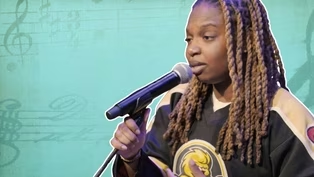
Video has Closed Captions
Clip: Ep6 | 2m 22s | Local South Carolina artist Toni Esther performs "Soul Glow" on The AUXdacity. (2m 22s)
Providing Support for PBS.org
Learn Moreabout PBS online sponsorship









Support for PBS provided by:
The AUXdacity is a local public television program presented by SCETV
Support for this program is provided by The ETV Endowment of South Carolina.