
April 7, 2026 - Full Show
4/7/2026 | 26m 48sVideo has Closed Captions
Watch the April 7, 2026, full episode of "Chicago Tonight."
The debate over whether wealthy Illinois residents should be taxed at a higher rate. And we sit down with the state’s newest Supreme Court justice.
Problems playing video? | Closed Captioning Feedback
Problems playing video? | Closed Captioning Feedback
Chicago Tonight is a local public television program presented by WTTW
WTTW video streaming support provided by members and sponsors.
April 7, 2026 - Full Show
4/7/2026 | 26m 48sVideo has Closed Captions
The debate over whether wealthy Illinois residents should be taxed at a higher rate. And we sit down with the state’s newest Supreme Court justice.
Problems playing video? | Closed Captioning Feedback
How to Watch Chicago Tonight
Chicago Tonight is available to stream on pbs.org and the free PBS App, available on iPhone, Apple TV, Android TV, Android smartphones, Amazon Fire TV, Amazon Fire Tablet, Roku, Samsung Smart TV, and Vizio.

WTTW News Explains
In this Emmy Award-winning series, WTTW News tackles your questions — big and small — about life in the Chicago area. Our video animations guide you through local government, city history, public utilities and everything in between.Providing Support for PBS.org
Learn Moreabout PBS online sponsorship>> Hello and thanks for joining us on Chicago tonight.
I'm Brandis Friedman.
Here's what we're looking at.
Will Illinois lawmakers take another crack at a graduated income tax referendum?
A look at the renewed debate and what that money could be used to fund.
And we sat down with Illinois's newest Supreme Court Justice Sanjay Taylor.
>> First off tonight, a federal judge finds no evidence that charges against the broad view.
6 defendants were influenced by the Trump administration.
The case goes back to September when protesters outside the ice processing facility in Broadview allegedly surrounded vehicle, quote, would be intent to hinder and impede a federal agent.
Defense attorneys sought evidence showing the charges were politically motivated.
6 defendants were originally charged, including multiple political candidates and officials charges were later dropped against 2 defendants and the remaining 4 have filed a motion to have their charges dismissed.
Bears Hall of Famer Steve McMichael has been diagnosed with chronic traumatic encephalopathy or CTE.
One year after his death, his family and doctors made the announcement today.
Mcmichael was an integral part of a dominant 85 bears defense that went on to win Super Bowl 20.
He died last year after a battle with ALS and donated his brain to Boston University CTE Center.
2 recent which the long-term effects of repeated head trauma, the degenerative brain disease can only be diagnosed after Mcmichael will be honored at the race to in CTE on April 23rd in Chicago.
new birth center is coming to the city's south side.
A groundbreaking ceremony was held today for the new nonprofit Chicago's South Side Bird Center.
Organizers say once the space is built, it will offer services including prenatal care, birth services and postpartum care.
>> Today is special.
You all feel it.
And it's not just because we're breaking ground.
It's because we're standing in the middle of something that should have always existed.
It's been 10 years of choosing to believe that the people who are closest to the issues are the holders of the solution.
>> The birth center will convert the former Morningstar Bible Baptist Church building with assistance from the city's housing and Economic Development Fund.
It's expected to open early next year.
The sun was shining today for the ribbon cutting of the largest on site solar power installation in Cook County history.
Cook County Board, President Toni Preckwinkle joined commissioners on the roof of the Skokie Courthouse garage where the solar panels were installed.
Preckwinkle says thanks to the panels providing electricity directly to the building.
The courthouse will now purchase less than half of the electricity.
It once did.
Chicago public school students could get easier access to public library materials.
>> So with this expansion, every student no matter their ZIP Co.
School enrollment or their age, they'll have access to library cards and programs and resources that.
Make their lives more enriched.
I think it was Arthur.
This is specifically that having fun isn't hard when you have a library card.
>> Through a partnership between the Chicago public libraries and public schools.
All students will be able to instantly access resources at all.
81 public libraries with just a school ID number, no application or paperwork needed.
>> Up next, should the state's millionaires be taxed at a higher rate?
A look at the renewed debate right after this.
>> Chicago tonight made possible in by the Alexandra and John Nichols family.
The Pope Brothers Foundation.
And the support of these donors.
>> As the state looks for ways to balance its budget, some advocates a resume, the call for a so-called Millionaire's tax.
A study from the Illinois Economic Policy Institute says a 3% surtax on Illinois earning more than a million dollars a year could generate up to 5 billion dollars annually by the year 2033.
But critics argue that could open the door for increased taxation on small businesses and potentially fall short of relieving the property tax burden.
Joining us, our Austin Berg, executive director of the Chicago Policy Center, which is part of the Illinois Policy Institute and Frank Manzo economists with the Illinois Economic Policy Institute names are similar.
Different organizations and Frank contributed to the so-called Millionaires Tax study.
Gentleman, welcome back.
Thanks for joining us.
Thanks Frank.
Your coauthor of the study.
Give us a brief overview of the report.
Please write and yeah, we did this report with the project for Middle class renewal at the University of Illinois.
So want to make sure that they have a shout out.
But >> what we found is that a millionaire's tax could generate 4 billion dollars per year, at least and that money would be lockbox and dedicated specifically for property tax relief or for historic investments in education and what we found and what the data shows is that that reform could cut property taxes for for 3 million, Illinois homeowners by up to 20%.
It would grow the economy and it would make the state more competitive with peers Austin, the Illinois Policy Institute in 2024, you all were critical of the millionaires tax win.
60 1% of voters approved of it in a non-binding referendum on the ballot.
>> What are some of your concerns with?
The so-called millionaires tax in Illinois?
Well, my biggest concern would be it's taking our biggest problem as a state and making it worse.
And that problem is 3 words, people, people, people.
>> Over the last decade, we've seen nearly a million taxpayers on that leave Illinois and it's really hard to comprehend that number.
It's as if the 7 largest cities outside of Chicago.
Talk in Naperville, Aurora, Springfield, down the line.
We're just raced off the map that took 88 billion dollars in income with them.
And the IRS just released data just a couple of weeks ago showing who was leaving.
In fact, the group that's leaving the fastest twice the rate of other groups.
It's the highest income group measured by the IRS.
It's people making over $200,000 for every one person who comes in making that amount to leave.
So if we had just broken even on that number, if we hadn't lost those million people, we've been generating 5 billion dollars more in income tax revenue today.
That's a healthy way to grow our economy.
So concerns in that it's going to drive people away even more people absolutely make it So, frank, 3% surtax on millionaires.
How's it different from the progressive tax proposals that we've heard before, like in the 2020 fair tax bill, how to work differently.
So, yeah, it would be different in that.
It's a surtax small surcharge on people who have made income over a million dollars.
That's the first one.
You know that the previous fair tax was I think the as $250,000 or more would pay higher taxes is just.
>> This is 40,000 households and the state.
Less than one percent of the population paying a higher tax rate.
But the main difference is that the money would be lockbox and dedicated specifically for property tax relief for Illinois homers.
That's the main difference.
you know, mean, if there if there are other differences, we want to hear those as No, goes directly to a meaningful tax relief or for middle class and working class families.
I mean, Illinois is a high-tech state for the middle class.
There's no doubt about that.
It is a low tax state for for wealthy households and that's the difference.
Reform like this that actually delivers relief to the middle class and working families that that drive economic growth and drive spending can have a really a substantial impact on the state and grow our economy.
And this will be a 3% flat tax versus a graduated tax where after a certain income level, the tax the tax changes again, I mean, it is graduating and that it's at once you you know, one millionth and first dollar you have to pay a 3% tax on top of the of the state income tax.
Austin.
How are your concerns about how it will operate and whether or not it operates similar to Well, for one, I think when people hear millionaires, they immediately think sort of like gold, Rolex and pinstripe suit when, in fact, in Illinois.
>> This would also affect pastor incomes of people who what are called escorts.
These are landscapers, HVAC, you know, plumbing.
These are traits people.
making good money on past through businesses and working really hard to do it.
There's about 22,000 small businesses that would be subject to and I can't emphasize this enough.
Virtually all of our jobs growth in Illinois comes from those small businesses.
It's not coming from big corporations.
Those big corporations actually wouldn't be paying this.
It would be the escorts, the small businesses.
That's one concern.
I also think there's a bit of a bait and switch or on the property tax question.
hiking income taxes lead to lower property taxes, we would have low property taxes in Illinois.
We have a record high income taxes in Illinois.
We also have higher property taxes than every state with 0 income tax.
So I don't think that Illinois trust lawmakers with those promises, which is why they rejected the fair tax amendment in 2020.
Okay.
So Frank, as you mentioned, the report, you will sort of lock box earmark the of the revenue from this.
It's just 3 potential uses for the revenue that would be generated by.
>> A potential millionaires tax one would be providing property tax relief for homeowners in the form of rebates.
For those who qualify for the Homestead exemption to fully fund the evidence, base funding model and make it that education investments.
It's running behind right now in freezing school, property taxes and provide edge and provide additional education funding.
So a little bit of little called A little column B now and tell us a little bit about how these options would work.
So, yeah, there are We have different options are in our report because our different proposals and General Assembly right now and voters have been asked twice about a millionaire surtax to fund property tax Relief Fund schools.
So we want to provide multiple different options.
>> Either way, the state's economy grows by billions of dollars create 1000 jobs.
And the reason is that, you know, millionaires are that's going to very little effect on migration.
Talk about that earlier.
Millionaires are growing as a person as share of the of Illinois's economy.
And since 2019, the number of millionaires people making 1 million dollars or more per year has grown by 36% where and oh, by the way, in the last for decades there, their incomes have doubled after you adjust for inflation, whereas for the rest of us population and earnings have barely budged.
There's a growing sector of of the of the population in part because the tax code right now favors these individuals.
And so but what we find is that the the this report or this reform would could fully fund schools and improve our our graduation rates for for 2 million students or it could deliver substantial property tax relief.
Rebates of up to 20% for the average household for 3rd for 3 million homeowners across the state.
That's what the data shows.
Austin, is that feasible?
I don't think so.
And we can look to Massachusetts.
It's the most recent state to enact really like in the last 2030, years to enact a quote, unquote, millionaire's tax.
>> And data just came out 2 weeks ago showing the results and they have been shockingly bad for the state of Massachusetts after they passed this millionaire's tax.
The Cyrus data showed the first full year after it was implemented.
4 billion dollars left the state.
Remember, I said people, people, people drives people to other states.
I'm not asking people to shed a tear for millionaires.
I'm asking people to realize that we need to attract more of that investment to our state, Massachusetts.
drove people away.
70% of that 4 billion dollars came from high income earners.
And this is the most shocking part.
The full pie in Massachusetts.
All of the income that's called AGI Adjusted Gross income.
It shrank as a total pie actually shrink, making the state much, much weaker.
It's harder to fund schools heard from libraries harder to fund parks when your total income as a state is shrinking.
And I do not think Illinois should be copying that model.
Frank.
You look like you and Russ Behind a bizarre.
so Massachusetts is the most recent state.
As you mentioned, they're millionaires tax, raise 3 billion dollars last year.
So if you want all these taxpayers, you expect tax revenue to decline.
>> this reform raised 3 billion dollars in new revenue just last year alone and that money went to schools and went to tuition free community college and it went to infrastructure, including public transit and that state, Illinois could replicate that model because the states that have millionaires tax as their economies have grown at the same rate as states that do not have a millionaire's tax over the past few years.
So Austin in 2024, the Illinois Policy Institute for your part at the time you all found at the state spent 5.2 billion dollars more than its revenue.
>> Suggestions to rein in some of the state spending include a cap on state spending, adjusted for nominal GDP and strengthening the budgeting for results commission to limit excess spending.
break down.
What could the state be doing better to reign in spending versus raising revenue?
The business said the same thing.
If you called into a radio show on financial advice, what would they say?
Well, stop making bad decisions, start putting a structure in place to make better financial decisions.
We end up in these deficits every year because the state's growing spending far faster than taxpayers can afford.
>> And what we've suggested in which state Democratic and Republican states have adopted.
It's called a smart spending cap.
So it allows you to grow spending at a reasonable rate.
The rate of economic growth, population growth.
But anything beyond that usually need to go to voters to get them to approve So we think that's a smart, reasonable compromise to keep spending from growing out of control and to keep the cost of government reasonable.
That one of our biggest cost drivers for cost of living in Illinois for changes enough.
>> I mean, what I would suggest as as the same thing, put it to the voters as opposed to leave it in the hands of politicians and this constitutional amendment to impose a small surtax on millionaires to to deliver property tax relief could go to the voters who would lock box the revenue and say forever and perpetuity.
The revenue needs to go to this specific purpose property tax relief or funding public schools, which would stem the growth of property taxes.
If you do that and put into the voters and some politicians who want to win, you every year could just decided to change what their what they give money to.
That is the right move.
And so I agree.
But in the hands of voters.
>> According to Institute on Taxation and Economic Policy, the Trump administration's one big beautiful bill gave a and this is according your report as well.
gave a earners making or exceeding Annette $939,000.
Roughly $66,000 in tax cuts nationally.
41,500 in Illinois.
And as we've discussed, you know, one of the one of the main concerns with the millionaires tax is e migration of those millionaires out of state.
Frank early leaving other states.
>> Well, you know, that's that's a tax cut for people.
Basically may earn million dollars or more.
And, you know, I if you could ask around, but I don't think most people would say that the economy is doing particularly well following those tax cuts.
They have tens of thousands of dollars money that now that they didn't have prior they can afford pay a little bit more to to fully fund our schools are to deliver meaningful relief to to regular everyday people.
And now it's not.
It's not a huge burden on those folks.
In fact, millionaires are the research shows that they're called.
They refer to him as embedded.
Elise, what that means is that they're more likely to be married, more likely children are more likely to have business obligations and those in their states that they can't leave directions.
They're highly mobile.
They're leaving Illinois, taxing these people more would make them choose other states more than they currently are.
We need more of these people in our state because have to leave it.
I'm sure we'll talk about this again in the future, Alston Bird and And so thank you both for joining us.
Thank you.
Thank you.
>> Up next, we'll speak with the newest member of the Illinois Supreme Court.
Stay with us.
The state's highest court has its first Asian American Justice.
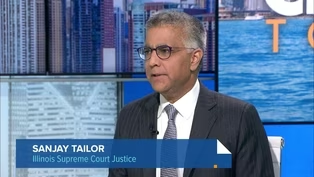
Sanjay Taylor, a former justice of the Illinois appellate court, was appointed to replace outgoing former chief Justice Mary Jane Theis in January.
Taylor will serve until at least December 2028 when Cook County voters will elect a justice to a 10 year term.
Joining us now is Illinois's newest Supreme Court Justice NJ Taylor.
Congratulations, Justice.
Thank you for joining later to be here.
So as we mentioned, you're the first Asian-American to serve on the Illinois Supreme Court.
How does it feel to have broken that barrier?
>> You know, this is a court that is unlike any other There are.
For women.
So it's a majority female court.
And for the first time in its history since 18, 18, it is the first majority-minority court we have for minorities of the 7 justices.
So it is a milestone.
Representation the people of Illinois.
>> You have been a judge since 2003 serving in 6 divisions of Cook County Circuit Court.
What type of experience would you say you bring to the Supreme Court?
What kind of experience does in Illinois Supreme Court justice need?
>> You know, became a judge in 2003 has an associate judge and over the next 19 years, I served 6 divisions of the court.
I don't know if it's a record, but I think it's kind of close.
And after that after I was elected circuit judge, I was assigned to the appellate court and so.
I a wealth of experience that I think has prepared me as well as they can.
>> For this new role, which of course, ministers are entire justice system in the state of Illinois and hears cases from every substantive area of law.
Right, of course, across, you know, so many different different courts.
You're going to get variety of experience, right?
A very diverse experience yourself.
>> You're a Democrat.
Strong ties to the Illinois to Illinois Party leadership in 1994, you took a three-month leave from your law firm at the time to work on a gubernatorial candidate.
Don Clark, Natchez campaign.
That's where you built some connections to other.
>> fellow young Democrats at the time.
How would you say your experiences?
Democrats shapes your approach to public service.
>> You know, I was not politically engaged at the time, but I was drawn to Don Clark, not just Canada, see because she wanted to change the way we funded public education.
I was so drawn to took a three-month leave of absence because I I've always felt that education.
All we can best lift people out adversity and of poverty.
Provide opportunity you know, she was out there she wanted to increase the way we fund or schools.
And so that there's not such a large disparity between.
school districts with the high property tax base and the school districts.
But the low property tax base.
And as you said, I made tremendous amount of contacts.
I've always felt that you make better friends in losing campaigns and it is served be well.
>> The role of the courts always been sort of a hotly debated topic and in recent years, even more.
So all eyes have been on the U.S.
Supreme Court with some of this action striking down Trump's tariffs soon to citing the birthright citizenship case.
Even the Illinois Supreme Court face some pushback in 2023 for upholding the legislation that ended cash bail under the safety Act.
How do you view the role of the courts?
You know, the courts are going to be addressing the issues that of the day.
>> cases that we except to hear our case substantial public interest.
So, for example, that statute to Pretrial Fairness Act, which eliminating cash bail Bill Nye Supreme Court has heard 8 appeals under that statute.
So that's an example of types of issues that hear.
We also hear appeals with this conflicts between the put courts of our state you the way I see our role is not only to the side, these very important issues for society, but also perhaps more importantly.
That we want to ensure that there is a high level public confidence.
And the courts and, you know, surveys done every year.
And they found it.
The state courts enjoy a 62%.
Approval rating in terms of public confidence that might sound low dew and is low.
But in fact, it's the highest level of public confidence among all government institutions.
State or federal.
Several years of about dozen years ago.
The state of Illinois to that court user survey costs 102 counties in the state of Illinois.
And 75% responders said that they found that the judges were fair and if they follow the law.
But, you know, again, that's a C and so what can we do to improve that?
Do you think other courts, federal courts in particular, lost some of that confidence?
>> Over the years from that, from the public?
Well, I think what you're seeing in the federal court says, of course, they are.
Addressing all the cases that are arising out of the current administration's policies.
Those are all matters.
A federal lawsuit not seeing as much of that in the state courts.
The federal courts are in the line like right now what I am troubled by is the challenges to the rule of law.
We have a lot of folks criticizing judges.
That the rulings.
But the judge is personally and, you as the chief justice United States said John Roberts, that has to stop, you know, and folks have been able and able to do that but I think the courts will hold.
They have always held and they will continue to protect the rule of law.
>> So the shoes that you're filling your taking the seat once held, as you said, Biden Justice Mary Jane Theis, who was the 4th woman to be chief justice of the court from 2022.
To 2025, it's customary for retiring Supreme Court justice is to select their replacements until scheduled election.
She appointed you to succeed her, but that resign and replace tradition.
It's gotten a little bit of scrutiny to think there should be more transparency to appointing new justices.
>> So the Illinois Constitution provides that.
If the legislature doesn't pass a statute.
Addressing had to fill vacancies that the justices of the Supreme Court Pickett justice to fill the vacancy.
The process has worked well.
The voters will get their say and it's not a guarantee that the appointed justice will when the election fact in 2022 an appointee, justice lost an election.
But I will say this.
The reason why it has worked well is because the justices of the Supreme Court.
Reviewing the decisions of the appellate court justices.
They're familiar with the work.
They're also familiar with the other work that they do in the commissions boards and committees that administer justice systems in the mail night well suited for the position.
5 seconds.
Will you seek a election in 2020?
I will justice and retailer.
Congrats again on your new position.
Thank you for joining us.
Appreciate best of luck to Thank you.
>> And that is our show for this Tuesday night.
Stay connected with our reporters and what they're working on by following us on Instagram at W T Tw Chicago.
>> And join us tomorrow night at 5, 30 10.
We'll talk with some local James Beard Award finalist about their restaurants and what the nomination means to Now for all of us here at Chicago Brandis Friedman, thank you for watching.
Stay healthy and safe and have a good night.
>> and Clifford School, Congo, personal injury and wrongful death with more than 40 years
 New
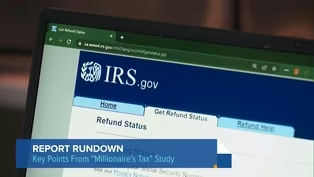
NewThe Debate Over Taxing Wealthy Illinois Residents at a Higher Rate
Video has Closed Captions
In 2024, a nonbinding referendum passed with more than 60% of Illinoisans in favor of such a tax. (11m 58s)
 New
NewOne on One With Illinois' Newest Supreme Court Justice
Video has Closed Captions
Sanjay Tailor is the first Asian American justice on the state's highest court. (7m 51s)
Providing Support for PBS.org
Learn Moreabout PBS online sponsorship
- News and Public Affairs

Top journalists deliver compelling original analysis of the hour's headlines.

- News and Public Affairs

FRONTLINE is investigative journalism that questions, explains and changes our world.











Support for PBS provided by:
Chicago Tonight is a local public television program presented by WTTW
WTTW video streaming support provided by members and sponsors.