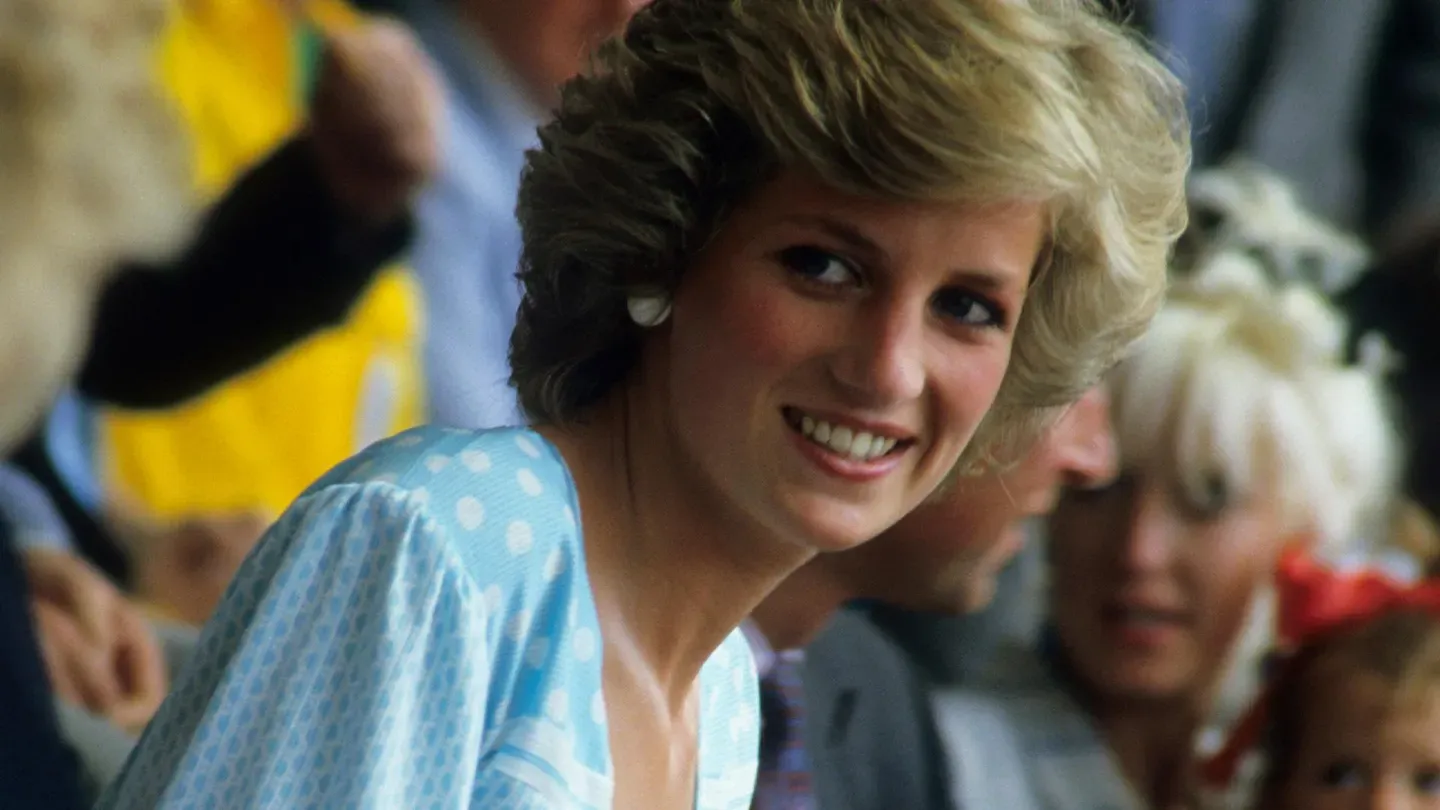
Diana's Decades
1980s
6/29/2026 | 46m 24sVideo has Closed Captions
The 80s see Diana emerge from shy princess to the most photographed woman in the world.
The 80s see Diana emerge from shy princess to the most photographed woman in the world.
Problems playing video? | Closed Captioning Feedback
Problems playing video? | Closed Captioning Feedback
Diana's Decades is presented by your local public television station.
Diana's Decades
1980s
6/29/2026 | 46m 24sVideo has Closed Captions
The 80s see Diana emerge from shy princess to the most photographed woman in the world.
Problems playing video? | Closed Captioning Feedback
Where to Watch Diana's Decades
Diana's Decades is available to stream on pbs.org and the PBS app.
Providing Support for PBS.org
Learn Moreabout PBS online sponsorship-June 1997, and New York City is host to the world's hottest celebrity, selling history's most famous wardrobe.
-It was the auction of the century.
-And it's yours!
-The auction was a hit parade of iconic moments in Diana's life and times.
There was the fairy-tale princess from a more innocent age, so-called Dynasty Di from the '80s, Hollywood glamour for a glitzy new world, and the newly independent woman of the '90s, just when girl power was in the air.
-The clothes were symbolic of a life that she led, and they were being left behind.
-The auction would prove a tragic swan song rather than a new beginning.
And Diana's death two months later revealed just how caught up we all were in her life.
Against the backdrop of the old order crumbling and a new one taking its place, Diana was a modern woman for every age... -Hugging has no harmful side effects.
-...who made the waves as well as riding them.
-I am not a political figure.
My interests are humanitarian.
-To tell the story of Diana's life is to revisit the final decades of the 20th century in which she played so great a part.
♪♪ ♪♪ When Diana gave birth to a second baby boy, there was a new national sport.
Choosing a name.
[ Indistinct shouting ] [ Puppeteer imitating baby crying ] -I know, I know.
Let's call him Bing.
We haven't had a Bing in the family for ages.
-Prince Harry, or Henry Charles Albert David Windsor to you and me, was the spare to go with the heir.
-I name this baby Henry.
May God bless him and all who sail in him.
[ Puppeteer imitating baby crying ] -With up to 15 million viewers each week, the success of "Spitting Image" was a sign of an increasingly irreverent Britain.
-We spent a lot of time discussing how we would portray the royals, but it was shocking at the time.
I mean, and the newspapers, the red tops particularly, get furious.
"They've done a puppet of the royal baby.
How can they be so cruel?"
-Where the royal family is concerned, particularly their little children, I mean, recently, they did the one of the children, and they made the children look like monsters, actually.
[ Puppeteer imitating baby crying ] -I don't think that "Spitting Image" is as tasteless or as, um, as cruel a program as people like to make it out.
[ Indistinct shouting ] -"Spitting Image" was as clear a sign as any of a cultural shift in the '80s.
♪♪ Increasingly, new money trumped old institutions, including the royal family, whose most mysterious member was shy Di.
-We had a panic with the production team.
We have to do Princess Diana.
We have to.
She's, you know, the most famous person in the world, let alone the country.
But how?
We couldn't really get the caricature right.
With her, she basically never said anything.
So that's what we should have done.
We should have perhaps not even had her appear.
-I say, Diana.
-Who is it?
-Charles.
-Charles who?
-Hubby-wubby, dear.
-There's a sweet little sketch where Prince Charles is knocking on her bedroom door, and she doesn't want to come out.
I think that would have been really clever if we'd done that.
You never actually saw her, so you could just imagine, because the voice is very good.
-Oh.
Yeah?
-I wonder, could I nip in and get my trousers?
-No.
-Why not?
-I've eaten them.
-Not another pair.
-The thing about doing Diana's voice was that I hadn't really heard her speak in public much, so I was trying to get the voice, the very soft, kind of softly spoken voice.
Yeah?
Like, slowly, like that.
Yeah?
And I hope I got it right.
But what they didn't get right on "Spitting Image" was the beauty, her beauty.
-"Spitting Image" may have struggled with representing the 22-year-old princess, but for Diana herself, finding a voice would become the defining mission of the decade, now that her duties as royal broodmare had been fulfilled.
Those paying attention outside the gates of Kensington Palace will have spotted that marriage to the Prince of Wales was far from straightforward.
-The Prince and Princess and their baby arrived from the hospital at speed.
Then, less than an hour later, Prince Charles left to play polo, something most new fathers would hardly dare to suggest.
-According to Diana, it was after the birth of Prince Harry that Prince Charles said to Diana, "Oh, he's got red hair like a Spencer, and he's a boy," and, because he was looking forward to a baby girl who would be a Windsor.
And Diana said to me, "Well, when he said that, the shutters came down."
[ Indistinct shouting ] -Discord seemed to be the order of the day, with violent clashes between police and striking miners coming to a head in the autumn after a six-month standoff with the government.
-What we've got is an attempt to substitute the role of the mob for the rule of law, and it must not succeed.
♪♪ -Under Prime Minister Margaret Thatcher, 3.3 million face the dole queue.
-British Telecom's share price was on display high above the city today.
-Whilst luckier members of the public profited from mass privatization and a stake in the '80s free market dream.
-Any more applications for British Gas?
The list is closing in a moment.
-It was the most divided country I can remember until Brexit.
-Maggie, Maggie, Maggie!
-Out, out, out!
-You either loved Mrs.
Thatcher and thought she was the savior, or she was absolutely hateful.
-Like Thatcher and a growing number of women, Diana was not content with being a stay-at-home mom.
She wanted to carve out a meaningful public role for herself, but she went about it with a rather softer touch than the Iron Lady.
Just two months after giving birth, she attended her first public engagement as the newly appointed president of the children's charity Barnardo's.
But both press and public seemed more interested in her dress sense than the cause she was championing.
-Today's new look princess brought out the crowds in East London.
25-year-old Julie Wooldridge tours the world posing as a Princess Diana lookalike.
She turned up today to see how she must look next.
-I like it.
It's stunning, but at the same time, it's a little bit severe.
-It was through Barnardo's that Diana met someone who changed the course of her life, and she his.
-We sort of got hooked up together mainly because, you know, she became the president of Barnardo's, and I was an ex Barnardo boy.
There was a kind of a synergy that the press got hold of and nobody, including myself, did anything to dispel.
-Bruce Oldfield was then a rising star on the '80s fashion scene, and with Diana as a new client, he was about to get even bigger.
-I dressed people like Faye Dunaway, Bianca Jagger, people like that.
Diana was in a different sphere, really.
But when we met, we did hit it off pretty quickly, you know.
She's quite down to earth, and I'm quite down to earth.
-I think it was something about him being an outsider that made her have an affinity to him.
And also, she had a -- you know, she -- I think she liked fashion people and creative people anyway.
They were witty.
They were charming.
They were creative.
They were bold.
They were everything that the royal family weren't.
And she became really close to Bruce, and I think she allowed him to influence her.
She trusted him.
♪♪ -Hailed as the princess and the pauper by the press, their friendship resulted in the transformation of Diana from frumpy Sloane into sleek, '80s fashion icon.
But he certainly had his work cut out.
-To begin with, her style wasn't very current.
Her style was a bit Sloane Ranger-y.
The skirts were too full.
They were too long.
There was too much fabric involved.
There was a slight notion that she was following fashion.
If there was a sudden feel in the air of a new romanticism, she would join in, and that was not a good idea.
[ Laughs ] I did feel that there was myself and a few other designers who could actually steer her right.
We wanted her to be a racehorse, not a pit pony.
-Pit pony and racehorse.
♪♪ By the mid '80s, they'd become the perfect symbols of a divided Britain.
And as the gulf between the haves and the have-nots widened, Diana instinctively began positioning herself to step into the breach.
♪♪ By the mid '80s, the rallying cry was "greed is good."
-Get 5 1/2!
-[ Indistinct shouting ] -On both sides of the Atlantic, young, upwardly mobile go-getters were reaping the benefits of a new capitalist age.
But this new wealth gave rise to a new kind of red carpet event, and leading the way was Diana.
-In the '80s, charity balls became the sort of, the ritual events that people got all dressed up to go, but Diana was in the front of it.
-Ladies and gentlemen, Her Royal Highness, Princess of Wales.
-And you knew that with her, you were going to sell out.
-In March 1985, Diana was guest of honor at the glitziest of charity balls held at the Grosvenor House hotel.
Amongst the celebrities who'd forked out in aid of Barnardo's were Ringo Starr, Shirley Bassey, and Joan Collins, star of hit TV soap "Dynasty."
The ball was the grand debut for Diana's radical makeover.
But the competition that night was steep.
-Hello, possums!
-Dame Edna was also in the lineup that night, also dressed by Bruce Oldfield.
-There'll be a few specific replicas of this frock all over London in a day or two, won't there?
-Diana was on a mission, not just to champion Barnardo's, but to outshine everyone there.
-We made this gold lamé pleated dress, and it had a bare back.
And so everyone was, "Ooh, Diana wearing a bare back."
-It was a hugely sexy dress.
She looked like a goddess.
She looked confident, assured.
She looked like she could have just walked straight out of a glamorous Vogue shoot.
-There were hundreds and hundreds of pictures that went out the next day with Diana and Joan next to each other, and it was Dynasty Di and Dynasty Joan.
And it just caught the -- the zeitgeist.
♪♪ -For mere mortals wishing to keep up with these twin titans of fashion, there were two vital looks they had to perfect.
-'80s hair was power hair, wasn't it?
It was like this and sort of solid.
Yeah, you sort of had your solid hair.
Then you had your shoulder pads.
-I was a journalist, and I remember sometimes when I look back at shots, it looked like my shoulders went on forever.
It was shoulder pads, clip-on earrings, and thanks to Diana, there was the Diana blazer.
♪♪ That's how the ordinary person attained the Diana look.
[ Laughs ] ♪♪ -Shoulder pads were far more than a frivolous fashion accessory.
They were a potent symbol of change.
-They kind of gave you a sense of dominance, really.
They were like saying, hey, I'm not taking any... ♪♪ -By the mid '80s, the service and banking sectors were flourishing, and women were staking a claim in the previously male dominated workplace like never before.
-Trading.
And selling.
-Cash, 88, 90, cash.
-So tough jobs or not, women are taking them on and making it to the very top.
-It was called power dressing.
I think it was women's first foray into the male world.
And in those days, um, in order to be, you know, getting ahead, you had to be more -- You were like a female version of a male.
♪♪ [ Foghorn blows ] -The royal yacht arrived off Saint Mark's Square at breakfast time, and the island of San Giorgio Maggiore provided the backdrop.
-On a tour of Italy that spring, Diana proved she could power dress for Britain.
[ Camera shutters clicking ] But not content with just expressing herself through her wardrobe, she sees the rare opportunity to get her voice heard.
-[ Speaks indistinctly ] -[ Speaking halting Italian ] -Ah.
-Work that out.
-Salute.
-[ Laughter ] -Though encouraged by Charles to show off her broken Italian, Diana still appeared to be under his shadow, a pretty but nonetheless still pretty mute clothes horse who always deferred to her husband.
♪♪ A few months later, Diana took the initiative and encouraged Charles to attend the most audacious celebrity fundraiser ever seen.
-Rock 'n' roll!
-It's a tremendous achievement, and it will be obviously the concert of the decade at least.
-Live Aid was the brainchild of Bob Geldof, who corralled Diana's favorite pop stars into performing, with only the creme de la creme invited to play.
-I mean, I wouldn't go if it was just the Wurzels.
If it was the Wurzels and Bucks Fizz, I wouldn't bother.
♪♪ -As a pop devotee, Diana was more than happy to give her royal seal of approval to this uniquely '80s brand of glam philanthropy.
-Live Aid was probably one of the most perfect occasions for someone like Diana, who loved music, who loved popular culture, who loved the whole celebrity thing.
There's a picture I remember seeing, and behind her is David Bowie, and she just looks like a kid in a toy shop.
-But barely 60 minutes in, Diana was forced to leave by Charles, who preferred to attend a polo match than stick around for what he later privately referred to as, "a pop jamboree that my wife made me go to."
-Her "pop jamboree."
Not the coolest concert in London ever.
No, a pop jamboree.
-Cracks had started to appear in the marriage, and it didn't pass unnoticed.
-That's great.
Lovely.
-Diana, what are you doing?
-I'm having a satellite dish fitted to the palace roof so that I can watch MTV 24 hours a day, yeah?
-Well, I'm not having that monstrous carbuncle.
What we need is a traditional dish.
-Not all this again, Charles.
Oh.
-Just see how... -We had a couple of moles.
One was a guy who had worked as a under-butler in, I think, in Clarence House.
-Somebody who worked at the palace was letting the stories through to "Spitting Image."
And when it started to become apparent that Diana and Charles were drifting apart, although the press weren't making a massive thing of it, of course, "Spitting Image" were.
That was satire, you know.
And so we thought it would be hilarious that we would do jokes about them being in other countries from each other or, you know, never seeing each other.
But actually, that was what was happening.
♪♪ -On the eve of Diana's first-ever visit to the US, a well-sourced article in "Vanity Fair" questioned where the real power in the royal marriage lay.
♪♪ -I don't even know if Tina Brown was aware of the impact that the article would have had on the tension that was already brewing in the royal household, because, you know, she made it clear that Diana was popular.
Diana had power, and Diana was loved by not just Brits, but by Americans, as well.
And they were on the eve of going to the States.
And this was all about Charles.
This was the visit to kind of have Charles doing his royal duty.
But what they got was what was expected, you know?
Diana mania was rampant in the States.
They loved her.
The minute she stepped off the plane, the paps were not taking pictures of the prince.
They were there to see his wife.
-Charles had been here before, but this was her first visit.
In the car park, an English picnic for American fans delighted to be here.
But what did they think of the prince?
-Distinguished.
-But we're more used to him.
She's new on the scene.
♪♪ -The American media was really building up this trip in a big way, for understandable reasons.
And so there were the big crowds there.
And there was one young woman who I said to the cameraman, "Keep rolling on her," because she was getting so excited about the whole thing.
-She fulfilled our dream.
She grew up and married the prince.
So, that's what every little American girl thinks about.
-Day two of the Chuck and Di show, as the American media has dubbed it, has turned out more cameras than for anything else since the presidential inauguration.
-When we started out covering Diana, there was a sort of view of her as a, basically a very pretty clothes horse, a nice, posh girl who'd sort of got lucky and married into the royal family.
She was going to be the sidekick in the story of Prince Charles.
That did change, partly because she had this very direct connection with the public, particularly with women and girls, and she discovered that that brought a certain kind of power.
♪♪ -But it wasn't just ordinary people who were struck by Diana's magnetic power.
On their first night in Washington, she had everyone from the president and his wife to Hollywood A-listers at her feet.
-John, are you going to dance with the princess tonight?
-If she'd like me to.
-Inviting John Travolta was a brilliant idea.
They put on a hell of a show that night, and she put on a hell of a show.
And when I saw, you know, the picture in the paper the next morning, I was pretty sick, if the truth is known.
-No one from the British press were there to capture what will become the defining image of the trip, if not the decade -- Dynasty Di and the King of Disco taking to the White House dance floor at the stroke of midnight and cementing the two countries' famed special relationship.
-The White House has their own photographer, and there was no English photographer in there.
And that was it.
Of course, when we heard of what had gone on, we just put the cameras away that night and went out a few times.
I don't know what Charles thought of it at the time, but whoever arranged that certainly got their P.R.
right that night.
Magic pictures.
♪♪ -The next morning, Prince Charles made his feelings quite clear.
-At his first press conference, he wanted to talk about the exhibition.
They wanted to ask about her.
-Well, I'm not a -- I'm not a glove puppet, so I can't answer for that, I'm afraid.
But I think you enjoyed it, didn't you, darling?
Be an idiot if she didn't enjoy dancing with John Travolta, wouldn't she?
-I don't think he was deliberately trying to do her down.
I just think he couldn't quite cope with the phenomenon that had been created and he had helped create.
-Can you move backwards?
-What had been intended as a profile-building tour for the future King of England had turned into one long prom night for his wife.
-As people yelled complimentary remarks from across the drive, the prince managed to look graciously pleased.
-It might have done wonders for the two countries' special relationship, but it had done nothing for theirs.
While apparently reveling in the press attention, Diana was keen to prove she was a woman of substance as well as style.
-I've been doing drugs for four years, PCP, LSD, THC, mushrooms, hash, hash oil, trash drugs, and some others that I can't remember right now.
-The perfect opportunity arose.
Nancy Reagan invited her along to an open session with teen addicts as part of her controversial anti-drug campaign, Just Say No.
-And I know that we'll beat this.
We have to.
-Having witnessed the potent soft power of the First Lady, the royal mouse of Windsor would soon make sure her voice would be heard.
♪♪ Diana returned from the States on a high and with a renewed sense of purpose.
But for all the talk of her stateside success, 1986 would turn out to be her annus horribilis.
-The irony of it all was that at that time, Diana was going through what she called her dark ages, where she was depressed, where she was bulimic, where she suspected that her husband had gone back to the other woman in his life, Camilla Parker Bowles.
So for her, this was a dismal period.
♪♪ -It was here the couple were introduced to the tea ceremony, beginning with the little rice cakes, which always precede the brew itself.
The princess discovered, as everyone does, that they're hard to chew, harder to swallow.
-Press rumors about Diana's bulimia had not yet surfaced, but on a tour of Japan, no one could fail to notice how painfully thin she'd become, despite her best efforts to conceal it by wearing giant shoulder pads.
-We just put it down that she wasn't eating enough, because that's kind of all we knew about, thought about at the time.
Now I understand there was much deeper reason.
But if you look back at some of the images of the time, you know, they told a really sad story.
-Everything was brought into sharp focus when she and Charles attended a sumo wrestling contest.
♪♪ -But they're so fat, said the princess.
♪♪ Backstage, the star said he thought the princess was pretty but needed more weight.
♪♪ -Despite her private misery, in public, Diana still managed to look every inch the fairy-tale princess.
♪♪ And the royal show rolled on.
But those newly hired script writers, the Brothers Grimm, were turning their hand to soap opera.
-We knew a long time before anybody else the marriage was in trouble.
The protection officers were being a bit more loose with what they were telling us, but you could sense that there was a bit of tension there, and it wasn't as it used to be.
It just wasn't there.
♪♪ -Along with increasing numbers of women, Diana turned to a higher power for guidance on her love life.
♪♪ By 1986, astrology was in the ascendancy, and horoscopes were big business.
♪♪ And heading up a galaxy of star astrologers working for the tabloids was this woman.
-Diana contacted me out of the blue one Thursday morning in 1986.
It never occurred to me that there could be anything wrong.
I mean, life looked blessed as you're looking at it through the television news.
But on that first phone call, the only thing she said to me was, "I just want to know if there's light at the end of the tunnel," and it was just that simple statement that suddenly made me realize this wasn't somebody who just wanted a kind of look around their chart and have their ego kind of stroked.
There was something not right.
-The word Camilla wasn't mentioned in those days, but we all knew about Camilla.
It just became more and more apparent as time went on that this was -- the fairy tale was coming to an end.
-Determined not to be a victim, Diana turned to her astrologer to set her on a new path.
-She was feeling very disenfranchised at that point, totally powerless in the royal family and in her marriage and everything.
And I felt that one of the things she could do was to turn that around.
In other words, she was suffering greatly, and the way to address this was to help other people who suffered.
-The following year, Diana found the cause that would provide the power and agency she craved, and in taking it on, she attacked the prevailing prejudices towards a deadly new virus stalking the country.
-When AIDS hit, it was massive and terrifying, absolutely terrifying.
And there was a lot of misinformation about it, as there is in the early days of any disease.
It was also seen as only a gay disease.
So there was a huge backlash against the gay community, as well.
-I can remember some horrible slogans going around at the time that G-A-Y stood for "Got AIDS Yet?"
or that -- or AIDS was an "...Injected Death Sentence."
-Of course, homophobia was nothing new.
-A flood tide of filth is engulfing our country in the form of newsstand obscenity and is threatening to pervert an entire generation of our American children.
-But now this prejudice was being fueled by the AIDS crisis.
-Why haven't the bathhouses, whose sole purpose is to provide a setting for casual, totally promiscuous homosexual sex, been closed down, at least temporarily, until... -What it's a matter of is promotion of a lifestyle and... -Political and religious leaders were jumping on the bandwagon.
-This is to add the AIDS virus to the list of contagious diseases for which immigrants and aliens can be denied entry.
[ Crowd booing ] -And back in Britain, the Church of England became involved in the moral backlash.
-The scripture includes the teaching that all homosexual practice is an abomination and a perversion.
Those engaged in it should be challenged on an individual basis to repent.
[ Indistinct shouting ] -Given the prevailing attitudes, it's hardly surprising so many gay celebrities felt ambivalent about coming out.
-Pop stars, who we now know in retrospect from that era who were gay -- Elton John, Freddie Mercury, George Michael, Boy George -- they were not, in inverted commas, "out" at that time.
♪♪ -Many of these public figures were ones that Diana had very publicly admired.
-Her alignment with the, if you like, the gay world, it was seen as something murky and underground and not right, to being what it is, a normal part of life.
So she -- I don't think you can underestimate how much Diana did.
-When Diana opened Broderip Ward, it was really an iconic event.
-Today, the hospital reckoned that the princess's visit was worth all the government propaganda put together.
-The way AIDS was handled by the media and governments was a lot to do with blaming, stigma and blame.
So just to see a royal go and do this was totally amazing.
-All the speculation had centered on whether she would wear gloves when shaking hands with the staff and patients on the new ward.
-I think the princess actually helped get the message across by the mere fact that she wasn't wearing gloves, and the mere fact that she shook hands with the patients and myself.
She knew the facts.
-As somebody that knew people with AIDS, I thought, well, this is fantastic that Diana is doing this.
This is amazing, because this is changing attitudes.
She's showing that you can't get it by touching.
-Two years after this taboo-busting photo was taken, Diana headed to the hospital where David Evans was working.
-On the day Diana came to officially open the ward, it was the 1st of December which is World AIDS Day, and that was the first time I met her, on that ward.
I sometimes find it still a bit too upsetting to say this.
But she was sitting next to a man with K.S.
on his legs, and you could see their knees were touching.
So all the fears, all the stigmas around HIV, she broke those barriers down just by having knee to knee contact.
When Diana came over and shook my hand, I had tears streaming.
I can remember saying, "Oh, Your Royal Highness, you know, you've really made it for us," 'cause she had.
-Did you hear what she said about Marshall?
-No, but she talked about what I got on, which -- -Summer -- Summer kit.
-My summer kit, yeah.
-Her astrologer's advice to channel her suffering into helping others had worked.
And as much as she gave, she got back.
-Her public role, her care for the world, for humanity, for the suffering was something she loved.
And to be loved by the people kept her alive.
I mean, it was the reason she was alive.
-Just one minute we've got to go.
Can I just ask you this?
I'm thinking I saw a poll the other day which described you as lacking compassion for the less successful, remote, unsympathetic, unconcerned.
Does this bother you?
-Well, it's just not right.
And when you're here, you have to take some tough decisions.
You have to take decisions sometimes to close factories, to close businesses, or not to rescue them.
-No one knows how many sleep rough on Britain's city streets each night beneath cardboard and rubbish, but they number at least thousands.
-In some ways, Diana was the other side of the more brutal end of the Thatcher era.
She did enjoy visiting the sick.
She had a very caring side to her.
She also knew how to deploy that in terms of her role and her image.
So in some ways, Diana was sort of ministering victims of that strife.
♪♪ -One of the criticisms often leveled at Diana was that she didn't think about doing anything unless there was a camera present and a note-taking journalist to observe it.
Well, that actually is not the case.
As a friend, just the two of us, we went on several occasions to soup kitchens, and she would just turn up and sort of join in with whatever was being done.
-I don't think that she would have seen it in very stark political terms, but I think where there was a gap, if there was a gap in social roles in this national kind of story, Diana was up fulfilling it.
She understood that she was fulfilling that role.
-But Diana wasn't content with just fulfilling that role at home.
She was about to make her mark as a humanitarian on the international stage.
♪♪ As the 1980s drew to a close, Diana was fast becoming one of the most photographed women in the world.
♪♪ She was even rivaling some of her favorite pop stars in the celebrity stakes.
-There was never a day where a picture or a story of Diana was not in the newspapers in Britain, not one day.
[ Paparazzi clamoring ] She's the golden goose that lays the eggs, because, put a picture of her on the cover of a newspaper or a magazine, and your sales go up.
-Because Diana became such a legend as time was going on, each national newspaper appointed a royal photographer and a royal correspondent so that they would be on the case with her night and day.
-At that time, to be a royal reporter for one of the tabloid newspapers was a big gig.
You got an unlimited expense account.
You did an awful lot of traveling around the world.
It was, quite frankly, the most fun you could have with your clothes on.
But it was incredibly competitive.
You were always only as good as your last story.
There was always a pressure on to get a scoop and beat your rivals.
♪♪ -That pressure was considerably ramped up when a new weekly glossy hit the newsagent shelves.
"Hello!"
magazine would herald a new chapter in royal press coverage.
-Deference was replaced by newsworthiness.
Is it a good story?
That was the benchmark.
-They were more intimate stories coming out about the royal family, more about their private lives, if you like, and the way that they lived and what they did, especially with Diana.
Whatever she did, wherever she went, there was interest.
-One evening, Kent Gavin found himself at a performance of "The Phantom of the Opera" on the same night as Diana.
-It was pure luck that I happened to be there on that day, and Diana came in, sat right in front of me, and she said, "Hello, Kent."
I said, "Hello, ma'am."
And she said, "Kent, you know, will you be at William's first day at school tomorrow?"
And I said, "Yes, of course, ma'am."
And she said, "Well, Kent," and her quote was, "My husband won't be there tomorrow."
[ Cheers and applause ] I knew it was a story.
So during the interval, phoned "The Mirror," And when I came back down, she said, "Have you been upstairs, Kent?"
And I said, "I've been on to the office, ma'am."
And she, "hee-hee," a little giggle.
And of course, the headline was, "Charles misses William's first day of school."
That was it.
I feel sure she knew that would go out.
♪♪ -By now, Diana understood that the appetite for stories about her could be turned to her advantage, whether to stoke the embers of her troubled marriage or to foreground her good causes.
-This morning, the Princess of Wales as president of Barnardo's relaunched the charity, which wants to lose its Victorian orphan image and achieve a higher public profile.
-I fully realize that for many young people, family life is not always a happy experience.
-Diana's own childhood was torn apart when, age 6, her mother left home.
The experience made her a passionate spokeswoman for all those left behind by Thatcher's society free brand of politics.
-I know that family life is extremely important, and as a mother of two small boys, I think we may have to find a secure way of helping our children, to nurture and prepare them to face life as stable and confident adults.
-But as she increasingly found her own voice and gained confidence as a public figure, Diana began to shed more than just her shyness.
-We were dumped unceremoniously around about 1989, and it was not an easy thing to take, you know?
And it was a complete shut down.
Um... And, um, you know, didn't do a great deal for my business, you know what I mean, to suddenly, you know, your star client sort of decided that she didn't want to buy anything from you anymore, which was fine.
We're still here.
We're still making dresses, thank you very much.
Lots of them.
Um, yeah, but it was -- it was a bit of a shock.
♪♪ -Concorde had performed its usual magic.
On board, someone all New York was waiting for.
Her arrival broadcast live on every TV station in town.
-There she is.
There she is.
She's coming down now.
The Princess of Wales is in Manhattan.
-On her first solo visit to the Big Apple, Diana signaled to the world that there were other parts of her life she was leaving behind.
-It's her first visit to New York, her first solo visit to America.
-This was Diana being the working woman.
This was Diana choosing the charity she wanted to support.
This was Diana dictating her own schedule and saying what she wanted to do.
One day, she was supporting and championing British manufacturing, listening to the Welsh National Opera.
And the next day, the woman went ghetto.
The woman went downtown, Lower East Side Manhattan.
-This can be a dangerous city.
A SWAT team of police with machine guns were always on hand as the tour took in parts of the city that most New Yorkers never see.
[ Crowd cheering ] [ Siren wailing ] -Diana paid a visit to a shelter for battered women and homeless children, proving her reach went far beyond most royals.
-It's an island where the children can escape the frightening world of drugs and violence that is often found outside.
-The royal family had always had the Commonwealth, but it was always a, you know, shaking hands or looking at traditional dances or what have you.
But Diana crossed a lot of -- of those, if you like, cultural barriers.
She didn't hold herself back.
She talked to people.
She'd embrace people no matter what their background, their faith, their color.
-She, crudely, if you like, she sided with the underdog, and she probably saw the black and minority ethnic communities as part of that sort of underclass and connected with them, probably slightly aristocratically patronizing, we might see it, but coming absolutely from the kind of right place.
-Diana's whistle stop tour of New York concluded with her most controversial engagement, a visit to an AIDS ward for children in Harlem.
-The princess wanted to know about AIDS babies who also suffer from their mother's drug habit.
-When you have a problem with drugs, how on earth are you going to cope with AIDS, as well?
-At Diana's request, no TV crews were allowed to film her visit to the children's ward, and the only photographs that exist were taken by the hospital staff.
-When she picked up those AIDS babies, she broke all the protocol, all the rules.
The effect in the hospital with the nurses and other people that were there was just euphoria.
They just were amazed.
They couldn't believe that a member of the royal family was doing this.
-She picked up a 7-- I think it was a 7-year-old child.
And they were all nervous, apparently, because this child was quite spirited, and they thought he was going to kick off and embarrass them all.
But he put his head on her shoulder.
She felt a connection to this kid, because she knows what it's like to be an outsider, and she knows the power of what she can do as an activist and the difference it will make to these causes where everybody else is ignoring them.
-Staff told the princess they were surprised that she'd come to Harlem Hospital, a place never visited by any American president and few major political leaders.
-Their own politicians weren't doing this.
Their own celebrities weren't doing this.
And there was this princess that was making conscious time to come down and treat them like human beings and show compassion.
-The visit would cement Diana's reputation as a compassionate, modern royal and launch her as a celebrated humanitarian on the world stage.
-I was privileged to fly back with her on Concorde from New York.
I said to her, "Do you realize, ma'am, what you've done here?"
And she said, "Well, what are you talking about?"
I said, "Well, Nancy Reagan wouldn't be doing that."
She said, "I just felt emotionally I had to hold the kids," so she picked them up.
She said, "I felt like crying."
It was just, this was the girl.
This is how she was.
-Next time... -How often would my mom mention Diana, I genuinely as a kid thought they were best friends.
-...the queen of hearts becomes the people's princess.
-They're the most cold people on this earth.
-I think we forget just how dangerous the mood became.
♪♪ ♪♪ ♪♪













Support for PBS provided by:
Diana's Decades is presented by your local public television station.